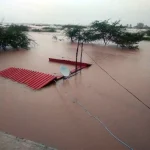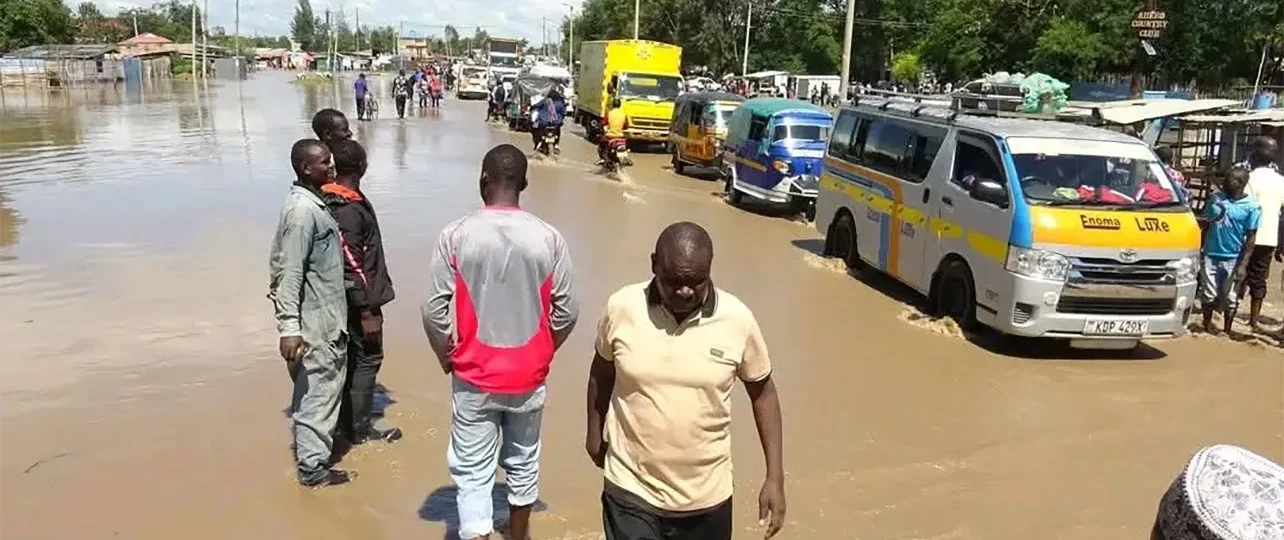

KENNEDYY Oguta did not sleep on the night the Sondu Miriu River made his home its own. He stood in chest-high water in the darkness of Nyakach, in Kisumu County, holding his youngest child above the waterline with one arm and the rope of a terrified goat with the other, praying – not to be rescued, because rescue seemed too large a word for what he needed – but simply for the water to stop rising.
It did not stop. By morning, there was no house in his village that had not been submerged. “There is no house that is not flooded,” he would later tell authorities, a sentence so stripped of drama it carries more weight than any lament. Kennedy is not a statistic. He is a man with children, with livestock, with a life that the river decided to rearrange in a single torrential night.
“There is no house that is not flooded.”
Kennedy Oguta, flood survivor, Nyakach
Across Kenya this month, at least 81 people have died in what meteorologists are calling one of the country’s most violent flood events in recent years. The Kenya Meteorological Department had issued a warning as far back as 25 February 2026, forecasting heavy rainfall across the central highlands and the Lake Victoria basin. The warning specified that rainfall exceeding 20 millimetres within 24 hours was possible in the most exposed areas. What followed far exceeded those projections.
THE VILLAGES THAT WENT UNDER
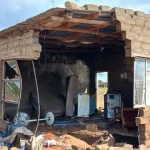
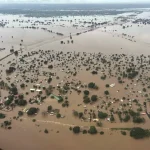
In Kisumu County, the full fury of the rains landed on the communities that could least absorb it. Approximately 1,200 hectares of farmland have been destroyed, crops swept away before the harvest, soil torn from the land and carried downstream. The worst-hit area is Nyakach, where more than 3,000 families have been displaced after the Sondu Miriu River overflowed its banks with catastrophic force. More than eight evacuation centres have been opened to absorb the displaced, most of whom arrived with nothing but the clothes they were wearing and the children they were carrying.
Local chief Seth Oluoch Agwanda described the scale of the erosion as unlike anything he had seen in years of service. “We have lost farmlands due to massive erosion,” he said, “and many crops.” For subsistence farmers in this region, the loss of a crop season is not a financial inconvenience — it is a catastrophe that will echo through the year in empty plates and hungry children, in debt taken on to buy seeds and start again, in the kind of despair that does not make national headlines.
Sarah Akinyi Onyango, another Nyakach resident, described families stranded in rising waters with young children — unable to move, unable to call for help, unable to do anything but wait. “Families remain stranded with children,” she said, her voice the voice of hundreds. In the evacuation centres, the shelter is basic, the food is not enough, and the uncertainty is total. Nobody knows when they will be able to go home. Nobody knows if home will still exist when the waters finally recede.
“Women and children are always the last to be rescued and the first to be forgotten.”
Human Rights Watch, Kenya Flood Assessment
NAIROBI: A CITY THAT SWALLOWED ITSELF
In the capital, the floods killed at least 37 people, making Nairobi the single deadliest zone in this disaster. The city woke on successive mornings in early March to streets turned to rivers, vehicles swept off roads, and power lines sparking dangerously in floodwater. Victims drowned. Others were electrocuted. Flights at Jomo Kenyatta International Airport were disrupted, with aircraft diverted to Mombasa as runways and access roads became impassable.
The flooding was most savage in the low-income settlements that ring the city’s rivers — Mathare, Mukuru Kwa Jenga, Kibra, Huruma, Embakasi. These are the places where the cheapest housing sits closest to the water’s edge, where drainage infrastructure is inadequate or absent, where corrugated walls offer no resistance to a wall of floodwater. In Nairobi alone, approximately 3,500 households were directly affected in early March, a number that has grown significantly as rains continued through the month.
The pattern is familiar to those who study inequality and urban climate risk. More than 60 percent of Nairobi’s population lives in informal settlements, and many of the structures in these areas were built on riparian land — the buffer zones beside rivers that exist precisely to absorb floods. Years of ignored regulations, corruption, and desperate housing need placed hundreds of thousands of people in the path of exactly the events now unfolding. As Hussam Mahmoud, a civil and environmental engineering expert at Vanderbilt University, has noted of such cities: when you build on floodplains and rip up ecosystems to lay concrete, you do not simply face flood risk — you manufacture it.
THE INFRASTRUCTURE BILL
The destruction of infrastructure is equally staggering. Previous flood events have given Kenya a grim preview of the economic toll: in 2024, an estimated $8 million was needed to repair a single washed-away railway line critical to Ugandan trade routes, and nearly $300 million was required to fix a network of roads damaged across the country. This year’s floods — still ongoing, with more rain forecast — are expected to impose comparable or greater costs on a government already under fiscal strain.
Roads have been closed across affected counties. Health facilities have been damaged. In Kiambu, deaths were reported, and landslides struck Kasaka, adding another dimension of terror to communities already dealing with inundation. Officials have urged “extreme caution” as forecasters predict continued heavy rainfall. The Kenya Meteorological Department specifically warned of intensified downpours between 20 and 23 March — the very days in which this article is being written.
The damage to agricultural land carries consequences that extend far beyond the immediate season. Fertile topsoil has been washed downstream, rivers silted, irrigation canals destroyed. The loss of nearly 10,000 livestock — a figure drawn from the 2024 floods but likely to be replicated or exceeded — strips farming families of both their economic assets and their food security in one stroke. Crops washed away mean hunger. Hunger means debt. Debt means that when the next flood comes — and it will come — families have even less to lose and even less with which to recover.
A CRISIS MADE IN THE GLOBAL NORTH
Scientists are unambiguous: climate change is not merely a background factor in what Kenya is experiencing. It is the engine driving it. Research published in the wake of recent East African flood events has confirmed that the extreme rainfall now devastating Kenya is approximately 40 percent more intense than it would have been without anthropogenic climate change. A warmer atmosphere holds more moisture; when it releases it, it releases it with greater violence and greater concentration.
East Africa has lived through a brutal climate whiplash in recent years — five consecutive failed rainy seasons between 2020 and 2023, the worst drought in 40 years, which pushed communities to the edge of survival. And then the rains came: the long rains of 2024, and now the long rains of 2026, each one wetter, faster, and more destructive than the models had predicted. Flood and drought. They are not opposites. They are two expressions of the same broken climate system.
The bitter irony is well established but worth restating: Kenya contributes a negligible fraction of global greenhouse gas emissions. The communities submerged in Nyakach, the families swept from Mathare, the farmers who have lost a year’s work in a night — these are people who did not create the crisis they are now paying for with their lives and livelihoods. The emissions were generated largely in the industrialised world, in factories and power plants and motorways, and the consequences have been delivered, with unerring precision, to the people who have no means to refuse them.
“They are really at the front line of the crisis.”
Dr. Friederike Otto, Imperial College London, on East African climate victims
THE STATE OF RESPONSE
President William Ruto has stated publicly that his government “stands in solidarity with every citizen affected” and pledged to cover medical costs for flood victims. Emergency response efforts have involved both national and county authorities, and the Kenya Defence Forces deployed a military rescue unit to support operations in Nairobi alongside the Kenya Red Cross Society. These are not nothing. But they must be measured against the scale of what is happening, and against the pattern of response that human rights organisations have documented in previous floods.
Human Rights Watch, in its assessment of the 2024 floods, found that authorities had not responded adequately and that marginalised communities — older people, people with disabilities, those in poverty — bore the heaviest burden with the least support. As of late April 2024, entire displaced communities in Mathare had received no shelter, no food, and no assistance from either county or national government, even a month after the waters rose. The risk that history repeats itself in 2026 is not theoretical.
Health authorities have warned of rising risks of waterborne disease. Cholera and malaria follow floodwater as reliably as hunger follows crop loss. In 2024, 48 cholera cases were reported in Garsen within days of the floods. Contaminated water supplies, stagnant floodwater, destroyed sanitation infrastructure — these are the conditions in which epidemics begin.
WHAT MUST BE DIFFERENT
Kenya is not without plans. The 2015–2045 National Spatial Plan and the 2018 Thematic Plan for Disaster Risk Management exist. The National Adaptation Plan 2015–2030 exists. What has consistently failed is implementation: the political will to enforce riparian setbacks, the resources to build resilient drainage in informal settlements, the commitment to restore degraded water catchments and forest cover before the next rain season rather than after the last catastrophe.
Greenpeace Africa, responding to this month’s floods, has put it with appropriate directness: Kenya is dismantling the natural systems that protect its people. Forests are not scenery — they are infrastructure. The Mau Complex, the Aberdares, the urban forest patches of Karura absorb rainfall, anchor soil, and regulate rivers. Every hectare of forest lost is another community left more exposed. The connection between a bulldozed hillside and a submerged village in Nyakach is not metaphorical. It is hydrological.
But structural change — ecosystem restoration, climate-proofed infrastructure, genuinely enforced land-use regulation — requires time. The 3,000 families in evacuation centres in Kisumu do not have time. They have today, and they have tomorrow’s forecast, and they have the knowledge that the rains are not finished.
THE NAMES BEHIND THE NUMBERS
81 dead. 3,000 families displaced. 1,200 hectares destroyed. These are the numbers that will appear in situation reports and international briefings. They are accurate. They are also insufficient.
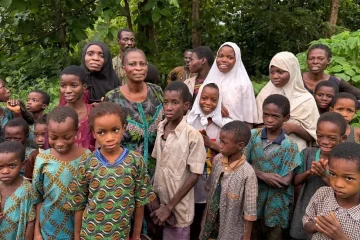
Behind them: Kennedy Oguta, holding a child and a rope in the dark. Sarah Akinyi Onyango, watching the water rise around her children. Seth Oluoch Agwanda, looking out over land he has served for years, knowing the harvest is gone. The schoolchildren who have not been to school since the rains came. The farmer who took out a loan for seeds that are now at the bottom of a swollen river. The elderly woman in Mathare who waited three days for help that never arrived.
These are the faces of the climate crisis in Africa. They are not abstractions. They are our neighbours, our family, our continent. And they deserve — at minimum — that we say their names, and do not look away.