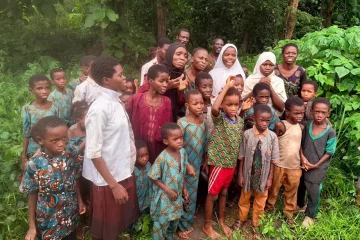
IN Kalimbezi’s* living room, a little girl snuggles up against him. She watches television, surrounded by other children. She was separated from her family during the chaos that followed the dismantling of the Buhimba displacement site in Goma in February 2025.
Since then, she has found stability and comfort in Kalimbezi’s home while waiting to be reunited with her loved ones. A father himself and a committed community volunteer, Kalimbezi is part of a network of temporary foster families active in Goma.
With the support of partners including the Central Emergency Response Fund (CERF), USAID’s Bureau for Humanitarian Assistance (BHA), the UK’s Foreign, Commonwealth and Development Office (FCDO), the European Union, and the governments of Germany, France, Norway, and Sweden, these families open their doors to children in need in the most critical moments.
During the latest escalation of violence, Kalimbezi did not hesitate. He welcomed four children into his home, true to his lifelong commitment.
“I made the decision to help these children because they are vulnerable,” he says simply. “Children are our future, and we must protect them.”

In just three weeks between late January and early February 2025, over 1,000 children separated from their families were identified by UNICEF and partners. Some got lost during the fighting, while others were separated from their parents following the sudden closure of displacement sites.
In response to the impact of the crisis on children, many families like Kalimbezi’s have stepped in to help, demonstrating the strength and effectiveness of the community-based approach to ensuring continued child protection. Even in neighbourhoods already weakened by the crisis, they offer temporary care within the warmth and caring environment of a home.
To help foster families carry out this essential work, UNICEF provides training, support, and mobile cash transfers. Enabled through flexible funding, this discreet and rapid support helps families meet the needs of the children they care for.

Six child-friendly help points have been established in Goma to guide children and families towards child protection and social welfare services tailored to their needs. Often, it is community volunteers like Kalimbezi—on the frontlines in their neighbourhoods—who identify vulnerable children and refer them to these support centres.
At the help points, para-social workers like Kasoki Kasolene take over to ensure individualised follow-up.
“The main goal of our work is to reunite children with their families and also identify any cases of abuse the children may have experienced,” she explains.
Para-social workers play a central role in the crisis response. They lead family tracing activities and provide much-needed psychosocial support to children.

This meticulous work takes time—sometimes days, sometimes weeks or sometimes even months. But every reunification is a collective victory, the result of coordinated efforts by foster families, community focal points, para-social workers and all local partners.
Since January 2025, more than 3,300 unaccompanied and separated children have been identified, and nearly 2,300 of them have been reunited with their families thanks to this strong community network.
UNICEF continues to strengthen this community-led approach—not only to help reunite children with their families, but also to offer them a safe and stable temporary environment that reduces the trauma of separation.
*The name Kalimbezi has been changed to respect the confidentiality of this dedicated man and the children he has welcomed into his home over the past seven years.