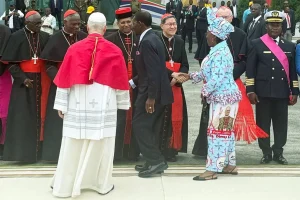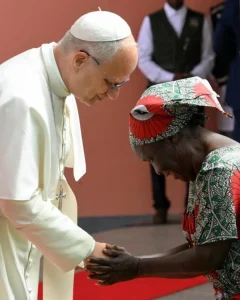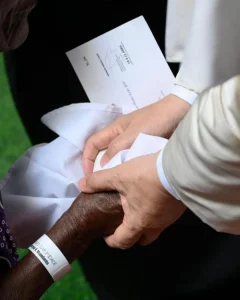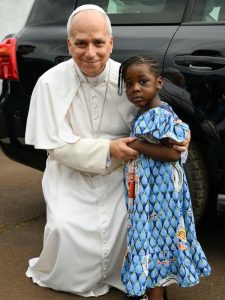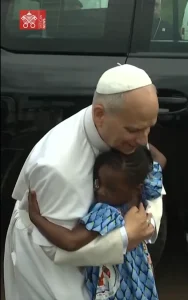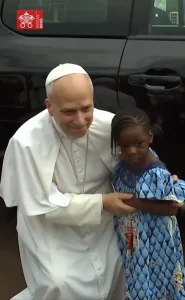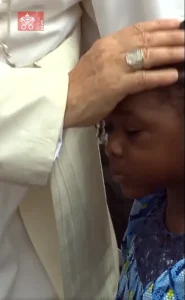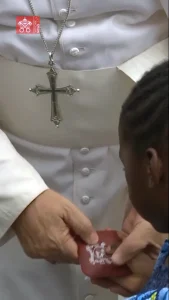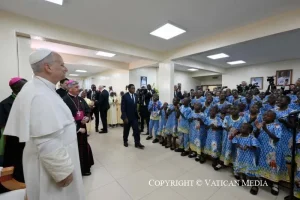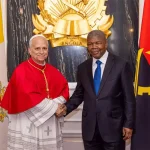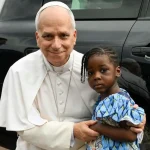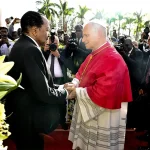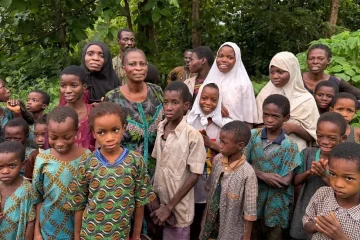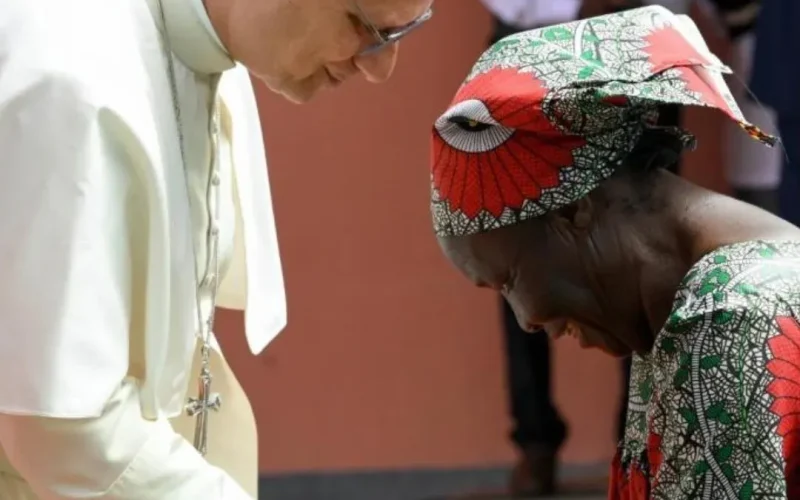
THERE is a particular kind of quiet that settles over a care home in the morning – a silence compounded of memory and patience, of lives fully lived and now lived slowly. It was into exactly this kind of quiet that Pope Leo XIV walked on Monday, in the northeastern Angolan city of Saurimo, and it was from within it that he delivered what may prove to be among the most luminous addresses of his entire African journey.
The facility, known to its residents simply as Lar – the Portuguese word for ‘home’ – is an Angolan government-run care home that currently hosts 62 elderly men and women. It is not a grand institution. It is not a hospital, a palace of compassionate purpose, or an architectural statement. It is a home, in the fullest and most human sense of that word. And it was precisely in that plainness that the Pope found his text.
Leo XIV did not arrive in Saurimo with the language of abstraction. He did not speak of papal encyclicals or doctrinal formulations. He spoke of Jesus visiting the home of Peter’s mother-in-law. He spoke of the intimacy of Capernaum, where Christ often broke bread with Mary, Martha, and Lazarus. He drew a straight, unbroken line between those ancient houses and this modest one in northeastern Angola.
“He dwells among you whenever you try to love one another and help one another as brothers and sisters. When all of you, or even some of you, pray together with simplicity and humility, He is here among you.”
It was a theological gesture of striking democratic generosity. The Pope was not placing Saurimo on a continuum with Rome or Jerusalem by way of hierarchy. He was saying something more radical: that divinity requires no cathedral, no bishop’s throne, no marble floor. That wherever the aged forgive one another a small slight – wherever they resist the temptation of bitterness and choose instead the harder, quieter work of reconciliation — there, too, is the sacred.
For a continent whose Christianity was often delivered at the point of a colonial sword, the distinction matters enormously.
THE MEASURE OF A NATION
The Pope did not shy away from the political register either. His words to the Angolan authorities who support the Lar were a challenge dressed as gratitude – a gentle but unmistakable indictment of every government that has treated the elderly as a demographic burden rather than a repository of civilisational wisdom.
“The care of the weakest is a very important sign of the quality of the social life of a nation. Let us not forget that the elderly are not only in need of assistance, but first and foremost need to be listened to, because they preserve the wisdom of a people.”
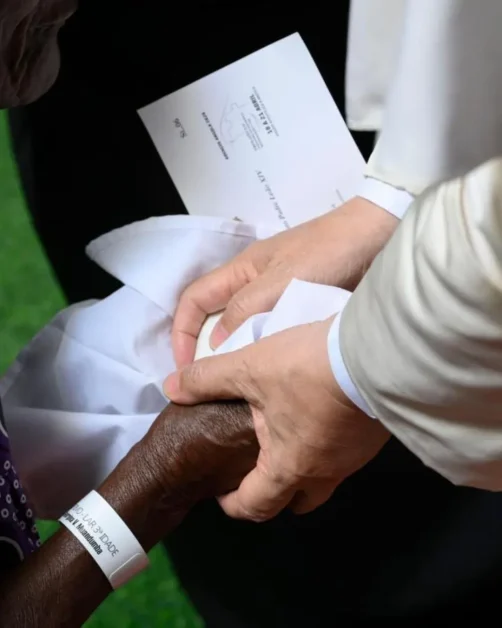
This is a criterion by which many nations – not only in Africa, but across the Global South and the affluent North alike – would find themselves wanting. The Pope was, in effect, proposing an alternative development index: not GDP per capita, not infant mortality rates, not digital penetration scores, but the dignity with which a society treats its most vulnerable members.
It is a framework as ancient as it is radical, and its utterance in Angola – a country still recalibrating its social architecture after decades of civil war – carries particular weight.
GARDENS, MASS, AND THE WITCHCRAFT QUESTION
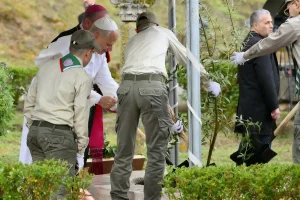
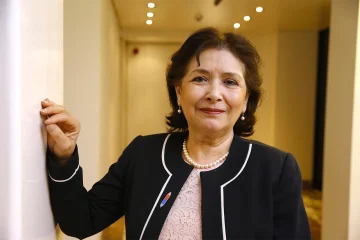
The care home’s director, Georgina Mwandumba, offered Vatican News a portrait of daily life at the Lar that quietly deepened the Pope’s homily. Residents tend small gardens – for the twin dignities of productive occupation and self-sustenance. They attend Mass together, even those who profess no Catholic faith. The Catholic Church maintains what Mwandumba describes as an excellent relationship with the facility, providing both spiritual accompaniment and financial support.
But Mwandumba also surfaced something darker: the persistence of beliefs that lead families to abandon elderly relatives, interpreting infirmity or perceived misfortune through the lens of witchcraft. Her greatest desire, she told the reporter, is that this ‘absurd practice’ be overcome, that families reclaim the culture of care that colonialism, urbanisation, and poverty have in many communities eroded.
It is a subject the Pope did not address directly in Saurimo. But it hangs over the visit like a shadow, a reminder that the pastoral and the sociological are inseparable in Africa’s religious landscape, and that the Church’s work here is never only doctrinal.
THE LONG SHADOW OF MAMA MUXIMA
To understand Monday’s visit fully, one must hold it alongside the events of the day before – events that sat at a considerably darker intersection of faith and history.
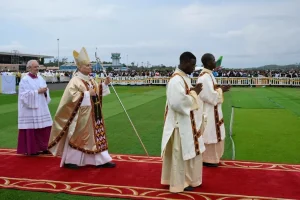
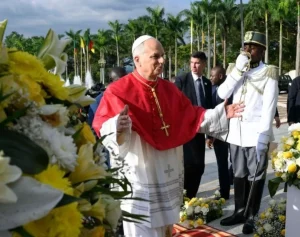
On Sunday, Pope Leo XIV stood at the Sanctuary of Mama Muxima, a revered Marian pilgrimage site along the Kwanza River, whose walls carry one of the most painful paradoxes in African Catholic history. The church was built by Portuguese colonisers in the late 16th century as part of a fortress complex directly linked to the trans-Atlantic slave trade. Enslaved Africans were gathered there, subjected to forced baptism by priests, and then marched over a hundred kilometres to Luanda before being shipped across the ocean.
“It is love that must triumph, not war.”
Pope Leo XIV, Sanctuary of Mama Muxima, 19 April 2026
Praying the Rosary inside that modest church, Leo invoked centuries of sorrow endured by Angolans. He called on believers to become ‘messenger angels’ of compassion and blessing. He stopped short of a direct naming of slavery -0 a choice that will inevitably generate debate among historians, theologians, and Black Catholics worldwide, for whom the entanglement of the Church with the slave trade is not a matter of academic distance but of lived spiritual inheritance.
The Vatican’s repudiation in 2023 of the so-called Doctrine of Discovery – those papal decrees, Dum Diversas and Romanus Pontifex, that provided theological cover for the dispossession and enslavement of non-Christian peoples – lends this visit an important but incomplete symbolic weight. Symbolic gestures and forensic accountability are different things, and many in the African diaspora will be watching to see whether this papacy is prepared to move from the former to the latter.
PEACE, CORRUPTION, AND THE ROAD NOT YET TAKEN
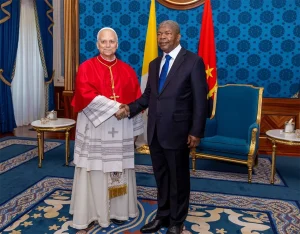
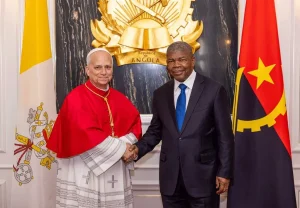
Earlier in his Angolan leg, near the capital Luanda, Pope Leo had called out exploitation with unambiguous directness and urged the pursuit of reconciliation after years of ruinous conflict. He welcomed a ceasefire in Lebanon as a sign of hope – a reminder that this papacy is operating within a global moment of plural fractures, and that the Pope’s African journey cannot be read in isolation from the wider architecture of war and peace he is navigating.
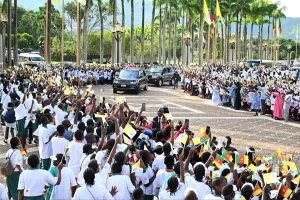
Addressing tens of thousands of Angolans, he called for a society free of war, injustice, and corruption. In a country where the memory of civil war is still fresh and where inequality remains structurally entrenched, these are not rhetorical flourishes. They are a challenge – to the state, to the Church, and to civil society alike.
WHAT SAURIMO TELLS US
There is a temptation, in covering papal visits, to be seduced by the optics of mass gatherings, the crowds in their hundreds of thousands, the stadium liturgies, the diplomatic choreography. Saurimo resists all of that. It offers something rarer and more difficult instead: an encounter with particularity.
Sixty-two people. A government home with a warm nickname. Gardens. Shared prayer across the boundaries of confession. A director whose greatest wish is the end of a practice that tears families apart.
Pope Leo XIV chose to bring his papacy into that room. In doing so, he said something about what he believes the Church is for – not for the powerful and the commemorated, but for the forgotten, the frail, and the wise.
Africa has given the world many things. Among them is an understanding of age that the industrialised world has largely lost – that the elder is not a problem to be managed but a library to be consulted. In a care home in Saurimo on a Monday morning, a Pope from the Americas came to Angola and, perhaps without fully knowing it, sat at the feet of that understanding.
The quality of a civilisation is not measured by its skylines or its satellites. It is measured by how tenderly it holds its most fragile members.
Three days in. The journey continues.