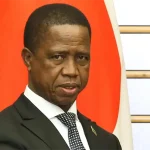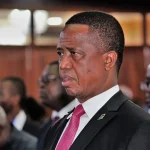
NEARLY eleven months after Edgar Chagwa Lungu, Zambia’s sixth republican president, drew his last breath at a private clinic in Pretoria, his remains are still unburied – seized, disputed, autopsied without family consent, and held in a state facility by the South African Police Service (SAPS). It is a spectacle without modern African precedent: a government using every instrument of the state – the courts, the police, the diplomatic corps – to wrest control of a dead man’s body from his widow and children.
On Wednesday, 22 April 2026, the Lungu family’s spokesperson and lawyer, Makebi Zulu, confirmed what had been building for weeks: the Zambian government had taken physical possession of the late president’s remains from Two Mountains Burial Services in Pretoria, where they had lain since his death in June 2025. Within hours, a five-hour postmortem examination had been conducted by South Africa’s Forensic Pathology Services – without the knowledge, consent, or presence of a single family member.
“A postmortem was conducted on the late President — started at 08:30 and ended at 14:00 — despite authorities being fully aware that the Supreme Court of Appeal had ordered the body’s immediate return.”
Makebi Zulu, Lungu family spokesman
Zulu said a diplomat from the Zambian Embassy in Pretoria and officers of the SAPS arrived at the funeral parlour with a “postmortem docket” alleging that Lungu had died of poisoning – a claim he characterised as a fabrication engineered by a third party acting at the behest of the state. “It is a dangerous precedent,” Zulu declared, “that anyone should be conducting a postmortem on the body of the late president without the consent or knowledge of the family.”
CHAOS IN THE COURTS
The legal battlefield on Wednesday was as chaotic as the political one. By the end of the day, at least two conflicting court orders were in play simultaneously – a fact that goes to the heart of the family’s accusation that the Hichilema government acted in knowing contempt of law.
An order dated 22 April 2026, obtained by the family from the South African courts, directed all parties to take the necessary steps to ensure Lungu’s remains were returned forthwith to Two Mountains Burial Services, or any alternative mortuary nominated by the applicants. The same order explicitly restrained the SAPS from handing the body to the Zambian government and directed the Zambian government to return the remains to the funeral home. It further required respondents to show cause why they should not be convicted of contempt of court.
By the time that order was in place, the postmortem had already been completed. The remains, family lawyers say, had already been transferred to a state facility. The family argues that the government pressed ahead with the procedure – and with the removal – in full knowledge that legal proceedings were live and that the Supreme Court of Appeal had ordered the body’s return.
“The court order directed immediate return of the body to Two Mountains — yet the postmortem ran from 08:30 to 14:00. Government knew. Government proceeded regardless.”
For its part, the Zambian Attorney General, Mulilo Kabesha SC, confirmed in a statement that the government had taken custody of the remains following the Pretoria High Court’s formal handover — and that the body would not be repatriated immediately, as SAPS investigations into the cause of death were ongoing. The statement said the remains had been relocated to a South African government facility.
HOW THE LEGAL FOUNDATION COLLAPSED
The government’s actions are predicated on the Pretoria High Court’s ruling of 8 August 2025, which ordered that Lungu’s remains be surrendered to Zambian authorities for a state funeral and burial at Embassy Park in Lusaka. That ruling held that national interest in honouring a former head of state overrides the private wishes of the deceased or their family, citing Article 177(5)(c) of the Constitution of Zambia.
The family had appealed that judgment to the South African Supreme Court of Appeal. On 24 December 2025, the appeal was permitted to proceed. However, by 30 March 2026 – the court-mandated deadline for filing full arguments – the family’s legal team had not submitted their papers. The government’s lawyers approached the Supreme Court Registrar on 21 April 2026 and were advised that the appeal had lapsed.
The Lungu family insists their submissions were filed within the official timelines prescribed by court rules. In a founding affidavit now before the Supreme Court of Appeal, they argue that the appeal was wrongly treated as having expired and that their legal challenge remains valid. The collision of these competing legal positions – one court deeming the appeal dead, another issuing urgent interim relief – is the constitutional fault line at the centre of this crisis.
THE BACKSTORY: A RIVALRY THAT DID NOT END WITH DEATH
The roots of this standoff reach back to the most bitter political rivalry in modern Zambian history. Lungu, who governed from 2015 to 2021, ordered the arrest of then-opposition leader Hakainde Hichilema on treason charges in 2017. Hichilema spent four months in detention before international condemnation forced his release, and the charges were dropped. Hichilema defeated Lungu at the polls in August 2021.
In the years that followed, Lungu claimed his movements were being restricted by police and that he had been placed under effective house arrest – denied a political comeback by a government determined to marginalise him. He left for South Africa for medical treatment and died there on 5 June 2025, aged 68, of causes his family has never publicly disclosed.
From the moment of his death, his widow, Esther, and their family were unequivocal: Lungu had made a specific, final wish that Hichilema should not come near his body, should not preside over his funeral, and should play no role whatsoever in his burial. In affidavits before the Pretoria High Court, they stated that the late president had made peace with dying in exile – abandoned, he felt, by a government that had hounded him in life and was now pursuing him in death.
“He had made peace with dying in exile. His dying wish was that Hichilema should not go anywhere near his body. Government has turned grief into a political weapon.”
Lungu family
A FUNERAL STOPPED MID-SERVICE
Long before Wednesday’s confrontation, the Zambian government had demonstrated its willingness to deploy state power against the Lungu family’s grief. On 24 June 2025 – one day before a private burial ceremony scheduled in Johannesburg – the Attorney General obtained an urgent court order from the Pretoria High Court halting the service.
Family members were forced to leave the Cathedral of Christ the King mid-ceremony and travel to a courthouse to respond to the emergency application. The funeral was suspended. The court set August as the date for a full hearing. That intervention – stopping a burial as it was happening – became the defining image of a government that many observers said had lost both its moral bearings and its sense of proportion.
Opposition voices were swift to condemn. Tonse Alliance faction president Brian Mundubile called the government’s handling of Lungu’s remains a “national embarrassment of the highest order” and “profoundly disrespectful not only to the late president, but to his family and to the people of Zambia.” Former Patriotic Front information chairman Emmanuel Mwamba said that President Hichilema had failed to demonstrate even elementary leadership in the matter.
THE FUNERAL PARLOUR WASHES ITS HANDS
Two Mountains Burial Services, the Pretoria facility that had held Lungu’s remains since his death, found itself trapped between competing legal demands. When the family’s lawyers at ENSafrica, acting for Two Mountains, finally communicated the parlour’s position, the message was stark: the funeral home had complied with the court order and released the body. It had received no legal instrument from the family — no court order, no injunction, no appeal reinstatement – that would have given it grounds to refuse.
In a document seen by this publication, Two Mountains’ lawyers confirmed that the remains were no longer in the care or control of the funeral home – that they had been taken into custody by the SAPS for ongoing investigations. The document also warned the Lungu family that should they return to court, they should not seek an order directing that the body be returned to Two Mountains. The parlour, in effect, walked away from the dispute it had been drawn into.
AFRICA WATCHES WITH GROWING UNEASE
The spectacle unfolding in the courts of Pretoria and Bloemfontein has reverberated across the continent. African heads of state and former leaders are watching a government use the full coercive apparatus of the state — courts, police, diplomatic missions — to override the dying wishes of a predecessor and override a grieving family in real time.
The principle at stake is not merely procedural. It reaches into the deeply held African cultural conviction that the dead deserve dignity, that a family’s right to bury their own is sacrosanct, and that no amount of political animosity should survive the threshold of death. Critics argue that whatever legal authority the Zambian government has assembled through the courts, it has squandered the moral authority that should define how a nation treats its former leaders.
The African Mirror’s previous reporting documented how this battle had already shamed Zambia before Africa. The events of 22 April 2026 — a postmortem conducted without consent, a body seized while a court order commanding its return was being typed — have deepened that shame into something approaching a continental scandal.
“Whatever legal authority Lusaka has assembled, it has squandered the moral authority that should define how a nation treats its dead.”
The African Mirror
WHAT HAPPENS NEXT
The Lungu family has returned to the South African Supreme Court of Appeal, arguing that their appeal was wrongly treated as lapsed and that their legal challenge to the August 2025 High Court ruling remains alive. A further hearing has been set for 21 May 2026, at which the government’s right to finally repatriate the remains is expected to be tested again.
In the interim, the body of a former head of state lies in a South African government facility — autopsied without his family’s knowledge, held by police, and the subject of a legal and political war that shows no sign of resolution. Edgar Lungu, who survived treason charges, house arrest, and exile, cannot escape what his own government is doing to him now.
For the Lungu family — for Esther, for the children, for the extended family that has been denied the most basic of human rights, the right to bury their dead — the question has long since ceased to be legal. It is moral. And on that question, the verdict of history is already being written.