THE gates of Drakenstein Correctional Facility witnessed history twice: once when Nelson Mandela walked to freedom, and again on Wednesday when the man who escorted him that day returned to honour his legacy.
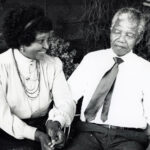
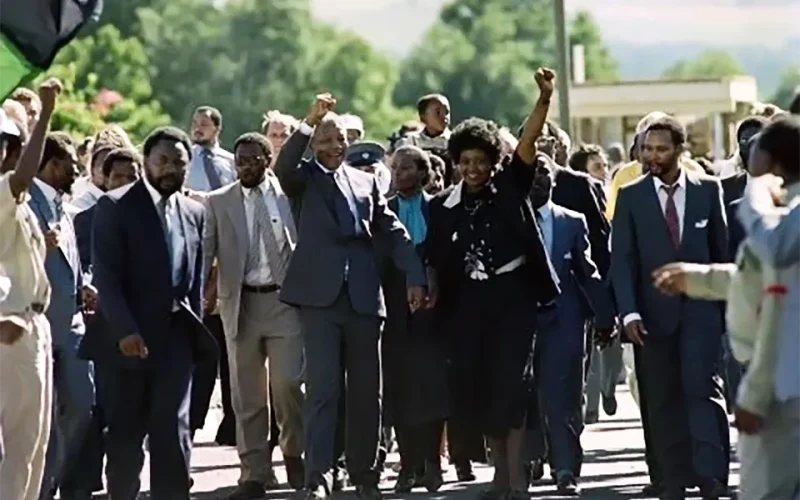
Thirty-six years ago to the day – at 4:15 pm on February 11, 1990 – the world held its breath as Nelson Rolihlahla Mandela, with Winnie Madikizela-Mandela at his side, walked out of these very gates into a massive, jubilant crowd. The moment transformed a prisoner into a legend and set South Africa on an irreversible path to democracy.
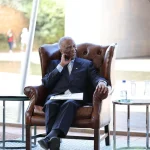
“To have been there beside the father of our nation as he took his first steps as a free man remains one of the greatest honours of my life,” President Cyril Ramaphosa told gathered dignitaries and correctional staff on Wednesday morning. “Few moments have marked me more than being a witness – at close quarters – to the day that lit the path toward the birth of a new South Africa.”
That historic walk from what was then Victor Verster Prison marked a decisive turning point in South Africa’s journey from apartheid to democracy, culminating four years later in Mandela’s election as the country’s first democratically elected president in 1994.
On Wednesday, Ramaphosa returned to that sacred ground not merely to commemorate, but to plant seeds for the future. He officially opened the Nelson Mandela Rules Training Academy – the first facility of its kind on the African continent dedicated to humane correctional practices.
“The eyes of the world were fixed on the gates just beyond where we stand now,” Ramaphosa recalled, his voice carrying the weight of personal memory. “They were waiting for the moment one man would walk out of the gates of history, and into legend.”
The new academy, housed in a refurbished training centre at Drakenstein, embodies the United Nations Standard Minimum Rules for the Treatment of Prisoners – known globally as the Nelson Mandela Rules, adopted by the UN General Assembly in 2015 in recognition of Mandela’s 27 years of imprisonment and his lifelong advocacy for human dignity.
In a powerful symbol of rehabilitation, the academy’s walls are adorned with striking artwork depicting Madiba, created by offenders themselves. Every table, every chair, every piece of furniture was crafted by inmates within South Africa’s correctional system – a living testament to the transformative power of skills development and meaningful work.
“This is not incidental. It is deeply symbolic,” Ramaphosa said. “It reflects the very essence of rehabilitation. It is about unlocking human potential, creativity and self-worth.”
The president confronted head-on South Africa’s crime crisis and the public’s understandable frustration, acknowledging the “lock the door and throw away the key” mentality many harbour toward offenders. But he challenged citizens to think beyond punishment.
“Madiba believed that justice is not measured by how harshly we punish, but by how faithfully we uphold human dignity, even in the most difficult circumstances,” he said.
The statistics paint a sobering picture: over the past three years, more than 18,000 ex-offenders on parole have re-offended, including for serious crimes. Minister of Correctional Services Dr Pieter Groenewald disclosed these figures last year, underscoring the urgent need for better rehabilitation.
“Offenders come from communities, from families,” Ramaphosa reminded the audience. “They are mothers, fathers, brothers, sisters, daughters and sons. Once they have served their sentences, ex-offenders are released back into the community. It is therefore a priority that we ensure they are rehabilitated.”
The new academy will serve as a knowledge hub not only for South African correctional officials but for the global corrections community, working in partnership with the United Nations Office on Drugs and Crime.
As Ramaphosa stood at Drakenstein on this anniversary, the circle felt complete: the man who walked beside Mandela on his journey to freedom now champions the values Madiba lived by – dignity, rehabilitation, and the unwavering belief in human potential for change.
“May this academy stand as a living tribute to Nelson Mandela’s legacy,” Ramaphosa declared. “May it shape generations of correctional practitioners committed to dignity and reform.”
The gates that once opened to set one man free now stand as a threshold to a new vision – one where South Africa’s correctional system becomes a place of transformation, not merely containment.
The Nelson Mandela Rules Training Academy officially opened on Wednesday, February 11, 2026, at Drakenstein Correctional Facility in Paarl, marking 36 years since Mandela’s release from prison.
Today marks exactly 36 years since the release of President @NelsonMandela on 11th February 1990. Earlier this morning, President @CyrilRamaphosa visited the Madiba House, which housed Nelson Mandela during the final years of his imprisonment.
— The Presidency ???? (@PresidencyZA) February 11, 2026
That historic walk from Madiba… pic.twitter.com/ivesW4GcDh