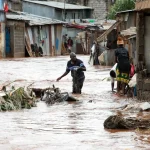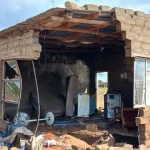
THEY came without warning to the people who needed it most. On the night of Friday 6 March 2026, walls of brown water poured through Nairobi’s most densely packed neighbourhoods – Mukuru, Kibra, Mathare, Huruma, South B and C, Pipeline, Githurai, Kahawa West – sweeping cars off roads, tearing through informal settlements, and dragging people into drainage channels that double as open sewers.
By Sunday, 9 March, 42 deaths had been confirmed across Kenya, nearly double the 23 recorded just 48 hours earlier. At least nine people remain missing. Over 50,000 Kenyans have been displaced. The Kenya Red Cross Secretary General, Dr Ahmed Idris, warned the numbers would continue to climb.
“The most recent data shows that 42 people are dead and over 50,000 are displaced across the country. Unfortunately, we anticipate this number will increase.”
Dr Ahmed Idris, Kenya Red Cross
Nairobi bore the heaviest toll: 26 of the 42 deaths were recorded in the capital, among them three children. The identities of many remain unknown. Nairobi West County Commissioner Rose Chege appealed to families with missing relatives to visit the City Mortuary. In a city of five million, the anonymity of the dead speaks to the scale of the dislocation.
THE GEOGRAPHY OF GRIEF
The disaster did not strike at random. It followed the contours of poverty. The worst-affected neighbourhoods – Mukuru, Kibra, Mathare – are Nairobi’s largest informal settlements, where hundreds of thousands of people live in housing built on floodplains, along riverbanks, and in drainage corridors that were never meant for human habitation. When the rains came, these areas had nowhere for the water to go.
The Eastern region added 10 deaths: eight in Makueni County and two children in Kitui. The Rift Valley recorded four fatalities in Narok and Kajiado counties. A child died in Mombasa on the coast, another in Homabay on the shores of Lake Victoria. The floods were not a Nairobi story alone – they were a national emergency.
The Kenya Meteorological Department confirmed that Kabete received 121 millimetres of rainfall on Friday alone, followed by 117mm on Saturday, on top of 144mm earlier that week. These are not unusual figures for the onset of Kenya’s long-rains season – but the infrastructure designed to absorb them has not kept pace with the city’s explosive growth.
INFRASTRUCTURE FAILURE MASQUERADING AS NATURAL DISASTER
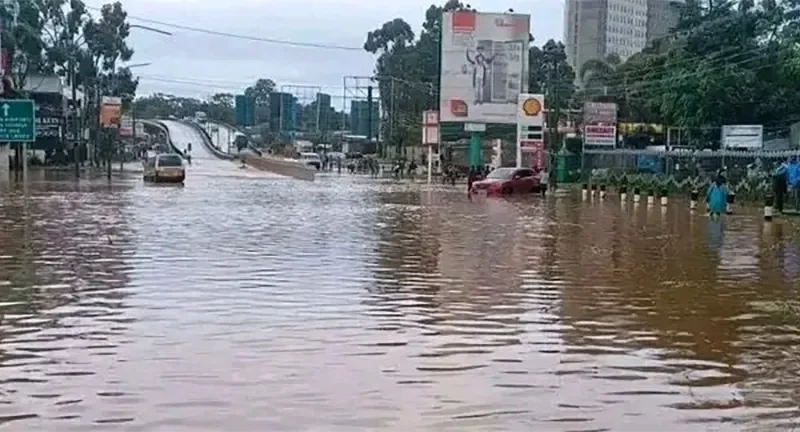
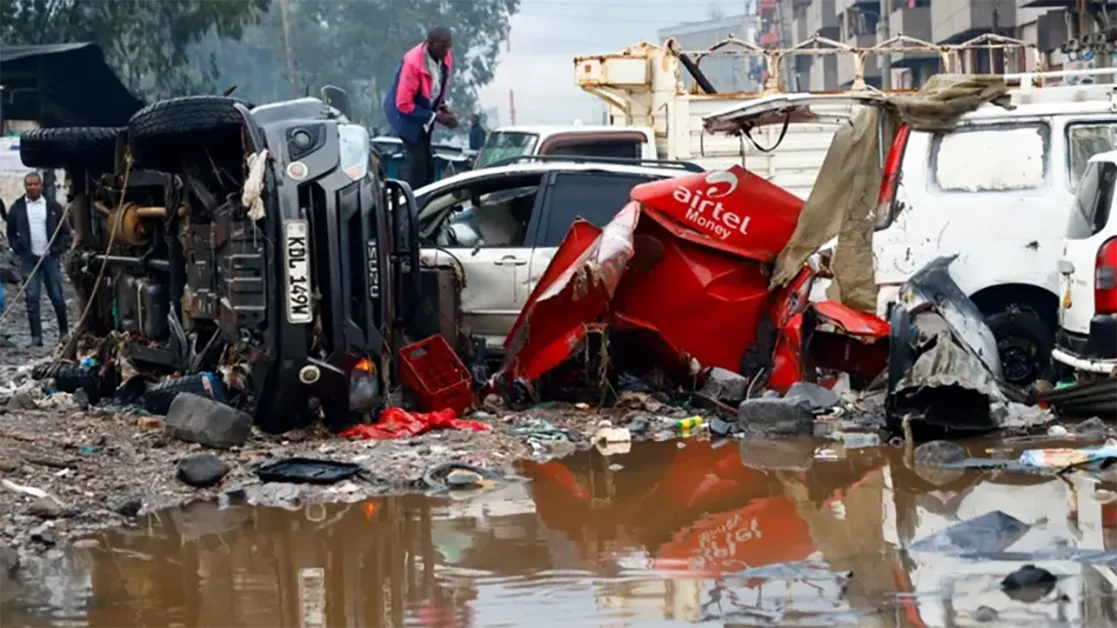
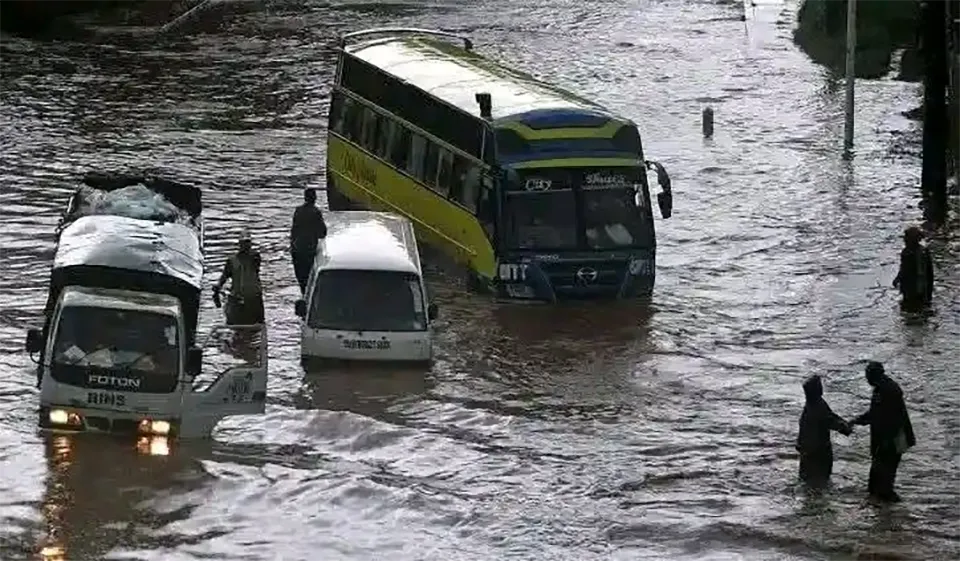
The most telling images from Nairobi’s floods were not of swollen rivers. They were of vehicles – matatus, private cars, trucks – submerged on city roads. At least 172 vehicles were swept away or stranded. A fuel station was consumed by water. The South C electricity substation was flooded when part of its boundary wall collapsed, cutting power to Industrial Area, Uhuru Gardens, and multiple surrounding estates.
Four major water pipelines were ruptured, cutting supply to large swaths of the city, including Eastleigh, Dandora, Korogocho, and Lower Kabete. Flights were diverted from Jomo Kenyatta International Airport to Mombasa for hours. The main arterial roads – Uhuru Highway, Mombasa Road, Thika Superhighway – were paralysed.
“The whole city is flooded yet again. How long will officials keep ignoring the lack of drainage?” — Nairobi resident Aisha Bajaber, on X
This was not an unforeseen catastrophe. The Kenya Meteorological Department had issued a formal warning on 3 March – three days before the floods peaked – forecasting very heavy rainfall between 4 and 8 March. The warning was specific, geo-referenced, and public. It named Nairobi, Nyeri, Kisumu, Narok, Eldoret, Mombasa, and Nakuru. The rains came exactly as predicted. The infrastructure failed exactly as feared.
Prime Cabinet Secretary Musalia Mudavadi acknowledged the systemic failure in measured terms. He pledged that all blocked drainage systems would be cleared and said that Nairobi, as a regional hub, could not continue to tolerate such outcomes. Nairobi Senator Edwin Sifuna was less diplomatic. “As part of the leadership in Nairobi, you will hear no excuses from me,” he said. “Yesterday’s flood situation was an indictment.”
THE GOVERNMENT RESPONSE
President William Ruto moved quickly. On Saturday, he ordered a multi-agency emergency response team – comprising the Ministry of Interior, the Kenya Defence Forces, the National Youth Service, St John Ambulance Kenya, the National Disaster Management Unit, and other agencies – to support rescue and relief operations. He directed the immediate release of relief food from national strategic reserves for distribution to affected families.
The government also committed to covering hospital bills for flood victims receiving treatment at public health facilities, and to providing emergency humanitarian assistance to displaced households. The toll road operator on the elevated Nairobi Expressway waived fees to ease congestion as alternative routes flooded. The Kenya Red Cross deployed first responders to Kirinyaga Road, where at least 20 people had been stranded by rising water.
A military rapid response unit towed stalled vehicles near the Kariokor-Ring Road roundabout, where the Nairobi River had overflowed. Emergency coordination meetings ran through the weekend. Yet even as the rescue machinery was mobilised, the fundamental question hung in the air: how many of these deaths were preventable?
CLIMATE CHANGE: THE MULTIPLIER NO ONE CAN IGNORE
The science is unambiguous. A 2024 World Weather Attribution study found that climate change had made devastating rains in East Africa twice as likely as they were in the pre-industrial era. Scientists have documented a consistent pattern across the region: global warming is compressing rainfall into shorter, more violent bursts — less drizzle, more deluge.
Kenya has lived this pattern across multiple seasons. In 2024, catastrophic floods killed hundreds and displaced more than 200,000 people nationwide. Each long-rain season now arrives with a higher baseline of risk, amplified by the same warming that is scorching other parts of the continent in drought. The people of Kibra and Mukuru did not burn the fossil fuels, accelerating that warming — but they are bearing the sharpest edge of its consequences.
Climate change has made devastating rains in East Africa twice as likely — yet the burden falls hardest on those who contributed least to the crisis.
For urban planners and policymakers, the implications are uncomfortable. Kenya’s cities — and Nairobi above all — are growing rapidly, with millions of new residents living in areas that formal planning frameworks have largely abandoned. The combination of accelerating extreme weather and stagnant urban infrastructure is not a recipe for occasional tragedy. It is a recipe for recurrence.
WHAT HAPPENS NEXT
As of Monday, 9 March, the Kenya Meteorological Department was forecasting a gradual reduction in rainfall intensity and geographic spread in the coming days. But its warning of 3 March remains formally in force. Emergency teams continue their search operations. Nine people are still unaccounted for. Hundreds of families in flood-prone areas have been advised to relocate and await clearance before returning.
The government’s immediate humanitarian response has been substantive. But the deeper reckoning will take longer, and the history of such reckonings in Kenya is not encouraging. The 2024 floods prompted similar pledges to fix drainage infrastructure, to enforce setback regulations along waterways, and to upgrade informal settlements. Much of that work remains undone.
The 42 dead of March 2026 will be buried. The displaced will return — many of them to the same floodplains, because they have nowhere else to go. And in six months, when Kenya’s short rains arrive, the question will be whether the drains have been cleared, the embankments reinforced, and the warnings heeded — or whether another week of grief awaits a city that already knows the answer.