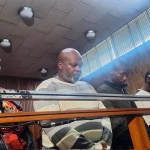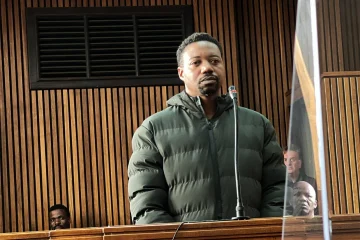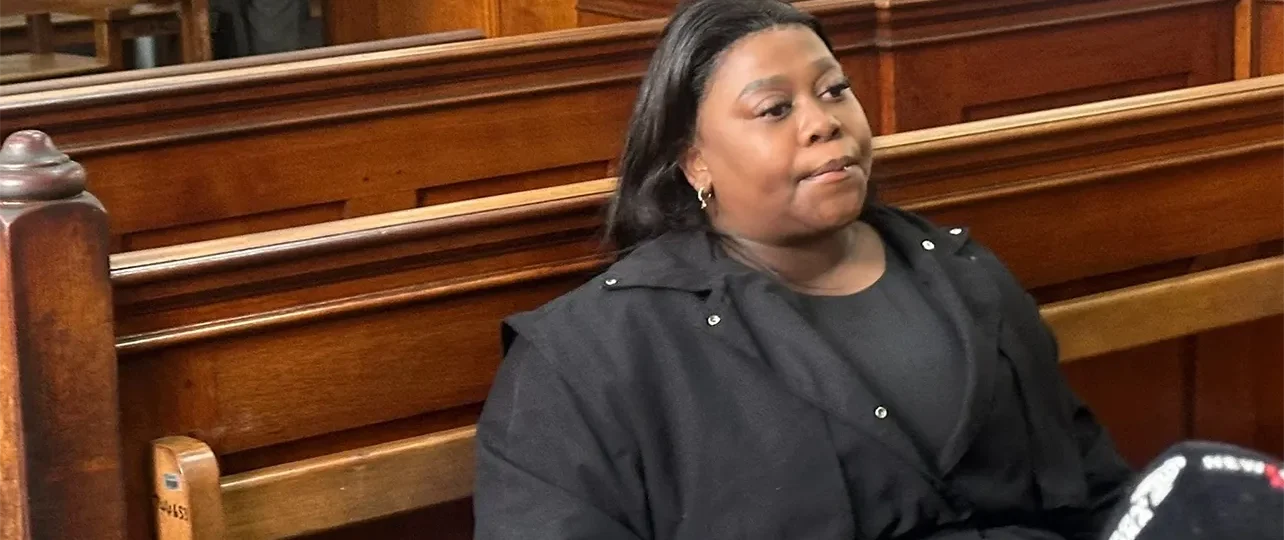

IN the 32 years of the democratic South African parliamentary politics, it would be difficult to recall a more audacious or troubling allegation against a sitting officer of the National Assembly. Mmabatho Nthabiseng Mokoena-Zondi, the Chief Whip of uMkhonto weSizwe (MK) Party, appeared before the Cape Town Magistrate’s Court on Thursday, 28 May 2026, on charges of fraud – having allegedly forced four parliamentary researchers to hand over more than half of their monthly salaries under the false pretence that the funds were required to sustain the legal defence of the party’s president, Jacob Zuma.
She was granted R30,000 bail and is expected to appear before the Bellville Serious Commercial Crimes Court on 18 June. The Hawks allege the scheme netted R233,317.99 over a five-month period between August and December 2024 – public money, derived from parliamentary salaries, allegedly redirected through coercion by the very official responsible for ensuring the MK Party’s MPs fulfil their legislative duties with integrity.
According to Western Cape Hawks spokesperson Warrant Officer Zinzi Hani, Mokoena-Zondi personally headhunted and recruited the four individuals into the party as researchers. Their vulnerability was structural: they were new to parliamentary employment, dependent on their salaries, and newly bound to an institution and a party that controlled their professional futures. The alleged mechanism of control was simple and brutal.
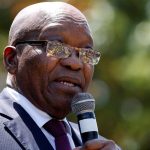
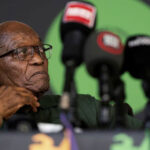
The alleged justification invoked to extract those payments was the name of Jacob Zuma, still the MK Party’s president and still, at 84, fighting serial prosecution in the KwaZulu-Natal High Court in Pietermaritzburg. Zuma’s arms deal trial – delayed for more than two decades by legal manoeuvres and political intervention – has at last been given a trial date. His legal costs are substantial and widely known to be a source of financial pressure within the party. That this context could be weaponised against subordinate employees – if the allegations are proven – reveals the depth of Zuma’s totemic authority within MK structures, and the degree to which that authority can be exploited by those who surround him.
The Office of Chief Whip: Its Weight and What It Means
The role of Chief Whip in South Africa’s National Assembly is not ceremonial. The Chief Whip is an officer of Parliament whose function is to maintain party discipline, manage the legislative programme, ensure attendance and voting compliance, and act as the primary interlocutor between the party’s parliamentary caucus and the institution’s administrative structures. It is, in short, a position of considerable power over the working lives of fellow MPs and parliamentary staff.
Mokoena-Zondi was appointed to the position in February 2026, replacing former chief whip Colleen Makhubele, who resigned from Parliament on 28 February after a turbulent tenure. Mokoena-Zondi, a former ANC Youth League leader, had previously served in an acting capacity. Her appointment to the permanent role came even as the allegations that now form the basis of the charges were, by police account, already being investigated – the alleged scheme having taken place between August and December 2024, more than a year before her formal appointment.
This timeline raises a pointed question: what did MK Party leadership know, and when did they know it? If the allegations are accurate, the conduct predates her appointment by more than a year. The researchers she allegedly defrauded were party personnel. The scheme allegedly operated within parliamentary structures. It strains credulity that no knowledge of the matter existed within the party before her elevation.
The arrest of Mokoena-Zondi does not take place in a vacuum. It is the latest convulsion in what has become a sustained political implosion within the MK Party – a formation that arrived in Parliament in May 2024 as the country’s third-largest party with 58 seats, riding a wave of popular disillusionment and Zuma’s enduring hold over segments of the electorate, particularly in KwaZulu-Natal.
Since then, the party has been marked by almost continuous internal warfare. Earlier this month, Nhlamulo Ndhlela – previously the most visible public face of the party after Zuma himself – was suspended and replaced as spokesperson by Sifiso Mahlangu on 18 May. The pattern of reshuffles, suspensions, and factional conflict has become so routine that each new episode barely registers surprise before the next arrives.
What is different about this episode is its nature. Previous MK Party turbulence has been ideological, tactical, or personal in character – battles over positions, narratives, and proximity to Zuma’s inner circle. The charges against Mokoena-Zondi are criminal. They involve the alleged exploitation of economically vulnerable employees, the abuse of a position of parliamentary authority, and the invocation of Zuma’s name as a justification for what, if proven, amounts to systematic theft.
There is a further dimension to this story that demands particular attention. Mokoena-Zondi is not merely a Chief Whip. She is one of three MK Party MPs appointed to serve on Parliament’s Impeachment Committee – the constitutional body tasked with examining President Cyril Ramaphosa’s conduct in the Phala Phala farmgate affair. She sits on that committee alongside MK Party deputy president and parliamentary leader John Hlophe and Khanyisile Litchfield-Tshabalala.
South Africa’s Impeachment Committee is a constitutionally mandated oversight mechanism – one of the most powerful accountability instruments available to Parliament. A sitting member of that committee now faces criminal charges relating to conduct that is itself a profound breach of public trust. The implications are not merely reputational. They go to the integrity of the committee’s work. Can proceedings in which a charged MP participates survive legal challenge? Will the MK Party retain her on the committee? What does her continued participation – or removal – mean for the committee’s quorum and composition?
These are not abstract questions. Parliament and its legal services will need to address them with urgency.
The MK Party’s initial response was measured almost to the point of evasion. Spokesperson Sifiso Mahlangu confirmed that the party acknowledged the charges and noted that Mokoena-Zondi had voluntarily presented herself to law enforcement – a formulation that frames self-surrender as a virtue rather than addressing the substance of the allegations. The party announced it was “studying the situation” and would release a formal statement thereafter.
Absent from the statement was any indication of whether Mokoena-Zondi would be suspended from her position as Chief Whip pending the outcome of legal proceedings, any expression of concern for the four researchers who allegedly endured months of financial predation, and any acknowledgement that the use of Zuma’s name – if accurate – constitutes a particular form of institutional exploitation that the party must confront.
The silence on these points is itself significant. In a party that has repeatedly invoked Zuma’s victimhood at the hands of “lawfare” and judicial conspiracy, the prospect of distancing itself from conduct allegedly carried out in Zuma’s name presents an acute internal contradiction.
What Comes Next
Mokoena-Zondi’s next court date is 18 June 2026 at the Bellville Serious Commercial Crimes Court – a specialist court whose mandate is precisely the prosecution of financial crimes of the kind alleged here. Her R30,000 bail was granted on “stringent conditions”, details of which were not immediately published.
In the immediate term, several questions demand answers from the MK Party, from Parliament’s Presiding Officers, and from the Impeachment Committee’s own structures. Will Mokoena-Zondi be relieved of her duties as Chief Whip? Will she be withdrawn from the Impeachment Committee, or will she attempt to continue serving while facing criminal prosecution? What is the party’s legal and ethical position regarding the researchers she allegedly defrauded? And what does this episode signal about the internal governance – or the absence of it – within South Africa’s third-largest parliamentary party?
The presumption of innocence is a constitutional guarantee, and Mokoena-Zondi is entitled to mount a full defence. But the allegations, if proven, represent one of the most brazen abuses of parliamentary office in recent South African political history. The Bellville Serious Commercial Crimes Court will, in time, be the arena in which the facts are tested. For now, a Chief Whip is on bail, a party’s credibility is further strained, and the institution of Parliament faces yet another challenge to its standing in the eyes of the public it exists to serve.
KEY FACTS AT A GLANCE
• Accused: Mmabatho Nthabiseng Mokoena-Zondi, MK Party Chief Whip and Impeachment Committee member
• Charge: Fraud (Bellville Serious Commercial Crimes Court, 18 June 2026)
• Alleged period: August – December 2024
• Alleged victims: Four parliamentary researchers personally recruited by the accused
• Alleged extraction: 50%–60% of monthly salaries per researcher
• Total alleged loss: R233,317.99
• Alleged pretext: Contributions toward Jacob Zuma’s legal defence costs
• Bail: R30,000 granted on stringent conditions
• MK Party response: Acknowledged charges; studying situation; committed to rule of law