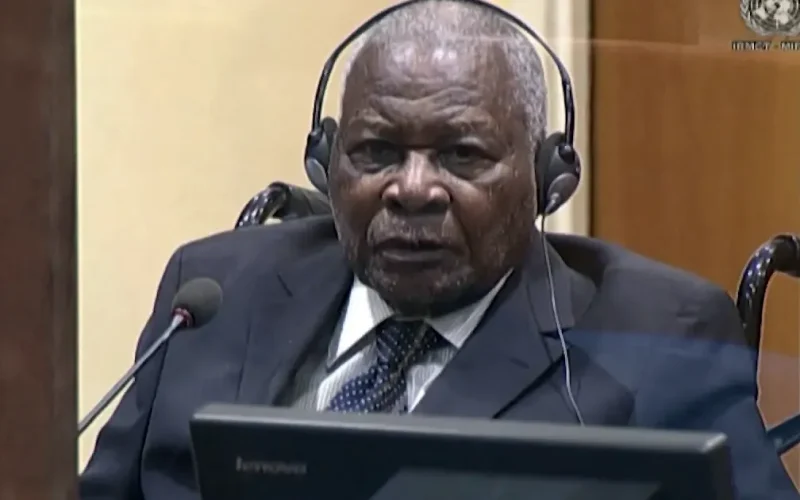
FÉLICIEN Kabuga is dead. He was 93. He died in a Dutch hospital on Saturday while in the custody of the United Nations, still technically on trial, still technically innocent – because the law never got to say otherwise. For the survivors of the 1994 Genocide against the Tutsi in Rwanda, that silence is a wound that will not close.
The International Residual Mechanism for Criminal Tribunals (IRMCT), the UN body overseeing the final chapter of the International Criminal Tribunal for Rwanda (ICTR), confirmed Kabuga’s death on Saturday. It was a statement stripped of ceremony. A man accused of financing the architecture of mass murder died as he had lived for much of the preceding three decades: beyond the full reach of justice.
“He died without a verdict. For survivors, that is not a legal technicality — it is a second wound.”
The Architect of Hate Radio and Armed Slaughter
Kabuga was not a man who wielded a machete. He was the man who paid for them. A Rwandan multimillionaire with extensive business interests, including tea farms in northern Rwanda’s Byumba prefecture, he used his wealth and his connections to President Juvénal Habyarimana’s ruling MRND party to help construct the ideological and material infrastructure of genocide.
Among his most notorious alleged contributions was the establishment and financing of Radio Télévision Libre des Mille Collines (RTLM) — the broadcast engine of the genocide. The station, founded with Kabuga as its Chairman Director-General according to testimony at the ICTR, did not merely traffic in ethnic prejudice. It named names. It gave locations. It told killers where Tutsis were hiding. It called them inyenzi — cockroaches — and urged their extermination. When the massacres began in April 1994, RTLM was their soundtrack.
Prosecutors also accused Kabuga of being among the primary importers of the machetes – some 500,000 of them – brought into Rwanda between January 1993 and March 1994, in the months before the killing began. They further charged him with funding and arming the Interahamwe, the Hutu paramilitary militias whose name translates as ‘those who attack together’ and whose hands carried out much of the slaughter across Rwanda’s hills and valleys.
The genocide was triggered on 6 April 1994 when the plane carrying President Habyarimana was shot down over Kigali. Within hours, organised killing had begun. Over roughly 100 days, approximately 800,000 Tutsis and moderate Hutus were murdered – a killing rate that exceeded even the industrialised horror of the Holocaust. Kabuga’s family was intimately tied to the regime: two of his daughters were married to two of Habyarimana’s sons.
Twenty-Six Years on the Run
For more than two decades after the genocide, Kabuga lived as a fugitive, one of the world’s most wanted men. An arrest warrant was first issued by the ICTR in 2013, though he had been under indictment since 1998. There were sightings in Kenya – which then-US Senator Barack Obama, visiting in 2006, publicly accused of allowing Kabuga to ‘purchase safe haven.’ The Kenyan government rejected the accusation as an insult. The United States State Department eventually posted a $5 million reward for information leading to his arrest.
He was found, in the end, hiding in plain sight in a suburb of Paris. On 16 May 2020 – exactly six years to the day before his death – French police arrested Kabuga in Asnières-sur-Seine, where he had been living under a false identity. He was 87 years old. He was transferred to the IRMCT’s branch in The Hague in October 2020.
His trial opened on 29 September 2022. It was, in many ways, the beginning of the end — and not in the way survivors had hoped.
Dementia, Suspension, and the Collapse of a Trial
Almost from the start, Kabuga’s defence raised concerns about his health. By 2023, medical experts had concluded he was suffering from severe cognitive impairment. He was, they said, unable to follow proceedings or meaningfully instruct counsel. In September 2023, the Appeals Chamber ruled that proceedings against him should be indefinitely suspended – he was unfit to stand trial.
The IRMCT subsequently ordered that Kabuga remain under UN detention while arrangements were sought for his provisional release to a state willing to accept him. Only Rwanda offered to take him. His lawyers rejected that option, arguing he feared mistreatment in his home country. No other state came forward. He remained in the United Nations Detention Unit in The Hague, suspended between international law and institutional inertia, as his health continued to deteriorate.
At the time of his death on Saturday, the IRMCT confirmed, Kabuga was ‘awaiting provisional release to a State willing to accept him on its territory.’ No such state had yet agreed. The IRMCT’s President, Judge Graciela Gatti Santana, has ordered a full inquiry into the circumstances of his death, appointing Judge Alphons Orie to conduct the investigation. Dutch authorities launched standard national law investigations.
“For 26 years, he evaded capture. He was then declared unfit for trial. He died in custody. The law could not find him in time, and age did the rest.”
The Verdict That Will Never Come
Kabuga pleaded not guilty to all charges. He faced counts of genocide, conspiracy to commit genocide, direct and public incitement to commit genocide, and crimes against humanity – including persecution, extermination, and murder. Had he been convicted, he would have faced life imprisonment, the maximum sentence available to the tribunal.
He died without that conviction being entered. He died, in the legal record, as a man whose guilt was never formally established – not because the evidence was insufficient, but because time and biology intervened. For the survivors of the genocide, the genocide widows, the orphaned children, now grown adults who watched their families die listening to a radio station this man financed, that is not a legal technicality. It is a second erasure.
The IRMCT’s statement noted that Kabuga’s case ‘was among the final major prosecutions connected to the Rwanda genocide’ handled by the mechanism. Its closure marks not the end of justice, but the end of the pursuit of it – at least for this accused. The broader reckoning with the genocide continues in national courts across Rwanda and in the gacaca community justice process, which has addressed over a million cases. But Kabuga was the face of the génocidaires’ financial elite. His death without a verdict leaves a particular absence.
A Systemic Failure of International Justice
The death of Félicien Kabuga without a verdict raises questions that go beyond this case, beyond Rwanda, and beyond 1994. There are questions about the structural capacity of international criminal justice to deliver accountability before biology delivers its own verdict.
The ICTR, which existed from 1994 to 2015, secured 62 convictions. It was a significant achievement for international law and for the principle that those who organise mass atrocity cannot indefinitely hide behind national sovereignty or geographic distance. But Kabuga – the alleged primary financier of the entire enterprise – evaded it for 26 years. When he was finally caught, his mind had already begun to fail him.
This is not an isolated pattern. Slobodan Milošević, indicted for genocide and crimes against humanity at the ICTY, died in his cell in 2006 before his trial concluded. Sudanese President Omar al-Bashir, indicted by the International Criminal Court for genocide in Darfur, has never faced trial. Justice, when it moves across decades, often arrives at an empty dock.
There is a lesson here for the African Union and the continent’s emerging accountability architecture. The International Criminal Court, which Kabuga’s case has been erroneously conflated with in some early reporting – it was in fact the IRMCT, a UN mechanism, not the ICC proper – remains a contested institution on this continent. But the Kabuga case is not an argument against international accountability. It is an argument for pursuing it earlier, faster, and with greater collective will.
What Rwandan Survivors Deserve
In Kigali and across Rwanda, the news of Kabuga’s death will be received with a grief that has no clean category. The genocide survivors who spent three decades waiting for the man who bankrolled their family members’ murders to be held to account will now wait forever. The declaration that he was unfit for trial had already angered survivors who felt the maximum sentence was the minimum Rwanda deserved. His death forecloses even that.
And yet Rwanda itself has demonstrated, in the years since 1994, something that the international community would do well to study: that accountability and reconciliation can coexist, that the naming of perpetrators and the acknowledgment of their crimes is itself an act of justice, even when criminal conviction proves impossible. The historical record of Kabuga’s role – assembled through decades of ICTR investigation, witness testimony, and documentary evidence – does not disappear with his death.
He financed the radio that called for killing. He imported the machetes that made it efficient. He funded the militias that made it organised. The evidence, painstakingly assembled, will endure as the verdict that law could not formally enter.
Félicien Kabuga (1 March 1933 – 16 May 2026). No verdict was entered. 800,000 people are still dead.