
SOUTH African President Cyril Ramaphosa has received strong recommendations on how to strengthen the country’s best anti-corruption agency, which has recovered over R41-billion for the state.
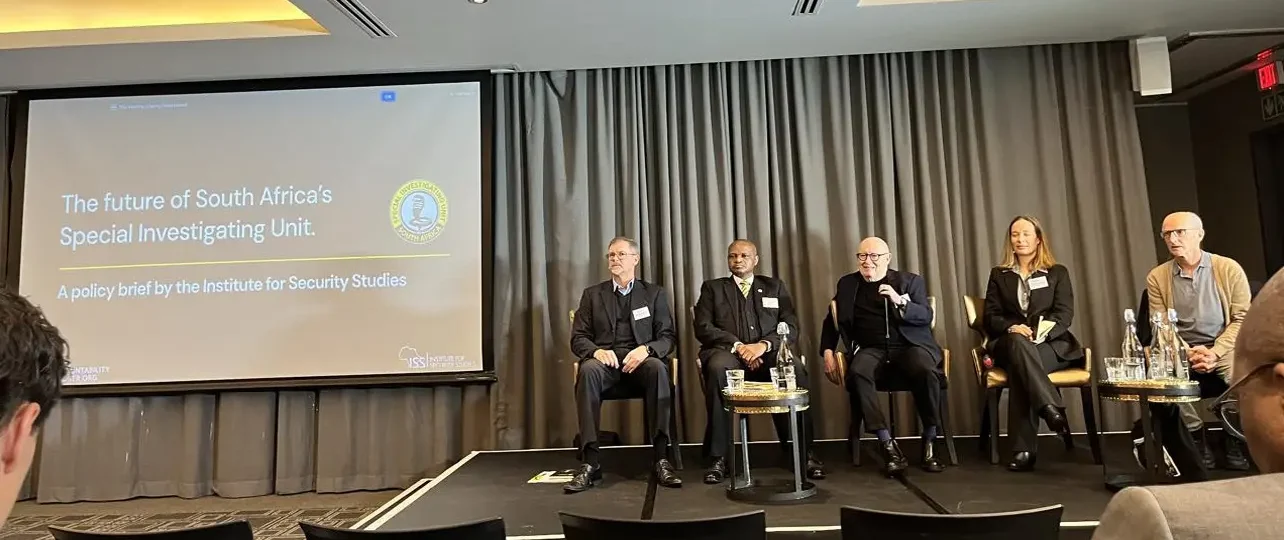
The comprehensive reform proposals, delivered by the Institute of Security Studies (ISS), target the Special Investigations Unit (SIU) – the nation’s most effective corruption-busting institution. The recommendations, contained in a policy brief authored by anti-corruption experts David Bruce, Colette Ashton, and Cheryl Frank, outline specific actions for the Presidency, National Treasury, and civil society to significantly enhance the SIU’s already impressive performance.

The ISS brief calls on President Ramaphosa to take direct control of processing SIU motivations for Presidential proclamations, removing them from the Department of Justice and Constitutional Development to eliminate costly administrative delays. The Presidency must also continue developing automated monitoring systems to track implementation of SIU recommendations, ensuring the unit’s findings translate into concrete action.
The ISS brief and Accountability Tracker (www.accountability-tracker.org), which allows the public to follow actions to implement recommendations made by anti-corruption institutions such as commissions, were launched in Pretoria on Wednesday.
The National Treasury faces a dual mandate: increase funding for corruption prevention through the Technical Assistance Unit in the Department of Public Services and Administration, and partner directly with the SIU to improve debt collection from government entities that owe the state money.
For civil society organisations, the recommendations are that they must assess the National Anti-Corruption Advisory Council’s proposal for the SIU to serve as South Africa’s new Chapter 9 anti-corruption agency, including conducting a comprehensive risk analysis and detailed cost assessments of this transformative proposal.
The most significant recommendations involve sweeping amendments to the SIU Act. The brief proposes making SIU recommendations legally binding rather than advisory, while revolutionising the funding model to allow the unit to retain a percentage of recovered funds or issue Certificates of Debt to investigated institutions.
Additional proposed amendments would enable direct referrals of criminal matters to the Directorate for Priority Crime Investigation, prioritising cases involving potential violence against witnesses, whistleblowers, or investigators. The reforms would establish statutory asset preservation and recovery powers within the SIU Act itself, moving away from current regulatory dependence.
The brief also called for amendments to the Protected Disclosures Act to improve legal, financial, psychological, and physical safety support for whistleblowers, while introducing transparent criteria for SIU leadership appointments subject to expert panel review and parliamentary ratification.
Critical Challenges Hampering Success
The authors of the brief found that despite the SIU’s remarkable achievements since its 1996 inception – recovering R7.9-billion in assets, including over R4.9-billion in actual cash and assets, setting aside R17-billion in irregular contracts, and preventing R11.6-billion in potential losses – the unit faces significant operational obstacles.
The SIU confronts a critical cash crunch linked to its expanding caseload, an ineffective funding model, and poor debt collection processes. Administrative delays in processing Presidential proclamations by the Department of Justice and Constitutional Development further constrain operations, while inadequate systems to enforce SIU recommendations undermine the unit’s impact.
Perhaps most concerning is the safety of SIU personnel and whistleblowers, which researchers identify as a major threat to continued effectiveness. The unit’s dependence on Presidential proclamations for investigations, while protecting it from political interference, simultaneously compromises its operational independence by preventing unilateral investigations of high-level officials.
The ISS research identifies the SIU’s organisational culture of integrity, excellence, and innovation as key factors driving its success, alongside independence in financial and human resources matters. The unit’s ability to effectively use civil law remedies and its expansion into corruption prevention work – though outside its statutory mandate – have established its reputation as the government’s most effective anti-corruption agency.
However, the brief warns that without structural reforms, these achievements risk being undermined by growing operational pressures and systemic constraints that prevent the SIU from reaching its full potential.
The Path Forward
The comprehensive recommendations represent a blueprint for transforming South Africa’s anti-corruption landscape. By addressing funding constraints, operational independence, legal powers, and safety concerns, the proposed reforms could potentially multiply the SIU’s already impressive recovery record.
The policy brief emerged from extensive cooperation with the SIU itself, incorporating insights from in-depth interviews with SIU staff and expert practitioners. This collaborative approach suggests strong institutional support for the proposed changes and creates momentum for implementation.
With South Africa facing ongoing challenges with corruption across government institutions, the timing proves critical. The SIU’s proven track record provides a foundation for expansion, but only if the structural impediments identified by the ISS research are systematically addressed.
The evidence-based recommendations now await action from President Ramaphosa, the National Treasury, and civil society organisations. Their response will determine whether South Africa’s most successful corruption-fighting institution can evolve into an even more powerful force against graft, potentially transforming the country’s anti-corruption landscape for generations to come.