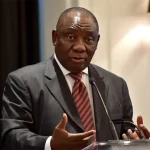
IN a dramatic turn of events that has sent shockwaves through South Africa’s political establishment, President Cyril Ramaphosa has announced the immediate suspension of Police Minister Senzo Mchunu and the establishment of a high-powered judicial commission to investigate explosive allegations of criminal syndicate infiltration within the country’s law enforcement agencies.
The bombshell announcement came exactly one week after Lieutenant General Nhlanhla Mkhwanazi, the KwaZulu-Natal Provincial Commissioner of the South African Police Service, demonstrated extraordinary courage by publicly exposing what he described as a sophisticated criminal network that has allegedly penetrated the very heart of South Africa’s criminal justice system.
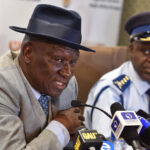
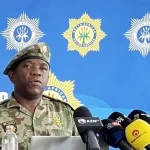
Mkhwanazi’s media briefing on July 6, 2025, was nothing short of seismic. In an unprecedented display of institutional courage, the senior police official laid bare allegations that would make even the most hardened crime investigators’ blood run cold. He alleged that Mchunu had not only interfered with sensitive police investigations but had actively colluded with business people, including a murder accused, to disband the Political Killings Task Team based in KwaZulu-Natal.
Even more damning were Mkhwanazi’s revelations about a Gauteng-based police investigation that allegedly unmasked a drug cartel-controlled syndicate with tentacles reaching into the highest echelons of power. According to the provincial commissioner, this criminal network had successfully infiltrated politicians, law enforcement officials from the SAPS, metro police and correctional services, prosecutors, the judiciary, and business people.
The courage displayed by Mkhwanazi cannot be overstated. In a country where whistleblowers often face intimidation, career destruction, or worse, his decision to go public with these allegations represents a pivotal moment in South Africa’s ongoing struggle against corruption and state capture.
Ramaphosa’s response was both swift and decisive, demonstrating the gravity with which the presidency views these allegations. The establishment of a judicial commission of inquiry, chaired by Acting Deputy Chief Justice Mbuyiseli Madlanga – the second most senior judge in the country – signals that this investigation will carry the highest level of judicial authority and credibility.
Justice Madlanga, who is retiring from the Constitutional Court at the end of July 2025, will be able to dedicate his full attention to this critical investigation. He will be assisted by two senior counsel, Advocate Sesi Baloyi SC and Advocate Sandile Khumalo SC, ensuring that the commission has the legal firepower necessary to tackle such complex and sensitive allegations.
The scope of the commission’s mandate is comprehensive and far-reaching. It will investigate not only the infiltration of law enforcement and intelligence institutions by criminal syndicates but also examine the facilitation of organised crime, suppression or manipulation of investigations, and the intimidation or removal of whistleblowers. The commission will scrutinise the South African Police Service, National Prosecuting Authority, State Security Agency, the Judiciary and Magistracy, and the metropolitan police departments of Johannesburg, Ekurhuleni, and Tshwane.
A Strategic Ministerial Appointment
The appointment of Professor Firoz Cachalia as acting Minister of Police represents a masterstroke in institutional rebuilding. Professor Cachalia brings impeccable credentials to the position: he is currently a professor of law at the University of the Witwatersrand, chairperson of the National Anti-Corruption Advisory Council, and previously served as an MEC of Community Safety in Gauteng. His academic background and anti-corruption expertise make him uniquely qualified to oversee the police ministry during this critical period.
The President’s decision to utilise Section 91(3)(c) of the Constitution to appoint Professor Cachalia from outside the National Assembly demonstrates the seriousness with which the presidency views the need for clean, competent leadership in the police ministry. This constitutional provision allows the President to select no more than two Ministers from outside Parliament, and its use here underscores the exceptional nature of the current crisis.
Vindication for Lieutenant General Mkhwanazi
The suspension of Minister Mchunu represents a significant vindication for Mkhwanazi, whose courage in speaking truth to power has now been validated at the highest levels of government. The fact that National Police Commissioner Fanie Masemola has stated that no action would be taken against the KZN police commissioner further reinforces the credibility of Mkhwanazi’s allegations and the institutional support for his whistleblowing.
This development sends a powerful message throughout the law enforcement community: those who stand up against corruption and criminal infiltration will be protected and supported, while those who may be complicit in such activities will face the full might of judicial investigation.
Implications for Cabinet Stability
The removal of Mchunu is expected to trigger a broader cabinet reshuffle, with sources indicating that President Ramaphosa may use this opportunity to address other problematic appointments. Speculation is mounting that the Minister of Higher Education, Dr Nobuhle Nkabane, whose conduct has embarrassed both the cabinet and the ANC and was recently prevented by the President from undertaking an official trip to China, may also face removal.
Such a reshuffle would represent a significant assertion of presidential authority and a clear signal that accountability and competence are non-negotiable in the Ramaphosa administration.
The Road Ahead
The commission faces a daunting task. With interim reports expected after three and six months, and the final report to be submitted to both the Speaker of the National Assembly and the Chief Justice, the investigation will operate under intense public scrutiny. The commission’s power to refer matters for immediate criminal investigation and to make recommendations on the employment status of officials, including potential suspensions, means that its work could have immediate and far-reaching consequences.
The President’s emphasis on ensuring that law enforcement agencies continue to function without hindrance during the investigation demonstrates the delicate balance that must be struck between accountability and operational effectiveness. The ongoing work of the Special Investigating Unit, the Asset Forfeiture Unit, and other bodies in fighting organised crime and corruption must continue unabated.
A Defining Moment
This commission represents more than just an investigation into alleged criminal infiltration; it embodies South Africa’s ongoing struggle to build institutions that are both effective and accountable. The President’s closing words in his address capture the essence of what is at stake: “In establishing this Commission of Inquiry, we are affirming our commitment to the rule of law, to transparency and accountability, and to building a South Africa in which all people are safe and secure.”
The courage of Mkhwanazi, the decisive action of President Ramaphosa, and the appointment of Acting Deputy Chief Justice Madlanga to lead this investigation represent a confluence of institutional strength and individual bravery that may well define South Africa’s trajectory in the fight against corruption and state capture.
As the commission begins its work, all eyes will be on whether this bold initiative can deliver the accountability and justice that South Africans deserve. The stakes could not be higher, and the implications will reverberate far beyond the borders of South Africa, serving as a test case for whether democratic institutions can successfully confront and defeat criminal infiltration at the highest levels of government.