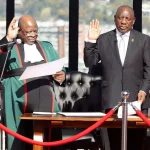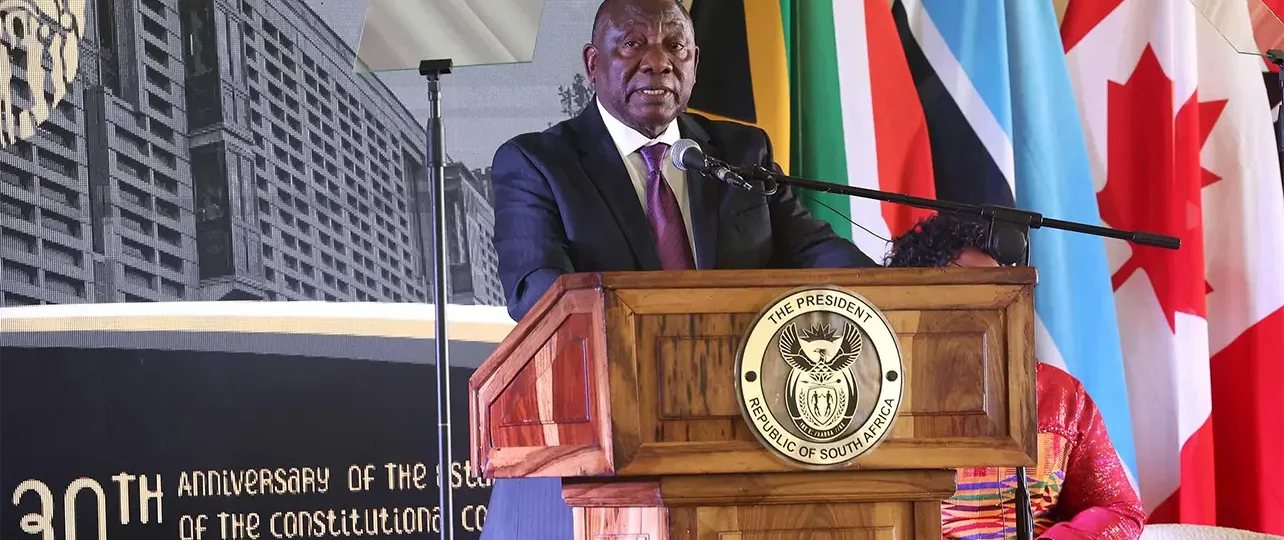

SOUTH Africa is taking concrete steps to ensure the full independence of its judiciary, President Cyril Ramaphosa has assured the nation, as the country’s apex Constitutional Court marked its 30th anniversary in a ceremony attended by chief justices from across Africa and beyond.
Speaking at the Constitutional Court in Braamfontein, Ramaphosa described the institution as “a beacon of democracy” and “a compass for our future journey,” while acknowledging the urgent need to bridge the gap between constitutional promises and lived realities for ordinary South Africans.
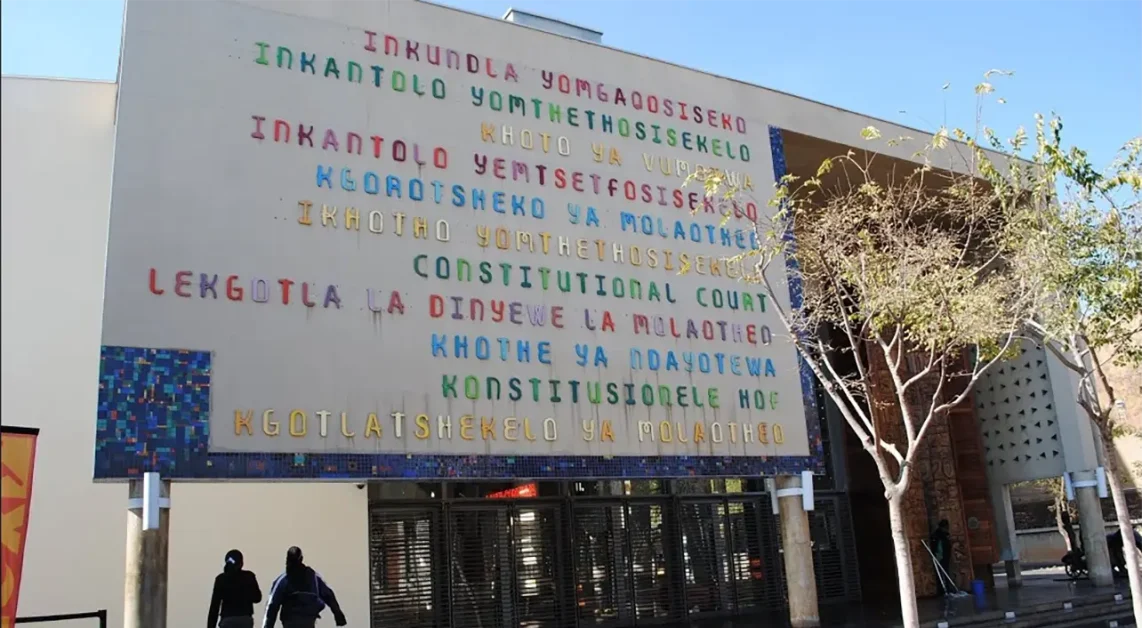
The Constitutional Court, established in 1995 following South Africa’s transition to democracy, holds profound symbolic significance beyond its legal mandate. Built on the site of the Old Fort prison that once symbolised oppression, the court embodies the nation’s transformation from apartheid to constitutional democracy.
“This court was established on the ruins of an oppressive legal system, and was built on the grounds of a former prison, embodying the hope that law could become an instrument of justice rather than repression,” Ramaphosa told the gathering of legal luminaries and dignitaries.
The President described South Africa’s Constitution as the nation’s “birth certificate,” adopted on May 8, 1996, when he served as chairperson of the Constitutional Assembly. Just as individuals cannot enjoy their rights without proper documentation, he argued, “without the Constitution our country would be cast adrift, and be vulnerable to the excesses of unchecked power.”
Transformative Jurisprudence with Real Impact
Over three decades, the Constitutional Court has developed what Ramaphosa termed “a rich and transformative jurisprudence” that has fundamentally shaped South African society. The court’s landmark judgments have abolished the death penalty, established rights to housing and healthcare, and advanced equality for marginalised communities.
The President highlighted several groundbreaking cases, including S v Makwanyane, which ended capital punishment, the Grootboom case, which centred on housing rights, and Minister of Health v Treatment Action Campaign that dealt with HIV/AIDS treatment access. These decisions, he emphasised, “are not merely legal decisions—they are decisions that have changed lives, shaped our society, and strengthened our democracy.”
The court’s progressive rulings have advanced rights for same-sex couples, women in traditional marriages, children, and society’s most vulnerable members, affirming that “dignity, equality and freedom are not reserved for the powerful, but guaranteed to all.”
Addressing the Implementation Gap
However, Ramaphosa candidly acknowledged a troubling disconnect between constitutional promises and reality for many South Africans. He cited the tragic case of Irene Grootboom, the applicant in the landmark housing rights case, who died in 2008 without ever receiving the decent home the court had affirmed was her right.
“It will forever remain a blight on our democracy that the applicant in the ground-breaking Grootboom judgment, Ms. Irene Grootboom, died in 2008 without her dream of a decent house being fulfilled,” the President said.
This reality points to what Ramaphosa called “widespread and systematic shortcomings in service delivery” that must be addressed. “Our people should not have to resort to litigation to have their rights realised,” he emphasised, noting the “troubling irony” of celebrating progressive court judgments while the state often must be compelled by litigation to fulfil its constitutional obligations.
Concrete Steps Toward Judicial Independence
Responding to these challenges, Ramaphosa announced concrete measures to strengthen judicial independence and support. The government has allocated increased funding in this year’s budget for enhancing access to justice, improving court services, filling vacant judicial posts, and addressing funding shortfalls.
More significantly, the President revealed that following recent meetings with the judiciary, a joint committee has been established to develop an action plan for advancing judicial independence, to be finalised within six weeks.
“We will ensure the Judiciary is rightly constituted as an equal branch of government with the Legislature and the Executive,” Ramaphosa pledged, emphasising government’s commitment to providing “institutional, infrastructure, financial, administrative, and legal support” necessary for independent judicial functioning.
An African and International Model
The Constitutional Court’s influence extends beyond South Africa’s borders. The anniversary celebration drew chief justices from Zimbabwe, Botswana, Canada, Egypt, Eswatini, Mozambique, Namibia, Nigeria, India, and Kenya, highlighting the court’s role as a continental leader in constitutional jurisprudence.
Ramaphosa noted how South Africa’s constitution drew inspiration from global models, including Germany’s Basic Law and Canada’s Charter of Rights and Freedoms, while remaining uniquely South African and deeply rooted in African liberation struggles dating back to the African National Congress’s 1943 African Claims document.
Challenges and Future Vision
Despite celebrating the court’s achievements, Ramaphosa acknowledged significant ongoing challenges, including persistent inequality, threats to judicial independence, inadequate implementation of court orders, and eroding trust in institutions. The 2022/2023 Judiciary Annual Report highlighted the Constitutional Court’s struggle to finalise cases within target time frames due to increasing caseloads, particularly following 2013 expansions to the court’s jurisdiction.
However, the President expressed confidence in the judiciary’s resilience, praising justices past and present for their “integrity, intellect, and independence” that have given life to constitutional ideals. He paid special tribute to founding justices Albie Sachs and Kate O’Regan, who attended the anniversary celebration.
A Living Institution for the Future
Looking ahead, Ramaphosa called for a collective recommitment to constitutional values. Legal professionals must uphold ethics and deepen constitutional jurisprudence, government leaders must respect the rule of law and implement court decisions in good faith, and society must ensure constitutional values continue to define national identity.
“As we look to the next 30 years, let us ensure that the Constitutional Court remains a living institution – responsive, principled, and deeply rooted in the values of ubuntu, accountability, and human dignity,” the President concluded.
Despite facing challenges of poverty, inequality, and unemployment, Ramaphosa expressed confidence in South Africa’s democratic trajectory, fortified by the knowledge that the guardians of the constitutional order continue guiding the nation toward its founding ideals of dignity, equality, and freedom for all.
The Constitutional Court’s 30-year journey from the ruins of apartheid to becoming a beacon of constitutional democracy serves as both a celebration of achievements and a call to action for ensuring that constitutional promises translate into tangible improvements in the lives of all South Africans.