TANZANIA’s ruling party faces virtually no challenge in elections later this month after the disqualification of the country’s two largest opposition parties, raising alarm about the state of democracy in the East African nation.
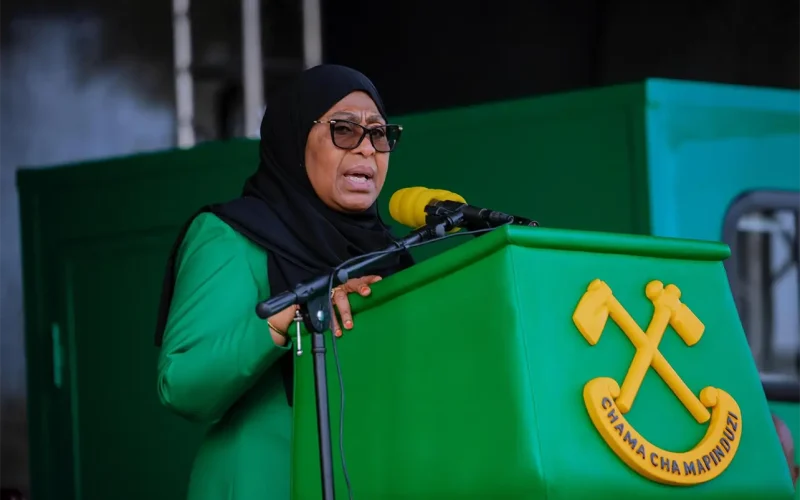
The October 29 presidential election will proceed without candidates from Chama Cha Demokrasia na Maendeleo (Chadema) and ACT Wazalendo, the country’s main opposition forces, leaving President Samia Suluhu Hassan’s Chama Cha Mapinduzi (CCM) party poised for an uncontested victory.
Chadema was disqualified for refusing to sign an election code of conduct, while the party’s chairman, Tundu Lissu, faces treason charges for calling for electoral reforms. The presidential candidate from ACT Wazalendo, Tanzania’s second-largest opposition party, was barred following a petition by the country’s registrar of political parties.
“CCM’s candidate, Samia Suluhu Hassan, is destined for a landslide victory after the disqualification of two major opposition parties,” wrote Nicodemus Minde, a researcher at the United States International University who has studied Tanzania’s political party dynamics for a decade, in an analysis published Tuesday in The Conversation.
The disqualifications mark a dramatic shift from the 2020 election, when opposition parties participated despite what observers called electoral flaws. Hassan, who became president following the death of John Magufuli in 2021, is seeking her first full term.
Democracy in Decline
The election comes as Tanzania experiences what Minde describes as a “decline in democracy, accompanied by heightened political repression and restrictions on political rights and civil liberties.”
The country’s democracy rating dropped from “Partly Free” in 2020 to “Not Free” in 2025, according to Freedom House’s democracy index.
“The campaign is now dominated by CCM at all levels,” Minde wrote, predicting low voter turnout with “little public enthusiasm, especially knowing that a CCM victory is certain.”
Voter participation has been declining for years. Turnout dropped from 42.7% in 2010 to 50.7% in 2020.
The Independent Electoral Commission reported that 37.7 million people registered to vote — a 26.55% increase from 29.8 million in 2020. While the commission attributes this to population growth, critics allege the figures could be used to manipulate results.

Opposition Silenced
Chadema’s “No Reforms, No Elections” campaign has focused attention on governance and human rights concerns, including attacks on media freedom and what critics call gross violations of human rights.
International bodies have taken notice. The African Commission on Human Rights and the European Parliament have both expressed concern about Tanzania’s deteriorating human rights situation.
With the main opposition sidelined, a fringe party called Chama Cha Ukombozi wa Umma (Chaumma) has emerged as the only nominal challenger. Its presidential candidate, Salum Mwalimu, and running mate Devotha Minja both defected from Chadema earlier this year.
“Chaumma’s apparent campaign resources have led some to conclude that it is surreptitiously backed by the ruling party,” Minde wrote, warning that Chaumma and 15 other small parties “run the risk of legitimising an already flawed electoral process.”
New Laws, Same Control
Three new electoral laws passed in 2023 promised reform, establishing what the government called an “independent” electoral commission. But Minde notes the changes are largely cosmetic.
“Despite these changes, the executive branch still maintains significant influence over the electoral structure and decision making,” he wrote. “The president still has the power to appoint the chair, vice chair and commissioners of the electoral body.”
The election will cover 272 constituencies across mainland Tanzania and the semi-autonomous region of Zanzibar, where incumbent Hussein Mwinyi of CCM faces competition from ACT-Wazalendo’s Othman Masoud.
CCM has ruled Tanzania continuously since independence in 1964, making it one of Africa’s longest-serving ruling parties. The upcoming election will be its seventh consecutive victory.
“With the opposition pushed aside and a controlled electoral process underway, CCM’s victory is all but certain,” Minde concluded. “The key question now is the future of Tanzania’s democracy.”