SHE had already collected on five corpses. Five family members – a sister, nephews, a niece, a lover – murdered for the insurance payouts that followed. Six life sentences handed down in November 2021 had made Rosemary Ndlovu one of the most reviled figures in post-apartheid South African criminal history. Yet the former police officer, badge now a distant memory, was not finished.
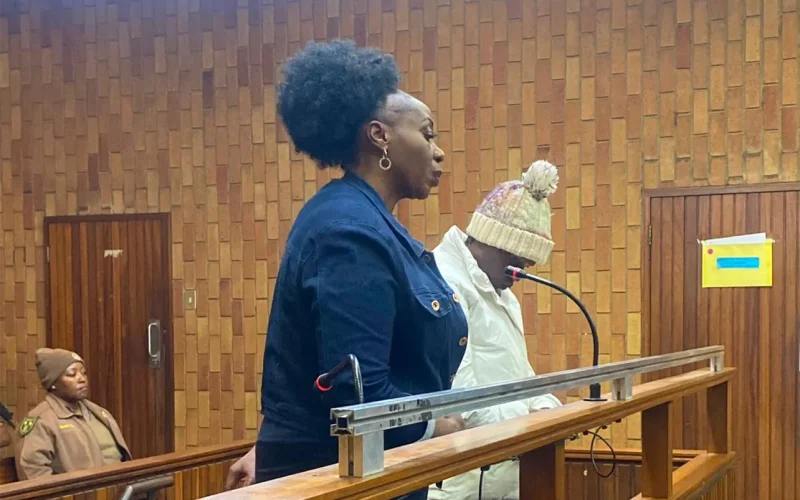
On Wednesday, the Kempton Park Magistrates’ Court delivered its verdict on a separate, chilling chapter: Ndlovu and her co-accused, Nomsa Mudau, have been convicted of incitement to commit murder in a 2018 plot to have Mudau’s husband, Justice Mudau, killed — for the insurance money that would follow his death.
The case is a masterclass in audacity. Ndlovu, by 2018, was already a woman with blood on her hands and a calculator in her head. That year, she reached into her network and contacted hitmen — a resource she evidently regarded as a professional amenity — and offered them to her friend Nomsa, who wanted her husband eliminated.
| “She indicated she would pay the hitmen after lodging a claim following her husband’s death.” |
THE PLOT IN DETAIL
According to the court record, Ndlovu initiated the chain of events by contacting the hitmen directly, informing them that Mudau would follow up with specific instructions. What followed was a series of telephonic communications and face-to-face meetings in Tembisa, during which Mudau spelled out her demands: she wanted her husband dead.
Her stated justifications, as presented in court, were an abusive marriage and extra-marital affairs. But the financial motive was nakedly apparent — Mudau told the hitmen she would pay them once she had lodged the insurance claim after Justice Mudau’s death. The payout was the point. The grievances were the packaging.
The hitmen, however, did not execute the plan. Instead, they reported the murder-for-hire scheme to the intended victim himself. Justice Mudau then opened a criminal case with the South African Police Service — an act of considerable courage, given that the woman organising his murder was herself a serving police officer with operational knowledge of investigations.
That tip-off triggered the arrests of both Ndlovu and Mudau. The investigation was led by Captain Kheswa Mabunda, whose methodical assembly of telephonic records, witness accounts, and meeting timelines ultimately gave Senior State Advocate Riana Williams the foundation for a successful prosecution.
| CASE AT A GLANCE | |
| Accused | Rosemary Ndlovu & Nomsa Mudau |
| Charge | Incitement / Instigation to Commit Murder |
| Court | Kempton Park Magistrates’ Court |
| Verdict | Guilty (alternative charge proven) |
| Intended Victim | Justice Mudau (husband of co-accused) |
| Year of Plot | 2018 |
| Ndlovu’s Prior Sentence | Six life sentences (November 2021) |
| Sentencing Date | 15 July 2026 |
| Lead Investigator | Captain Kheswa Mabunda |
| Prosecuting Advocate | Senior State Advocate Riana Williams |
THE VERDICT — AND WHAT IT MEANS
The court found that the State had successfully proven the alternative charge of incitement, instigation, or command of a person to commit murder. Advocate Williams argued that the evidence from State witnesses was consistent, corroborative, and met the criminal standard of proof beyond a reasonable doubt.
The distinction between the primary and alternative charge is legally precise but practically stark: incitement means the accused actively encouraged or procured another to commit murder. The court accepted the State’s argument that Ndlovu was the architect — she found and briefed the hitmen — while Mudau was the client who repeatedly and directly requested the killing.
Pre-sentence reports will be compiled before sentencing proceedings on 15 July 2026. For Ndlovu, who is already unlikely ever to leave prison, this adds a further conviction to her record. For Mudau, it is a reckoning that arrived because a group of hitmen chose to report a crime rather than commit one.
| “The hitmen reported the plot to the intended victim — an act that saved a life and delivered a conviction.” |
THE INSURANCE MURDER EPIDEMIC
The Ndlovu case did not emerge from a vacuum. South Africa has seen a disturbing proliferation of what investigators call ‘insurance murders’ — killings orchestrated to cash in on life policies and funeral cover. The incentive structure is grimly simple: in a country with high unemployment and widespread financial desperation, a modest life policy on a spouse, parent, or sibling can represent a year’s income or more.
Ndlovu’s original crimes — for which she received six concurrent life sentences — demonstrated the industrial scale the phenomenon can reach. She systematically took out policies on family members, then arranged for their deaths. The amounts were not enormous by any measure; the five murdered family members yielded claims that, in aggregate, would not purchase a middleclass home. The mundanity of the motive makes it no less horrifying.
The 2018 Mudau plot represents a lateral extension of the same logic: Ndlovu, it appears, had no personal financial stake in Justice Mudau’s death. She was facilitating a friend’s insurance fraud murder scheme — performing, in effect, a criminal service. That a former police officer was at the centre of both schemes speaks directly to the institutional challenges facing the South African Police Service.
ANALYSIS: WHAT THIS VERDICT SIGNALS
For the National Prosecuting Authority, this conviction carries symbolic as well as practical weight. The NPA has faced sustained criticism over prosecution rates in high-profile and politically connected cases. A clean conviction in a case as complex as this one — built on witness testimony, telephonic evidence, and multi-party coordination — demonstrates prosecutorial competence at a moment when the institution needs to assert it.
The case also illustrates the critical role of informants and the courage of intended victims who come forward. Had Justice Mudau not opened a case, the plot might never have surfaced. The hitmen’s decision to walk away and report — rather than execute — arguably saved his life and created the evidential chain that led to the dock.
What remains to be seen is the sentence. Mudau faces her first conviction; the court will need to weigh the seriousness of the offence against mitigating factors, if any. For Ndlovu, additional custodial time is academic — she will not leave prison regardless of what the magistrate decides on 15 July. But the record matters. Each conviction is a further act of accountability, however belated, for a pattern of premeditated violence that claimed five lives and nearly claimed a sixth.