IN language that left no room for equivocation, Nigeria’s premier legal body on Saturday pronounced the mass sexual assault of women at a traditional festival in Ozoro, Delta State, a “national disgrace” – and demanded that those responsible, including bystanders who cheered and those who failed to intervene, face the full force of the law.
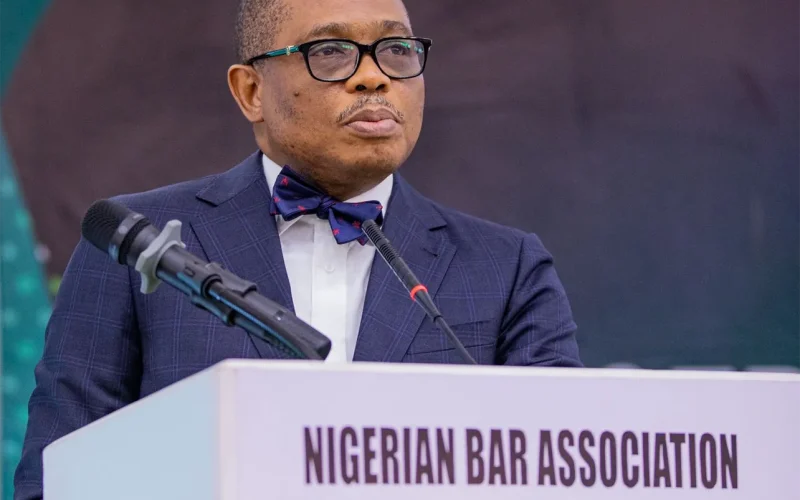
The Nigerian Bar Association (NBA), in a statement signed by its President, Mazi Afam Osigwe, SAN, and the Chairperson of the NBA Women Forum, Huwaila Muhammad, condemned what it described as “gender-based violence in its most primitive and shameful form,” calling on the Delta State Government, law enforcement, traditional rulers, and festival organisers to act with urgency and without excuses.
The statement arrived as police confirmed that the total number of suspects in custody had risen to 15 — including the chief organiser of the event, a community leader — following a second wave of arrests driven by video evidence that had by then circulated to every corner of Nigerian social media.
“A society reveals its true character in how it treats its women. Where women are chased, stripped, groped, violated, and publicly humiliated by mobs under the guise of celebration, what is on display is not culture. It is barbarity.”
Mazi Afam Osigwe, SAN — President, Nigerian Bar Association
WHAT HAPPENED IN OZORO
The violence erupted on Thursday, 19 March 2026, in Oramudu Quarters, Ozoro, during what is traditionally known as the Alue-Do festival — described by some community representatives as a fertility celebration associated with the Uruamudhu community, one of five that comprise Ozoro Kingdom in Isoko North Local Government Area.
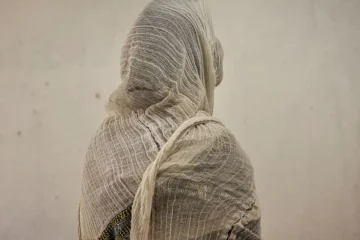
But this year, the festival became a scene of organised predation. Video footage — captured by bystanders and widely shared under the hashtag #StopRapingWomen — showed young women being dragged off motorcycles, stripped of their clothing, groped and chased through the streets in broad daylight. In one widely circulated clip, a young woman seated on a bike was pulled to the ground by a group of young men who tore at her dress. In another, a woman fled across open ground, her attackers pulling at her clothing as she struggled to cover herself. In a third, a victim attempted to shield herself from a mob pressing in around her.
Warning messages had reportedly been distributed through WhatsApp groups for students at Southern Delta University, Ozoro, advising female students not to step outside from noon on Thursday. Those unaware of the warnings — including women from outside the community — appear to have been among the primary targets.
The National Association of Nigerian Students (NANS), Zone B, described the incident as a gross violation of human rights and said its leadership, alongside the Student Union President of Southern Delta University, visited victims who were receiving treatment at a local hospital. Medical personnel who examined the students confirmed they had been molested; doctors reported no penetrative rape among those seen.
FIFTEEN IN CUSTODY; ARRESTS ONGOING
The Delta State Police Command moved on the same day the videos went viral. Commissioner of Police Aina Adesola ordered the immediate arrest and transfer to the State Criminal Investigation Department (SCID) of Chief Omorede Sunday — identified as both the head of Oramudu Quarter and the chief organiser of the event — along with four associates.
By Saturday morning, eleven additional suspects had been detained, bringing the total to 15. Named among the second group were Samson Atukpodo, Steven Ovie, Ugbevo Samson, Afoke Akporobaro, and Evidence Oguname, with six others yet to be publicly identified. Police spokesperson SP Bright Edafe confirmed the arrests were made following a “thorough analysis of available video evidence and intelligence,” and that the CP Special Assignment Team had been directed to lead the investigation.
In a statement that will complicate any defence rooted in cultural practice, Edafe said plainly: “Preliminary findings indicate the unfortunate incident was carried out by criminal elements who exploited the situation to commit acts of sexual violence, which are in no way representative of any legitimate cultural practice.”
“No tradition, no custom, no so-called cultural practice can excuse or legitimise the degradation and violation of women. Any practice that permits such cruelty is not culture. It is criminality.”
Nigerian Bar Association statement, 21 March 2026
THE NBA’S CONSTITUTIONAL AND MORAL INDICTMENT
The NBA statement was remarkable not merely for its tone, but for the precision of its legal framing. The association placed the acts squarely within Nigeria’s constitutional architecture, citing violations of “the fundamental rights to dignity of the human person, personal liberty, and security as guaranteed under the Constitution of the Federal Republic of Nigeria, 1999 (as amended), as well as other international human rights instruments.” It enumerated specific criminal offences engaged: assault, sexual violence, and public indecency.
The statement drew an unambiguous line between culture and criminality — rejecting the implicit and, in some quarters, explicit defence that what occurred was rooted in tradition: “Any practice that permits such cruelty is not culture. It is criminality.”
It widened the net of accountability to encompass those who watched without acting: “Those who aided, enabled, or failed to intervene must also be held accountable. Justice must not be delayed, and it must not be selective.”
And it directed its gaze not only at prosecutors and police, but at the custodians of tradition itself: “We further call on community leaders, traditional institutions, and festival organisers to take urgent responsibility. Cultural celebrations must never become theatres of violence. They must reflect dignity, order, and respect for human life — not chaos and cruelty.”
The statement closed with a moral ultimatum that functions, in context, as a test of national character: “Nigeria must not become a place where women live in fear of being stripped of both their clothing and their dignity in public spaces. This must never happen again.”
GOVERNMENT AND CIVIL SOCIETY RESPOND
The Federal Government’s response came swiftly from the Ministry of Women Affairs and Social Development, whose minister, Hajiya Imaan Sulaiman-Ibrahim, ordered the arrest and prosecution of all perpetrators. The ministry invoked the Violence Against Persons (Prohibition) Act, which explicitly criminalises the acts alleged, and committed to providing psychosocial care, medical attention, and legal assistance to victims. It also pledged intensified engagement with traditional leaders “to address harmful norms and prevent a recurrence.”
Delta State Commissioner Charles Aniagwu called the incidents “barbaric” and “totally unacceptable,” reaffirming his government’s zero-tolerance policy for gender-based violence: “There can be no culture in any part of Nigeria that permits the targeting or discrimination of women.”
A coalition of more than 500 women’s rights organisations under the aegis of Womanifesto described the attacks as “organised and institutionalised abuse” and called for immediate prosecution. “This is not our culture,” co-convener Abiola Akiyode-Afolabi said in a joint statement. “This is organised and institutionalised abuse, and it must be treated as a crime.”
On X, the anger of ordinary Nigerians was direct and unambiguous. “Some cultures need to die,” wrote one user. “If your culture tells you that there are days meant to rape and molest women, then that culture must die.” Another asked bitterly: “What is the Delta State government even doing about this? How long has this been going on in Ozoro?”
THE MONARCH SPEAKS; THE ‘TRADITION’ UNRAVELS
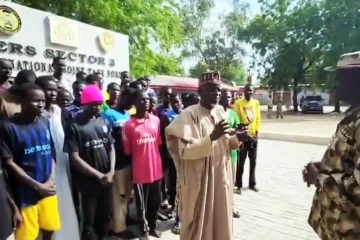
Perhaps the most significant repudiation of any cultural defence came from within the community itself. The Ovie of Ozoro Kingdom, His Royal Majesty Anthony Ogbogbo, convened a gathering at his palace and stated unequivocally that he had never, in more than twenty years as monarch, heard of any festival tradition in his domain involving the harassment, molestation, or assault of women.
“I have more than 200 videos and photographs of what transpired,” he told those assembled. “I have never heard that a festival is celebrated with girls being harassed, sexually molested or raped in my community.”
His testimony severs the argument at its root: what occurred in Ozoro was not the expression of an ancient ritual. It was the commission of crimes, executed under the cover of festivity, by individuals who will now face the law.
A NATION ON TRIAL
There is a pattern here that Nigerians — and Africans watching from beyond the country’s borders — have seen before. Gender-based violence erupts in a communal or public context. Videos spread. Outrage follows. Condemnations are issued. Then, too often, the perpetrators walk free, the survivors are quietly forgotten, and the conditions that enabled the violence remain structurally undisturbed.
This time, the institutional response has been unusually swift and multi-directional: the police have acted, the federal government has issued directives, the Bar Association has issued a constitutional indictment, civil society has mobilised, and the traditional ruler has spoken. The question Nigeria is now asking — and watching — is whether the courts will follow.
The NBA stated it plainly: “Silence, indifference, or excuses in the face of such brutality only embolden further abuse.”
Fifteen men are in custody. The law is watching. So is the country.
KEY FACTS AT A GLANCE
▸ Attacks occurred on 19 March 2026 during the Alue-Do festival in Oramudu Quarters, Ozoro, Isoko North LGA, Delta State.
▸ Viral videos showed women being dragged off motorcycles, forcibly stripped, groped and chased through the streets in broad daylight.
▸ WhatsApp warnings had circulated to Southern Delta University students: female students were told not to step outside from noon on Thursday.
▸ 15 suspects are in custody following two waves of arrests; the chief organiser and community head, Chief Omorede Sunday, was among the first detained.
▸ The NBA invoked the Nigerian Constitution (1999, as amended) and international human rights instruments in its formal condemnation.
▸ The Federal Government, Delta State Government, and a 500-organisation women’s coalition have all demanded prosecution.
▸ The Ovie of Ozoro Kingdom, HRM Anthony Ogbogbo, stated he had never known such practices in 20+ years as monarch.
▸ Medical assessment of student victims confirmed molestation; doctors reported no penetrative rape among those examined.