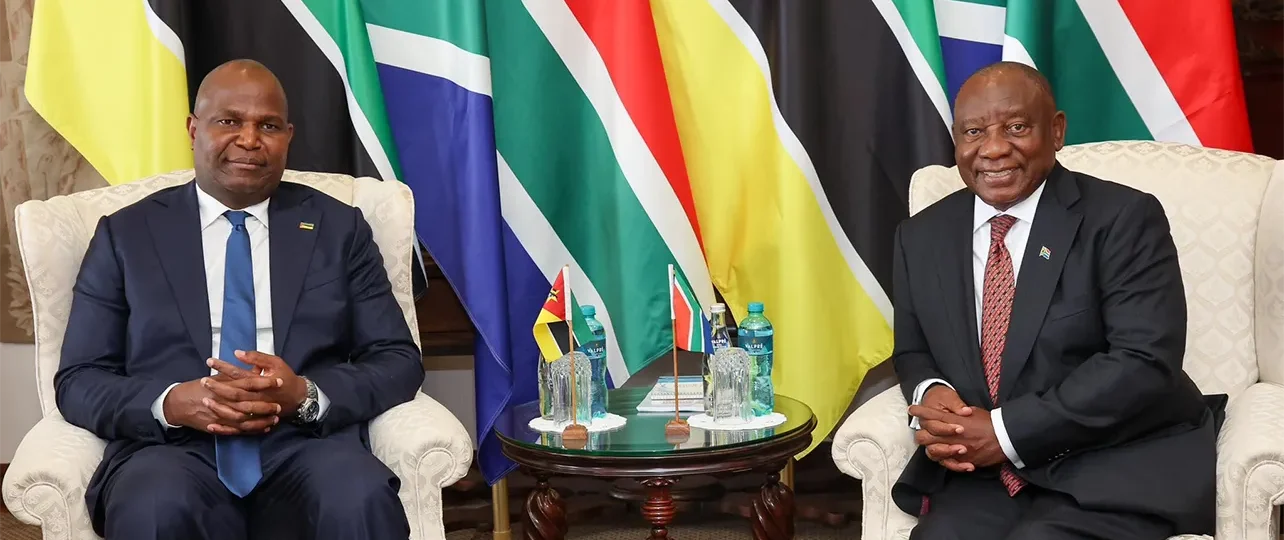

PRESIDENT Cyril Ramaphosa stood in the gardens of Mahlamba Ndlopfu and delivered what amounted to a plea to the continent: judge South Africa not by the mobs in its streets, but by the soul of its liberation history. Flanking him was Mozambican President Daniel Francisco Chapo, whose very presence in Pretoria illustrated precisely how badly the crisis has escalated.
The working visit between Ramaphosa and Chapo was billed as bilateral business: trade, investment, and economic integration. But no amount of diplomatic framing could obscure the elephant in the room. South Africa is haemorrhaging goodwill across the continent at an alarming rate, as nation after nation – Nigeria, Ghana, Mozambique – formally summons Pretoria’s envoys or dispatches their own presidents to demand answers.
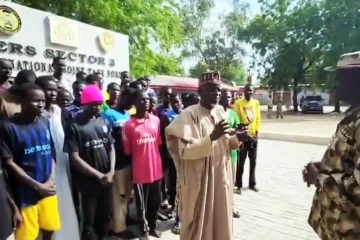
The statistics are grim. At least two Nigerian nationals are confirmed dead – one, Nnaemeka Matthew Andrew, found at Pretoria Central Mortuary on 20 April following an alleged encounter with Tshwane Metro Police. Four Ethiopians have also been killed. Nigeria’s Foreign Minister Bianca Odumegwu-Ojukwu announced evacuation flights for at least 130 Nigerian nationals who chose flight over continued exposure to violence, and warned: ‘This figure is expected to rise. Nigerian lives and businesses in South Africa must not continue to be put at risk.’
“South Africans inherently are not against people from other nations. We are one people. We have always been one people.”
It is against this backdrop that Ramaphosa’s remarks must be read – not as the serene assurances of a leader in command, but as the damage-limitation manoeuvres of a presidency caught between its constitutional obligations, its electoral base, and its continental reputation.
The President’s core message was threefold. First, that South Africans are not fundamentally xenophobic and carry a debt of solidarity to the African nations that sheltered the ANC during the apartheid years. Second, that the law on employment of undocumented migrants exists and will be enforced – a signal to the domestic audience demanding visible action. Third, that the solution is regional and cannot be imposed by any one country alone. ‘We must all work together, join hands, to find solutions to this problem,’ Ramaphosa said. ‘And in the past, we have found solutions.’
The position being advanced by South African officialdom – and by ordinary citizens who have been quick to mobilise on social media – is a careful one: we are not against immigrants, only against illegal immigrants who commit crimes. Ramaphosa himself gave explicit legislative backing to this framing, reminding employers that a law has been passed prohibiting the employment of persons without the requisite work permits, and calling on all foreign nationals to ensure they hold proper documentation.
For South Africa’s critics on the continent, this distinction is a fig leaf. Ghana’s Foreign Minister Samuel Okudzeto Ablakwa, in summoning the South African acting High Commissioner Thando Dalamba, recalled Ghana’s own anti-apartheid solidarity and warned that attacks on ‘law-abiding individuals’ violate the very Pan-African compact South Africa routinely invokes. The viral footage that triggered Ghana’s formal protest showed a Ghanaian national – documented or not – being publicly humiliated and ordered to ‘fix his country’ rather than live in South Africa. There was no legal procedure at that moment, only contempt.
Nigeria’s Senate went further, passing a resolution titled ‘Intensifying Xenophobic Persecution of Nigerians in South Africa’ and calling for urgent diplomatic and humanitarian action. Senators were explicit: they were not only dealing with physical attacks but ‘a growing pattern of profiling and dehumanisation’. That word – dehumanisation – matters. It is the language of process, not of isolated incidents.
Ramaphosa’s conditional framing – condemning violence while simultaneously underscoring the documentation requirement – did not fully satisfy either constituency. Nigeria and Ghana were reportedly not satisfied precisely because the President balanced his condemnation of attacks with a reminder about illegal immigration. The domestic anti-immigration movement, meanwhile, remains galvanised, with groups including March & March and ActionSA having staged demonstrations in Johannesburg, Durban, Pretoria, and the Eastern Cape, in some cases leading to the looting and torching of foreign-owned businesses.
ECONOMIC STAKES AND BORDER WARNINGS
The meeting with Chapo carried a pointed economic subtext. Mozambique is not a passive party in South Africa’s supply chain. The Lebombo corridor handles approximately 1 500 heavy-goods vehicles per day. Maputo’s port is a critical export node for South Africa’s chrome, coal, and magnetite sectors. A blockade – even a temporary one – would be commercially painful.
South Africa’s Cross-Border Road Transport Agency had already warned on Monday that Mozambican nationals were planning to blockade the Ressano Garcia and Ponta de Ouro border posts on 4 May as retaliation. SAPS intelligence confirmed the threat. It did not materialise at full scale, but the warning itself changed the diplomatic temperature of Tuesday’s meeting. Chapo arrived not merely as a neighbour, but as the representative of a country whose citizens are being attacked and whose economic leverage is real.
The bilateral communiqué that emerged struck a cooperative tone, but the harder question – what concrete enforcement mechanisms will follow – was left to ministerial talks. South Africa’s Minister of Trade, Industry, and Competition, Parks Tau, welcomed Chapo on behalf of the government, and discussions were confirmed to span economy, security, and social issues. A joint commitment to cooperation was reaffirmed. But commitments and communiqués have been the currency of every previous cycle of xenophobic violence, and they have not broken the pattern.
South Africa cannot be both the headquarters of the African Union’s economic integration agenda and the country from which African nationals flee on evacuation flights. The distance between those two realities is the measure of the crisis that President Ramaphosa, standing beside President Chapo in Pretoria’s autumn sunshine, has yet to close.