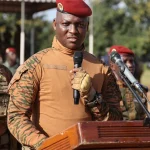
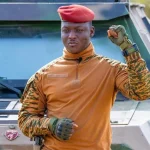
WELL, well, well. Who could have possibly seen this coming? Captain Ibrahim Traore – the social media-savvy saviour who swept into power in September 2022, promising to rescue Burkina Faso from the clutches of a government “not acting in the interest of the people”, has finally decided to drop the charade. And what a performance it’s been.
For those keeping score at home, Traore’s latest move is dissolving all political parties in Burkina Faso. Yes, you read that correctly. All of them. Over 100 political parties – poof! – gone with a stroke of a ministerial pen. Their crime? According to Interior Minister Emile Zerbo, they were guilty of the heinous offence of “fuelling divisions and weakening social cohesion.” Because nothing says “social cohesion” quite like a military dictator eliminating every voice that isn’t his own.
The leopard, it seems, is finally showing his spots.
Give credit where it’s due: Traore’s social media game has been a chef’s kiss. A masterclass in digital propaganda, really. Slick posts in both French and English showcase gleaming new highways, hospitals sprouting from the ground, and a narrative of economic revolution that would make any PR firm weep with envy. The world was meant to believe that Burkina Faso had found its transformational leader – a man of the people, by the people, for the people.
Meanwhile, on the ground? A rather different story was unfolding, though you’d be hard-pressed to hear about it from within Burkina Faso’s increasingly shrinking information space.
WHEN JOURNALISM BECOMES AN EXTREME SPORT
Here’s where the plot thickens – or rather, where the façade cracks. Those pesky journalists who insisted on doing their jobs (you know, reporting facts, asking uncomfortable questions, that sort of nuisance) found themselves with three delightful career options:
- Flee into exile (the popular choice among those who valued both their freedom and their lives)
- Become state parrots (repeat after me: “Everything is wonderful, the Captain is brilliant, infrastructure is booming”)
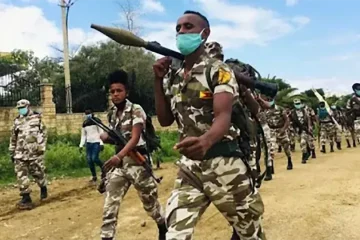
- Get conscripted into the military (nothing says “free press” like forcing journalists to pick up rifles)
It’s almost impressive, in a deeply dystopian way. Why bother with messy censorship laws when you can simply eliminate dissenting voices through forced military service? Innovation!
Remember when Traore was supposedly leading Burkina Faso back to democracy? Ah, those were the days – what, two years ago? The suspension of political activities after the coup was just temporary, we were assured. A necessary pause while the good Captain cleaned house and prepared for a glorious democratic rebirth.
Instead, what we’ve got is the complete dissolution of the country’s entire political framework. The law governing party financing? Repealed. The status of opposition leaders? Abolished. The assets of all dissolved parties? Confiscated by the state, naturally.
It’s “rebuilding the state,” according to Minister Zerbo. Which is technically true, if by “rebuilding” you mean “constructing a one-man authoritarian regime from the rubble of a multiparty democracy.”
Perhaps we should have read the tea leaves when Traore started cosying up to his fellow military rulers in Mali (Assimi Goita) and Niger (Abdourahamane Tiani), forming their charming little Alliance of Sahel States. Nothing screams “commitment to democracy” quite like a boys’ club of coup leaders.
Here’s the thing about leopards: they can’t change their spots, and eventually, they stop pretending to try. Traore came in with the rhetoric of liberation, wrapped himself in the language of popular revolution, and promised to be different from all those other dictators.
But dictators, much like leopards, are remarkably consistent creatures. They consolidate power. They silence dissent. They eliminate opposition – sometimes literally, but often through the more “civilised” method of simply making opposition illegal. They control the narrative with propaganda while the reality on the ground tells a darker tale.
Traore’s spots are showing, and they reveal exactly what critics suspected all along: just another predator in revolutionary’s clothing, just another autocrat who believed his own press releases a bit too much.
The real tragedy here isn’t just that Traore has revealed himself to be yet another in a long line of military strongmen more interested in power than people. It’s that Burkina Faso, along with much of the Sahel region, faces genuine crises – Islamist insurgencies, displacement, poverty, and instability. These nations desperately need competent, accountable governance.
Instead, they get Instagram-friendly authoritarianism: all the oppression of classic dictatorship, now with better graphics and a hashtag strategy.
So here we are. The social media posts will continue, no doubt, showcasing phantom highways and imaginary hospitals. The world will be told that everything is going swimmingly. And in Burkina Faso, where there are no political parties to contest elections, no journalists to report the truth, and no freedoms to speak of – literally – Captain Traore will keep insisting he’s different.
But a leopard doesn’t become a lamb just because it tweets about it.
The spots, Captain, were always there. We’re just finally being allowed to see them.