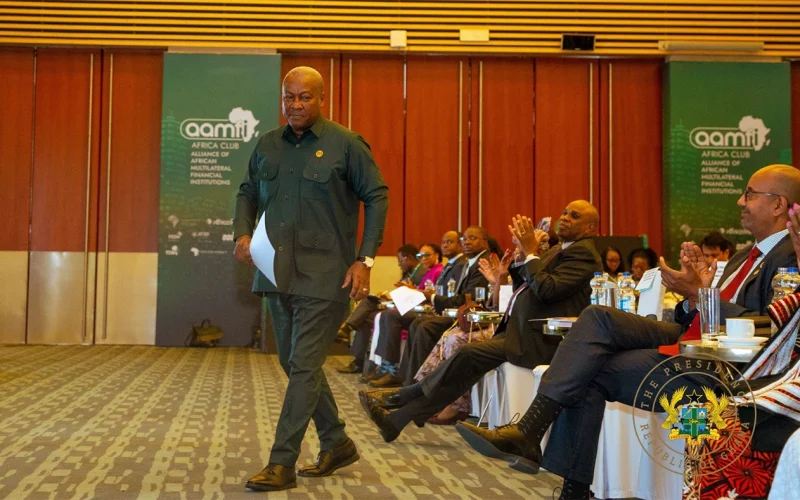
In a powerful call to action at the African Union Summit, President John Dramani Mahama challenged African nations to revolutionise their approach to economic development by strengthening domestic resource mobilization and reducing reliance on external funding.
Speaking at the “Heads of State and Government Breakfast Dialogue,” Mahama, who serves as the African Union’s Champion for Financial Institutions, painted a picture of both promise and urgency for the continent’s economic future. While forecasting encouraging growth rates of 3.7% in 2024 and 4.03% in 2025, he confronted head-on the stark reality of a $402 billion annual financing gap that threatens to undermine Africa’s development goals through 2030.
“This gap is more than just a figure,” Mahama declared, “it signifies the unrealised aspirations of countless Africans whose hopes for a better future hinge on our capacity to invest wisely in crucial areas like infrastructure, education, technology, and health.”
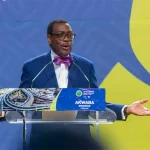
The high-profile dialogue, organized in partnership with the Alliance of African Multilateral Financing Institutions (AAMFI), drew influential leaders including WTO Director General Dr. Ngozi Okonjo-Iweala and AAMFI Chairperson Professor Benedict Oramah. The gathering focused on mobilizing African investment for implementing Agenda 2063, the continent’s ambitious development blueprint.
Mahama’s analysis cut through surface-level optimism, acknowledging that despite positive growth trends, many African economies remain trapped in low-productivity sectors, with economic expansion failing to translate into improved living standards for citizens. His proposed solution is comprehensive: strengthening tax administration, combating illicit financial flows, and establishing crucial financial institutions including an African Central Bank, Investment Bank, and Pan African Stock Exchange.
WTO chief Okonjo-Iweala reinforced Mahama’s message with a practical warning against excessive borrowing, advocating instead for innovative investment strategies. “We need to capitalise on investments flowing into Africa and ensure their sustainability for our development,” she emphasised, suggesting new approaches such as leveraging pension funds for long-term capital generation and adding value to natural resources.
The vision presented at the dialogue was clear: a unified, prosperous Africa powered by its own financial strength rather than external support. As climate challenges, geopolitical tensions, and potential health crises loom, the urgency of this transformation becomes even more apparent. The message from Africa’s leadership is unequivocal – the time for financial self-reliance is now.