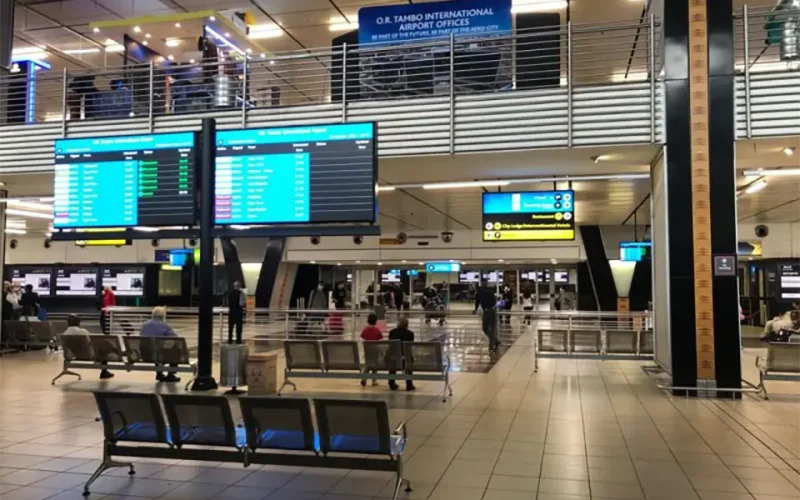
A passenger walked through OR Tambo International Airport’s security checkpoints carrying two training hand grenades in their luggage, exposing catastrophic failures in South Africa’s premier aviation gateway that only came to light when Ethiopian authorities discovered the explosives upon arrival in Addis Ababa.
The unprecedented security breach at Africa’s busiest airport has triggered a R2 million fine, multiple suspensions, and the termination of a decades-old screening contract, marking one of the most serious lapses in the continent’s aviation security history.
Despite advanced scanning technology deployed throughout OR Tambo, the grenades passed through baggage screening systems without detection due to what investigators have confirmed was human error by security personnel. The training devices – harmless but identical in appearance to live explosives – were only identified by Ethiopian authorities at Bole International Airport, widely regarded for its stringent security protocols.
Aviation Coordination Services (ACS), the third-party contractor responsible for Hold Baggage Screening operations, has accepted responsibility for the failure and initiated disciplinary action against the employee involved. The company had been operating the screening area for nearly two decades without a formal government contract, creating what officials now acknowledge were dangerous accountability gaps.
Institutional Fallout
The Airports Company of South Africa (ACSA) responded swiftly to the crisis, announcing the immediate termination of ACS’s services and plans to insource all baggage screening operations. Mzwandile Petros, ACSA’s general manager for security, was placed on precautionary leave as investigations continue.
“This was an isolated lapse attributed to a failure of security personnel to detect the grenades effectively,” ACSA stated, while acknowledging the broader systemic weaknesses exposed by the incident.
The South African Civil Aviation Authority imposed the R2 million penalty, underscoring the severity of a breach that could have had catastrophic consequences had the devices been genuine explosives with malicious intent.
ACSA has announced comprehensive reforms, including:
- Implementation of an Integrated Security Management System linking all individual security platforms
- Enhanced surveillance in critical areas with intensified staff training
- Collaboration with multiple agencies including the Border Management Agency, State Security Agency, and South African Police Service
- Direct insourcing of screening operations to eliminate third-party accountability gaps
The incident has reignited long-standing questions about contract compliance and oversight at South Africa’s key international airports, particularly regarding ACS’s two-decade operation without proper government tender procedures.
As the continent’s primary aviation hub handling millions of passengers annually, OR Tambo’s security failure has implications extending far beyond South Africa’s borders. The breach exposes vulnerabilities that could undermine passenger confidence in African aviation security and raises concerns about potential exploitation by individuals with malicious intent.
“The failure was not due to scanner malfunction but rather a breakdown in operational procedures and human oversight,” according to the investigation findings, highlighting that even sophisticated technology cannot compensate for human error and inadequate supervision.
The incident serves as a stark reminder that critical infrastructure security depends not only on advanced technology but on rigorous training, proper oversight, and accountable management systems – elements that failed catastrophically in this case.
ACSA’s commitment to comprehensive reforms and direct operational control represents an acknowledgement that the continent’s busiest airport cannot afford such lapses in an era of heightened global security threats.