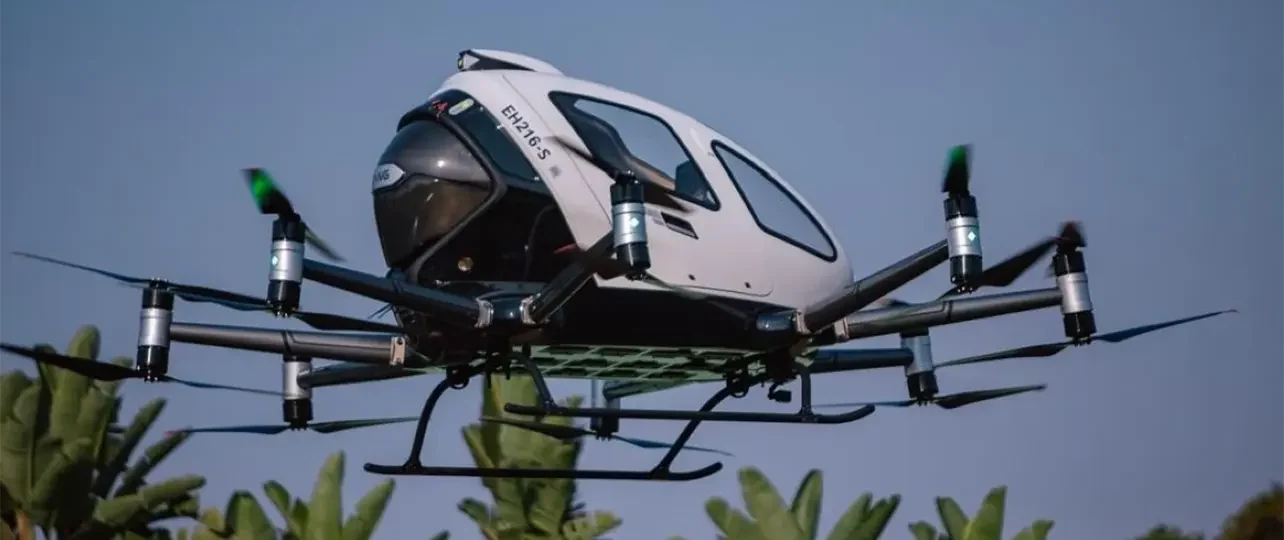

IN a moment that will be etched in African aviation history, Rwanda became the first nation on the continent to successfully launch a self-flying electric air taxi, marking a transformative leap into the future of urban mobility during the Aviation Africa 2025 Summit on September 4.
The sleek, white EHang EH216-S electric vertical takeoff and landing (eVTOL) aircraft rose silently into Kigali’s azure sky, carrying with it the hopes and ambitions of a continent ready to embrace cutting-edge technology. This wasn’t just a flight—it was a declaration that Africa is soaring into the future of sustainable transportation.
Breaking Barriers, Setting Standards
The Chinese-developed aircraft, operating in partnership with China Road and Bridge Corporation (CRBC) and the Government of Rwanda, represents far more than technological innovation. It embodies Rwanda’s unwavering commitment to positioning itself as Africa’s digital pioneer, following its groundbreaking success with drone delivery services that revolutionised healthcare access across the nation.
“If Dubai can become what it is today from a desert, Rwanda also has what it takes to be the digital city of the century,” declared President Paul Kagame, his words resonating with the confidence of a leader who has consistently transformed vision into reality.
The fully autonomous aircraft, designed to carry two passengers at speeds up to 130 km/h with a 35-kilometre range, operates with remarkable efficiency. A 25-minute charge powers a 30-kilometre journey, while the complete charging cycle takes just 90 minutes through EHang’s proprietary electric portal—a testament to the practical viability of electric aviation.
Engineering Excellence Meets African Ambition
Safety stands paramount in this aerial revolution. Tom Peng, project manager for the Rwanda deployment, emphasised the aircraft’s redundant safety systems featuring 16 electric propellers designed to maintain flight capability even if half fail. Emergency protocols include automatic returns to departure points and designated emergency landing zones, ensuring passenger safety remains uncompromised.
The economics are equally compelling. At approximately $410,000 per aircraft (roughly Rwf600 million), the EH216-S positions itself as a viable alternative to traditional helicopter services, with operational costs expected to make urban air mobility accessible to a broader market segment.
Minister of Infrastructure Jimmy Gasore underscored the strategic importance of this partnership: “Rwanda is committed to building a future where cities are more connected and the economy more dynamic through innovative transport solutions. Our partnership with CRBC provides the engineering foundation to support our vision for advanced air mobility.”
Beyond Transportation: A Vision Realised
This historic flight represents more than urban mobility—it’s the manifestation of Rwanda’s multi-modal approach to smart city development. The nation plans to complement its aerial innovation with a 5.5-kilometre cable car system, with construction beginning in 2026 for completion by 2028, creating an integrated, sustainable transport ecosystem.
EHang’s Chief Engineer Rucheng Lu sees Rwanda as the gateway for African expansion, envisioning applications spanning tourism, cargo transport, surveillance, firefighting, agriculture, and aerial entertainment. With over 300 EH216-S units delivered globally, more than 70,000 safe flights completed, and over 30,000 passengers transported, the technology arrives in Africa with proven reliability.
?? A Historic First: EHang Completes Africa’s First Pilotless Human-carrying eVTOL Flight
— EHang (@ehang) September 5, 2025
At the 9th Aviation Africa Summit in Kigali, Rwanda, EHang successfully completed Africa’s first pilotless, human-carrying eVTOL flight with the EH216-S, in partnership with CRBC.
?? The… pic.twitter.com/I1SUebYwgV
Regulatory Readiness and Commercial Viability
While the technology demonstrates readiness, success hinges on regulatory framework development by Rwanda’s Civil Aviation Authority and strategic operational partnerships. Full commercial deployment is projected within three to six months, depending on regulatory approval and partnership establishment.
The implications extend far beyond Rwanda’s borders. As other African nations grapple with urban congestion and infrastructure challenges, Rwanda’s pioneering approach offers a blueprint for sustainable, technologically advanced solutions that leapfrog traditional transportation limitations.
A Continental Challenge Issued
This landmark achievement positions Rwanda as the continental hub for advanced air mobility technology, attracting international investors and technology partners eager to participate in Africa’s emerging urban aviation market. The demonstration flight provides regulators, industry stakeholders, and the public with tangible proof of concept, paving the way for broader continental adoption.
Rwanda’s breakthrough arrives amid global competition in urban air mobility development, but its African-first achievement sends an unmistakable message: the continent is not merely adopting technology—it’s leading innovation.
The historic flight over Kigali represents more than technological advancement; it embodies African ingenuity, ambition, and readiness to embrace the future. As the EH216-S touched down after its maiden demonstration flight, it left behind a transformed landscape—not just for Rwanda, but for the entire continent.
The question now reverberates across Africa’s capitals: Who will be next to follow Rwanda into the skies of tomorrow?
As Rwanda continues its remarkable transformation from a nation rebuilding itself to a continental technology leader, this latest achievement reinforces its position as a beacon of African innovation and sustainable development. The sky, quite literally, is no longer the limit.