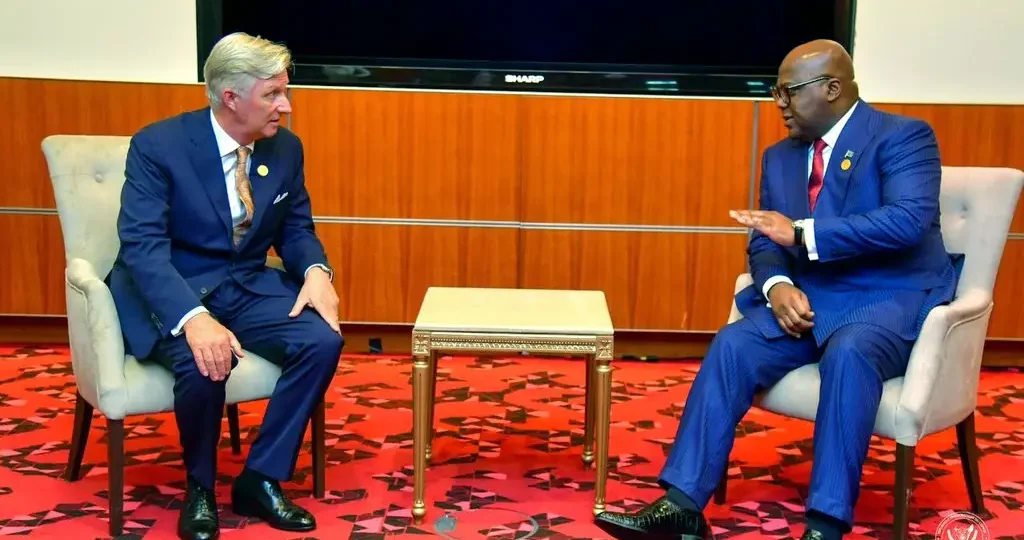

IN a significant diplomatic meeting on the margins of the World Summit for Social Development, King Philippe of Belgium has pledged his personal support and mobilised Belgian resources behind the Democratic Republic of Congo (DRC)’s transformative Kivu-Kinshasa Green Corridor project, potentially marking a new chapter in the former colonial power’s relationship with the vast Central African nation.
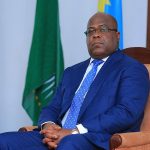
The Tuesday meeting between King Philippe and DRC President Félix Tshisekedi in Doha focused heavily on the ambitious infrastructure initiative, with the Belgian monarch introducing the country’s international cooperation agency Enabel and Belgian private sector players as potential partners in what officials describe as a project of “major importance for the universe.”
The Green Corridor Vision
Officially unveiled in January 2025 during President Tshisekedi’s participation at the World Economic Forum in Davos, Switzerland, the Kivu-Kinshasa Green Corridor represents one of Africa’s most ambitious sustainable infrastructure projects. The initiative aims to create a modern, environmentally-focused transportation and development link between the mineral-rich Kivu provinces in eastern DRC and the capital Kinshasa, approximately 1,500 kilometres to the west.
While specific technical details of the corridor’s design remain under development, the project is conceived as a comprehensive green infrastructure network that would address multiple challenges simultaneously: connectivity, economic development, and environmental protection in one of the world’s most ecologically significant regions.
Strategic Importance and Background
The corridor would traverse some of the DRC’s most challenging terrain, connecting the volatile but resource-wealthy eastern provinces—home to significant deposits of cobalt, coltan, and other critical minerals essential for green technology—with the political and commercial hub of Kinshasa and ultimately to Atlantic port access.
The eastern Kivu provinces, despite their mineral wealth, have long suffered from conflict, inadequate infrastructure, and isolation from national and international markets. This isolation has contributed to persistent instability and limited the region’s ability to convert natural resources into broad-based economic development.
The “green” designation signals the project’s commitment to sustainable development principles, likely incorporating renewable energy components, environmental safeguards, and climate-resilient design—a crucial consideration in a nation that contains the world’s second-largest rainforest and critical biodiversity reserves.
Projected Economic Impact
While the DRC government has not released detailed economic projections, infrastructure experts suggest a completed corridor could be transformative for the country’s economy:
Trade Facilitation: By dramatically reducing transportation costs and travel time between the mineral-producing east and export routes through Kinshasa, the corridor could unlock billions of dollars in mineral exports currently constrained by prohibitive logistics costs. Current transport times between Goma and Kinshasa can exceed two weeks by road when passable; a modern corridor could reduce this to days.
Regional Integration: The project would physically integrate regions that have historically been economically and administratively disconnected, potentially adding several percentage points to national GDP growth by enabling the free flow of goods, services, and people.
Value Addition: Improved connectivity could support the development of mineral processing facilities in eastern DRC, allowing the country to export refined products rather than raw materials—a long-standing government objective that could significantly increase export revenues.
Agricultural Development: The corridor would open vast agricultural areas to commercial farming by providing reliable market access, potentially transforming food security dynamics in both eastern DRC and Kinshasa.
Investment Climate: Successful delivery of such a megaproject would signal improved governance and project execution capacity, potentially catalysing broader foreign direct investment across sectors.
Conservatively, economists suggest the corridor could add $2-4 billion annually to the DRC’s GDP once fully operational, representing a meaningful boost to an economy currently valued at approximately $65 billion.
Job Creation Potential
The employment implications of the Kivu-Kinshasa Green Corridor extend across multiple phases and sectors:
Construction Phase: Infrastructure projects of this magnitude typically generate substantial direct employment. Based on comparable African infrastructure initiatives, the construction phase alone could create:
- 50,000-80,000 direct construction jobs over a 5-7 year build period
- An additional 150,000-200,000 indirect jobs in supporting industries, including cement production, steel fabrication, equipment rental, catering, and security services
Operational Phase: Once completed, the corridor would require permanent workforces for:
- Transportation and logistics operations
- Maintenance and infrastructure management
- Energy generation and distribution (if the project includes power generation components)
- Administrative and regulatory functions
This could translate to 15,000-25,000 permanent direct jobs.
Economic Multiplier Effects: The most significant employment impact would come from economic activities enabled by the corridor:
- Mining operations expansion (current mines operating more efficiently, new deposits becoming economically viable)
- Agricultural commercialisation (smallholder farmers transitioning to commercial production)
- Manufacturing and processing facilities (value-added industries)
- Service sector growth (hospitality, retail, and financial services along the corridor)
- Technology and innovation hubs in connected urban centres
These secondary and tertiary effects could generate 300,000-500,000 additional jobs over the first decade of operations, making it one of the largest employment initiatives in Central Africa.
Skills Development: The project presents opportunities for technical training and skills transfer, particularly if international partnerships include capacity-building components—a potential area where Belgian cooperation through Enabel could prove especially valuable.
Belgian Engagement: A Complicated History Reimagined
King Philippe’s enthusiastic support for the project carries particular historical resonance. Belgium’s colonial rule over the Congo (1908-1960) remains one of history’s most brutal episodes, and the relationship between the two nations has been marked by periodic tension and reconciliation efforts.
In recent years, Belgium has sought to rebuild the relationship on more equitable terms. King Philippe expressed “deepest regrets” for colonial-era violence during a 2022 visit to Kinshasa, though he stopped short of a formal apology. His personal engagement with the Green Corridor project suggests Belgium views partnership on major development initiatives as part of that reconstruction.
The introduction of Enabel—Belgium’s development agency with extensive experience in infrastructure, natural resource management, and institutional capacity building—alongside Belgian private sector actors, suggests a comprehensive support package combining concessional financing, technical expertise, and commercial investment.
For President Tshisekedi, securing such high-level international backing strengthens the project’s credibility with other potential partners and lenders. The emphasis on private sector participation reflects a pragmatic recognition that public finances alone cannot fund infrastructure of this scale.
Challenges and Path Forward
Despite the enthusiasm, formidable challenges remain. The DRC’s track record on megaproject delivery has been mixed, with corruption, capacity constraints, and political instability often derailing ambitious initiatives. The eastern provinces’ ongoing security challenges—with numerous armed groups operating in the region—pose both physical risks to construction and broader questions about governance and stability.
Environmental concerns will require careful management. While billed as a “green” corridor, any major infrastructure project through rainforest and biodiverse regions carries ecological risks that will demand rigorous impact assessment and mitigation.
Financing remains perhaps the most immediate challenge. Projects of this nature typically require $5-10 billion in investment—a sum requiring coordination among multilateral development banks, bilateral partners, private equity, and commercial lenders. The Belgian commitment, while important diplomatically, would need to be matched by substantially larger financial commitments from China, the EU, the World Bank, and private infrastructure funds.
President Tshisekedi’s emphasis on an “open-minded approach” to partnerships suggests a pragmatic willingness to engage various international actors, potentially including Chinese contractors who have dominated African megaproject construction in recent decades, European financing, and American critical minerals interests.
A Test Case for New Development Paradigms
If realised, the Kivu-Kinshasa Green Corridor could represent a new model for African infrastructure development—combining environmental sustainability, economic transformation, and international partnership in ways that benefit local populations while addressing global priorities like supply chain resilience for green technology minerals.
The project’s success or failure will likely influence how the international community engages with infrastructure development across Africa’s resource-rich but infrastructure-poor regions, making the Belgian King’s support more than just a bilateral matter—it’s a statement about how developed nations might productively engage with African development in the post-colonial era.
As President Tshisekedi noted in Doha, the positive impact could extend to “all of humanity”—a bold claim that reflects both the project’s ambitious scope and the high stakes riding on its successful implementation.