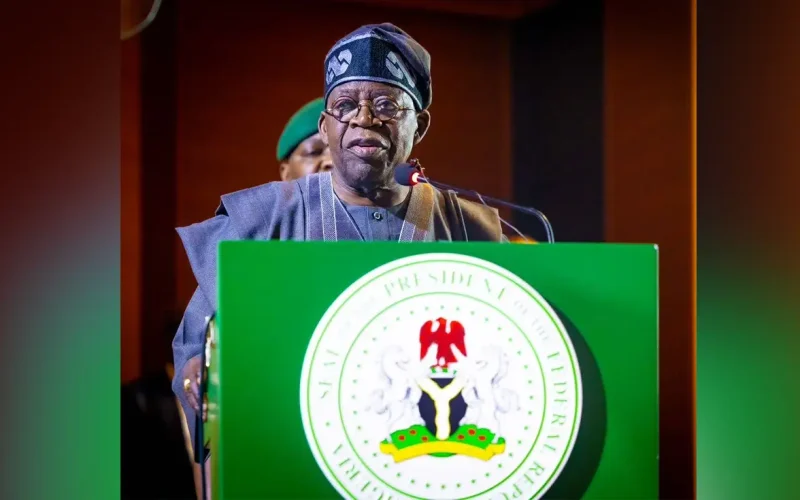
IN a moment of unflinching candour that resonated through the Andrews Otutu Obaseki Auditorium, Nigerian President Bola Ahmed Tinubu delivered what many are calling the most direct challenge to judicial integrity in recent memory.
“Justice must never be for sale, and the Bench must never become a sanctuary for compromise,” the President declared, his words cutting through the assembled gathering of Nigeria’s most powerful judges. “Corruption in any arm of government weakens the nation, but corruption in the Judiciary destroys it at its core. When justice is compromised, governance loses its integrity, and democracy loses its foundation.”
The occasion was the 2025 All Nigerian Judges’ Conference of the Superior Courts, but the message transcended the ceremony. This was not diplomatic protocol – it was a reckoning.
Standing before the men and women who hold the balance of justice in their hands, President Tinubu painted a stark picture of what hangs in the balance. The Judiciary, he reminded them, is not merely an institution of government. It is the living conscience of the Republic, the final refuge of citizens when all other doors close.
“A judgment may be grounded in law and delivered with clarity,” he explained, “but unless the public perceives it to be fair, impartial, and untainted, its moral authority is diminished.”
The President acknowledged what many Nigerians whisper in frustration: delays that stretch for years, questions about integrity that erode trust, barriers to justice that leave the poor and vulnerable without recourse. These perceptions, he insisted, cannot be dismissed or ignored. They demand action.
Tinubu’s address walked a careful line between support and accountability. He pledged tangible reforms: modernised infrastructure, digitised court processes, enhanced judicial welfare, and sustained investment in the National Judicial Institute. Courts, he declared, must no longer be places where cases languish – they must become “beacons of efficiency” where justice moves swiftly and transparently.
But material support came with a moral imperative. Technology and infrastructure mean nothing, the President warned, if integrity is compromised.
“No amount of reform can succeed if integrity is compromised,” he stated with unmistakable gravity. His administration, he made clear, stands ready to support every effort to eliminate misconduct from the Bench. Discipline must be “firm, transparent, and consistent.”
The message was unambiguous: the Judiciary must cleanse itself, or it cannot claim the moral authority to cleanse society.
Questions That Demand Answers
As the conference delegates prepared for days of deliberation, President Tinubu challenged them to move beyond diagnosis to action. He posed the difficult questions that every Nigerian asks:
How do we reduce the backlog of cases that deny timely justice?
How do we strengthen discipline within judicial ranks?
How do we make justice accessible to the poor, the weak, the voiceless?
And most fundamentally: How do we build a Judiciary that truly remains “the last hope of the common man”?
Guardians of the Republic
In his closing words, President Tinubu elevated the assembled judges beyond their technical role as interpreters of law. They are, he declared, “guardians of Nigeria’s moral conscience and architects of her democratic destiny.”
“You hold in your hands the power to shape the moral compass of our Republic,” he told them, “to ensure that no citizen is too weak to be heard and no authority too powerful to be restrained by law.”
The story of Nigeria’s democracy, he reminded them, is still being written. Each fair judgment strengthens the Republic. Each courageous ruling preserves its soul.
The chapters written in this era, he urged, must be remembered “for integrity, courage, and fidelity to the rule of law.”
As the conference opened under the weight of these words, one thing became clear: the President has placed the question of judicial integrity at the centre of Nigeria’s democratic project. The promise of support is real. But so is the expectation of accountability.
For a nation long frustrated by delays and doubts about judicial independence, President Tinubu’s address offered both hope and challenge. The infrastructure will come. The resources will flow. But the true measure of this moment will be whether Nigeria’s judges answer the call to become what their Constitution demands and their country desperately needs: fearless guardians of justice, uncompromised and uncompromising.
The common man is watching. History is watching. And in the halls of Nigeria’s courts, the work of restoration begins now.