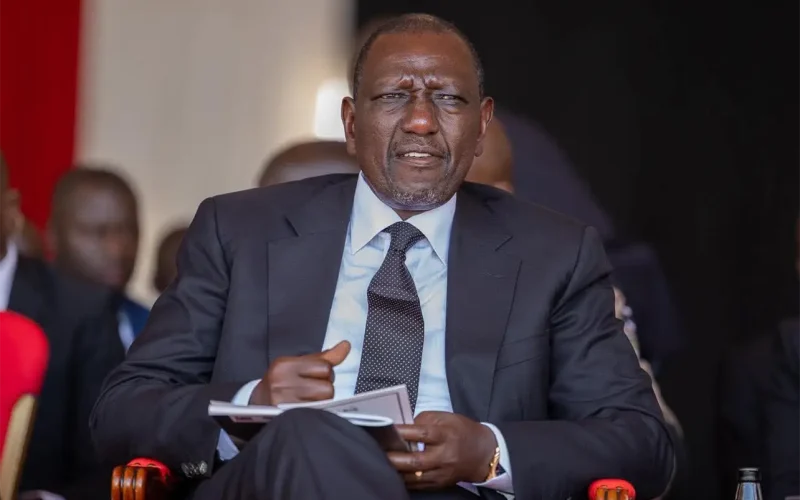
PRESIDENT William Ruto is facing mounting criticism after a New York Times investigation revealed his government ignored years of sexual abuse allegations against a senior diplomat responsible for protecting vulnerable Kenyan workers in Saudi Arabia.
Robinson Juma Twanga, who served as labour attaché at the Kenyan embassy in Riyadh, allegedly demanded sex and money from women seeking help, according to the investigation published this week. Some women reported that Twanga pressured them into sex work to raise funds for plane tickets home.
The revelations pose a significant challenge for Ruto, whose economic strategy depends heavily on labour migration. Diaspora remittances reached a record $4.2 billion in 2022, surpassing the $1.2 billion generated from tea, Kenya’s top export.
Twanga’s position gave him enormous influence over hundreds of thousands of Kenyan migrant workers, mostly women, employed in the Middle Eastern kingdom. Yet despite multiple complaints dating back to 2019, Kenyan authorities took no disciplinary action.
A senior U.N. official said Kenyan labour officials acknowledged receiving reports of sex abuse by Twanga at a December 2019 meeting, but simply urged overseas diplomats to monitor him rather than removing him from his post.
Francis Atwoli, head of Kenya’s Central Organisation of Trade Unions, said numerous women had reported that Twanga solicited sex by 2020. Atwoli relayed these complaints to senior government officials, including the labour secretary at the time. He even mentioned the abuse at a 2021 news conference, though he did not name Twanga publicly until recently.
The backdrop to the scandal is grim. At least 274 Kenyan workers, nearly all women, have died in Saudi Arabia over the past five years. Autopsy reports frequently reveal broken bones, burns and extreme emaciation, yet death certificates almost always list natural causes.

Women interviewed by The Times described horrific abuse by their Saudi employers—rape, beatings, starvation—only to face further exploitation when they sought help from their own embassy.
Selestine Kemoli told The Times she fled to the Kenyan embassy in 2020 after her employer slashed her with a knife, raped her and forced her to drink urine. She recalls Twanga asking if she expected a red carpet at the embassy, then telling her to consider sex work if she was unhappy with her job.
Kenyan officials have offered conflicting responses. Roseline Kathure Njogu, a senior foreign ministry official, said that no formal complaint had been filed, despite the documented accounts. She described the alleged conduct as unconscionable and criminal.
Current Labour Secretary Alfred Mutua told The Times that Twanga retired under the previous administration and that the recent revelations prompted an investigation that could lead to criminal charges. But the Ruto administration has delayed releasing records about Twanga, despite directives from a government watchdog.
The scandal has drawn rare criticism from within Ruto’s governing coalition. The National Assembly summoned the foreign secretary, who defended the labour program. Senator Faki Mohamed Mwinyihaji accused the government of treating citizens like livestock, valued only for the money they send home.
The investigation also revealed broader systemic failures. Ruto’s family and political allies profit from the foreign-staffing industry, while his government has rolled back protections and made it cheaper to send workers abroad.
Kenya has secured far weaker protections than other labour-sending countries, with Filipino domestic workers in Saudi Arabia earning roughly 67 percent more and accessing embassy-run safe houses. Kenya has not pushed for a higher minimum wage in seven years and recently slashed mandatory pre-departure training from weeks to days.
Twanga declined to comment when contacted by The Times. Francis Wahome, a lobbyist for Kenya’s staffing industry, acknowledged that several women had complained about Twanga but claimed he believed the sex was consensual.
For the hundreds of thousands of Kenyan women working in Gulf nations, the scandal underscores a harsh reality: the institutions meant to protect them may instead be exploiting their vulnerability for profit.