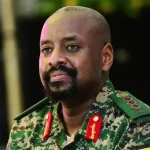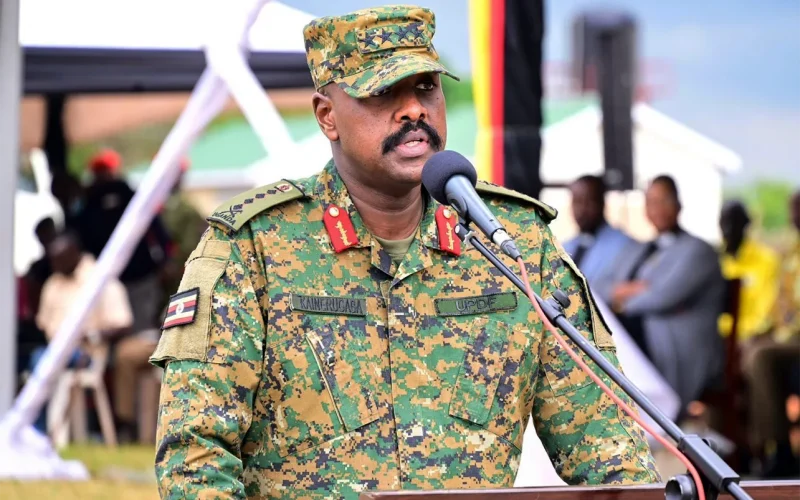
IN any functioning constitutional democracy, when a military officer publicly threatens to eliminate a political party and its leaders, the response would be immediate: investigation, suspension from duty, and criminal prosecution. When that officer is also the son of the sitting president and has previously confessed to torture and made death threats against opposition figures, the alarm bells should be deafening.
Yet in Uganda, General Muhoozi Kainerugaba operates in a sphere of absolute impunity that exposes the hollow nature of the country’s constitutional framework.
A Pattern of Documented Criminal Behaviour
Kainerugaba’s latest declaration that the National Unity Platform (NUP) will be “removed and extinguished from our land like a bad dream” is not an isolated outburst. It represents the continuation of a documented pattern of behaviour that, in any system governed by the rule of law, would have resulted in criminal prosecution years ago.
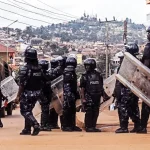
The general has publicly admitted to holding opposition activist Eddie Mutwe “in my basement” and subjecting him to torture. He has issued explicit death threats against opposition leader Robert Kyagulanyi, known as Bobi Wine, including a promise to behead him. During the 2021 electoral period, security forces under the chain of command he influences killed at least 54 protesters, according to human rights documentation.
Each of these acts constitutes serious criminal violations under both Ugandan law and international human rights standards. Torture is prohibited under the Ugandan Constitution and the country’s ratification of the Convention Against Torture. Threatening violence against political opponents violates multiple provisions of Uganda’s Penal Code. Extrajudicial killings represent the most severe form of state violence.
In a constitutional democracy, confession to such crimes would trigger automatic criminal investigation and prosecution. The fact that Kainerugaba not only remains free but continues to serve as Chief of Defence Forces of the Uganda People’s Defence Force reveals the extent to which Uganda’s legal institutions have been subordinated to executive power.
The Constitutional Fiction
Uganda’s 1995 Constitution contains explicit protections against the very behaviour Kainerugaba embodies. Article 24 prohibits torture and cruel, inhuman, or degrading treatment. Article 29 guarantees freedom of conscience, expression, assembly, and association. Article 43 ensures protection of the law and due process.
These provisions exist on paper. In practice, they offer no protection when the perpetrator is the president’s son and the nation’s top military commander.
The constitutional requirement for an independent judiciary, enshrined in Article 128, becomes meaningless when no court dares to issue an arrest warrant for the country’s military chief. The separation of powers doctrine collapses when the executive branch includes both the president and his son commanding the armed forces.
Kainerugaba’s invocation of divine authority, declaring himself “a prophet of Almighty God” while promising to eliminate a political party, represents a troubling fusion of religious messianism, military power, and dynastic succession. This combination has historically preceded some of the darkest periods in African governance.
The Target Responds
Bobi Wine’s response to these threats has been measured but clear, highlighting the authoritarian reality beneath Uganda’s democratic facade. As someone who has survived assassination attempts, endured beatings by security forces, and watched his supporters killed in the streets, Wine understands that Kainerugaba’s threats are not rhetorical flourishes but statements of intent backed by lethal force.
The National Unity Platform leader has consistently called for adherence to constitutional processes and the rule of law, even as those principles are systematically violated by the very institutions meant to uphold them. This places opposition figures in an impossible position: they are expected to respect legal boundaries while facing adversaries who operate entirely outside them.
Impunity as State Policy
What makes Kainerugaba’s behaviour particularly significant is not merely its brazenness but its function within Uganda’s political system. His threats serve as a form of state terrorism, designed to intimidate opposition supporters and demonstrate the futility of challenging the Museveni regime through constitutional means.
When the head of the armed forces can publicly threaten to eliminate a political party without facing any legal consequences, the message to ordinary citizens is clear: political participation carries potentially lethal risks, and the institutions that should protect you have been captured by those who threaten you.
This represents impunity not as a failure of governance but as a deliberate governing strategy. By allowing his son to make threats and admissions that would result in immediate prosecution elsewhere, President Museveni signals that power in Uganda flows not from constitutional authority but from control of the coercive apparatus of the state.
International Complicity Through Silence
The muted international response to Kainerugaba’s behaviour raises troubling questions about the selective application of human rights principles. Uganda receives substantial military and development assistance from Western democracies that pride themselves on supporting the rule of law and democratic governance.
Yet when the chief of a partner nation’s military publicly threatens to eliminate political opposition and confesses to torture, the response from donor nations has been largely silence. This acquiescence suggests that strategic interests in regional stability and counter-terrorism cooperation outweigh stated commitments to human rights and democratic accountability.
The Dynastic Question
Underlying the impunity question is the unspoken reality of dynastic succession. President Museveni has ruled Uganda since 1986. His son’s prominent military role and increasingly bold political statements suggest a succession plan that would transform Uganda from a constitutional republic into a hereditary military regime.
Kainerugaba’s behaviour can be understood as the assertion of inherited authority. His invocation of prophetic status and divine mandate echoes the language of monarchy, not constitutional democracy. His threats to eliminate opposition reflect the logic of dynastic power: dissent is not a legitimate expression of democratic citizenship but a form of treason against the ruling family.
What Constitutional Democracy Requires
In a genuine constitutional democracy, Kainerugaba’s public statements would trigger multiple accountability mechanisms. The attorney general would be obligated to open criminal investigations. Parliament would demand explanations and potentially initiate impeachment proceedings. The judiciary would issue arrest warrants. Civil society would mobilise for justice. International partners would impose consequences.
None of these mechanisms has functioned in Uganda because they require institutional independence that no longer exists. The attorney general serves at the president’s pleasure. Parliament is dominated by the ruling party. The judiciary understands the limits of its authority. Civil society operates under constant threat. International partners prioritise stability over accountability.
The Cost of Impunity
The consequences of this impunity extend far beyond Kainerugaba’s individual actions. When military officers can threaten citizens without legal consequence, the entire foundation of civilian rule erodes. When confessions to torture go unprosecuted, the prohibition against such treatment becomes meaningless. When death threats against political leaders are treated as normal political discourse, violence becomes an accepted tool of governance.
Uganda’s experience demonstrates how constitutional democracy dies: not through dramatic coups or the suspension of constitutions, but through the gradual accumulation of unchecked abuses that render constitutional provisions irrelevant. The document remains, the institutions persist, but the substance of constitutional rule vanishes.
Conclusion: The Impunity Test
Kainerugaba’s case represents a test of whether Uganda possesses any functional mechanisms for holding power accountable. His public threats, torture admissions, and violent rhetoric have created what should be straightforward criminal cases requiring no complex investigation. The evidence exists in his own words, published on social media for the world to see.
If Uganda’s legal system cannot prosecute such obvious violations by such a high-profile perpetrator, it cannot credibly claim to be a constitutional democracy governed by the rule of law. The question is not whether Kainerugaba’s behaviour constitutes crimes—that is beyond dispute. The question is whether Uganda remains a state where law applies to those who wield power, or whether it has completed its transformation into a system where power itself places individuals beyond legal accountability.
For Bobi Wine and millions of Ugandans who continue to believe in constitutional democracy despite overwhelming evidence of its failure, the answer to that question will determine whether political change is possible through peaceful, legal means or whether the complete absence of accountability for those in power will ultimately force a reckoning through other means.
The general has made his intentions clear. The question now is whether Uganda’s constitutional order exists in anything more than name, or whether it will prove capable of asserting that in a democracy, no one—not even the president’s son and military chief—stands above the law.