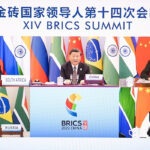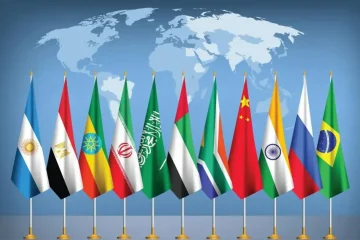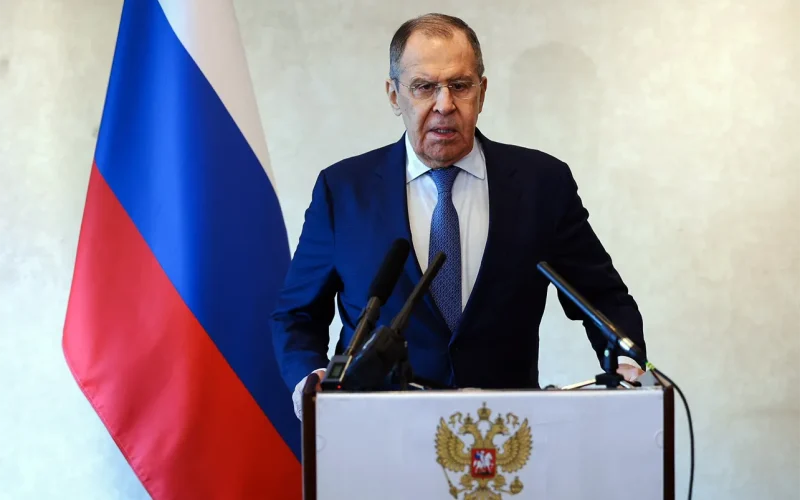
RUSSIAN Foreign Minister Sergey Lavrov has outlined an ambitious vision for BRICS to play a central role in reshaping global economic architecture, arguing that the West’s attempt to maintain dominance through sanctions and economic pressure is accelerating the shift toward multipolarity.
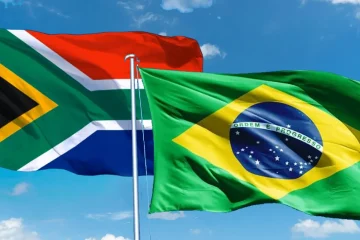
In an exclusive interview with TV BRICS, Lavrov described the United States as “objectively losing its economic influence” while countries like China, India, and Brazil rise as new centres of power. He said the BRICS nations’ combined GDP, adjusted for purchasing power, has already exceeded that of the G7.
“The West is reluctant to relinquish its formerly dominant positions,” Lavrov said, citing what he called unfair methods, including sanctions on Russian energy companies and attempts to control trade between BRICS members.
Lavrov pointed to initiatives adopted during Russia’s 2024 BRICS chairmanship in Kazan, including alternative payment platforms, mechanisms for settlements in national currencies, and reinsurance facilities for intra-BRICS trade. He emphasised these are responses to U.S. control over financial systems rather than provocations.
“We have not refused contacts with them to the extent that they are willing to engage on a mutually beneficial basis,” Lavrov said, while noting that Russia and its partners are creating “an architecture that will not be subject to unlawful actions by any player on the Western flank.”
The foreign minister suggested BRICS could serve as an overarching framework for harmonising development plans across Eurasia, Africa, and Latin America, working alongside regional bodies like the Eurasian Economic Union, Shanghai Cooperation Organisation, and ASEAN.
“The inclusion of Eurasian giants – China, India, Russia, and now Indonesia – positions BRICS as a potentially highly effective participant in the formation of the Greater Eurasian Partnership,” he said.
Indonesia joined BRICS in 2025, adding to the bloc’s expanding membership.
India’s Chairmanship Priorities
With India now holding the BRICS chairmanship, Lavrov praised New Delhi’s focus on counter-terrorism, food and energy security, and information and communications technology security. He noted Russia’s active participation in an upcoming AI summit India will host.
“India’s chairmanship presents a modern, highly relevant agenda that addresses today’s challenges while preparing for the future,” Lavrov said.
On energy security specifically, Lavrov said it will be “particularly important in the context of actions taken by the Trump administration in the global energy sector,” referencing U.S. efforts to control energy supply routes and discourage partners from purchasing Russian energy.
Ukraine and U.S. Relations
Lavrov also addressed Russia’s relations with the United States under President Donald Trump, expressing frustration that sanctions imposed during the Biden administration remain in place despite what he characterised as positive initial signals, including a Putin-Trump meeting in Anchorage.
He said new sanctions on Russian oil companies Lukoil and Rosneft were imposed weeks after that meeting, and that the U.S. state of emergency targeting Russia was extended in April with justifications he called “pure Bidenism.”
Lavrov reiterated Russia’s security concerns regarding Ukraine, stating that preventing NATO weapons deployment on Ukrainian territory and protecting Russian-speaking populations remain fundamental objectives.
The foreign minister’s comments reflect Moscow’s broader strategy of strengthening ties with non-Western powers while maintaining that Russia remains open to cooperation with all countries on mutually beneficial terms.