
THE United States has barred senior Rwandan officials from entering American territory, escalating a rapidly intensifying confrontation with Kigali over its alleged backing of the M23 rebel movement in eastern Democratic Republic of the Congo – a conflict that has already blown apart a peace agreement brokered by President Donald Trump less than three months ago.
Secretary of State Marco Rubio announced that the State Department would impose visa restrictions on several unnamed senior Rwandan officials under Section 212(a)(3)(C) of the Immigration and Nationality Act, which empowers the Secretary to deny entry to foreign nationals whose presence in the United States would carry serious adverse foreign policy consequences. Family members of those targeted may also face restrictions.
The move lands four days after the Treasury Department’s Office of Foreign Assets Control delivered a more structurally significant blow: sanctions on the Rwanda Defence Force itself — Rwanda’s entire military apparatus — and four of its most senior commanders, including Chief of Defence Staff Gen. Mubarakh Muganga, Army Chief of Staff Lt. Gen. Vincent Nyakarundi, Maj. Gen. Ruki Karusisi, commander of the 5th Infantry Division, and Brig. Gen. Stanislas Gashugi, commander of Special Operations Forces.
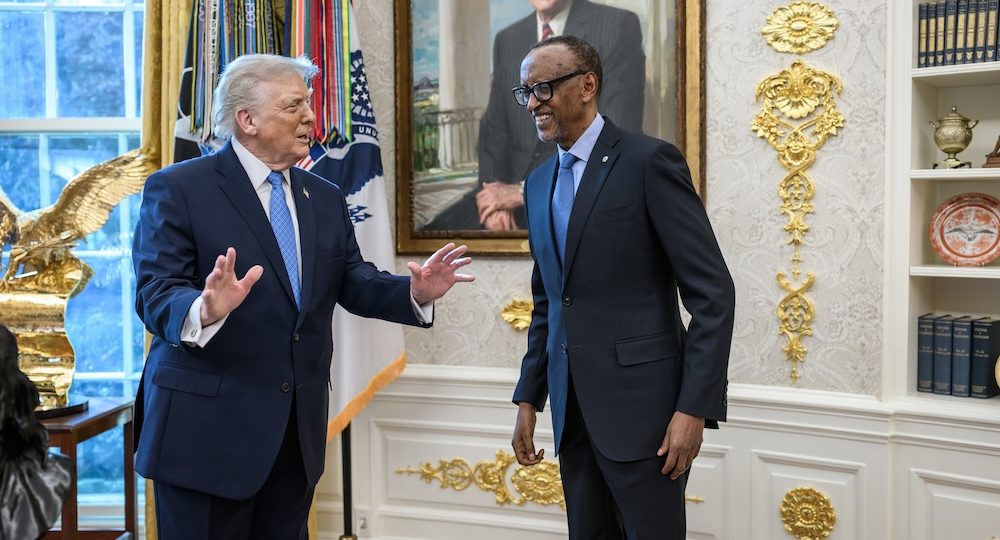
Together, the two actions represent Washington’s most sweeping punitive response yet to what it has characterised as Rwanda’s flagrant violation of the Washington Accords — the joint declaration signed on December 4, 2025, when Trump hosted DRC President Félix Tshisekedi and Rwandan President Paul Kagame at the White House and predicted what he called a “great miracle” for the region.
The miracle proved short-lived. Just days after the signing, Rwanda-backed M23 fighters captured Uvira, a strategic city along the DRC-Burundi border, in what Washington described as a clear violation of the accords. Although M23 later withdrew from Uvira under intense diplomatic pressure, the rebels continue to hold key Congolese cities, including Goma and Bukavu, the provincial capitals of North and South Kivu.
The Treasury Department was unsparing in its assessment of Kigali’s role. It found that the RDF had introduced advanced military equipment to the battlefield in eastern DRC, including GPS jamming systems, air defence equipment, and drones, with thousands of RDF troops actively engaged in combat operations. The RDF also provides training to M23 fighters at Rwandan military facilities and has supported M23’s recruitment efforts, including the recruitment of refugees. In exchange, Rwanda has gained access to mineral-rich areas of eastern DRC that help finance M23’s armed rebellion.
UN and military sources told Human Rights Watch that several thousand Rwandan soldiers, including special forces, crossed the border into Congo in the weeks preceding the December offensive on Uvira.
Rwanda has rejected both the sanctions and the visa restrictions, calling them one-sided measures that misrepresent the conflict’s complexity and ignore the role of the FDLR — the Democratic Forces for the Liberation of Rwanda, a Hutu armed group with roots in the 1994 genocide — which operates alongside Congolese government forces. Washington’s own statement on Friday acknowledged the DRC’s obligations, calling on Kinshasa to immediately neutralise the FDLR while demanding that Kigali withdraw its troops and military equipment.
The dual pressure tracks suggest Washington is attempting to hold both parties to the accords while making clear that Kigali bears principal responsibility for the current breakdown. Senate Foreign Relations Committee Chairman Jim Risch reinforced that posture, stating that the sanctions “send a blunt message: those who violate terms brokered by the United States will pay a steep and escalating price.”
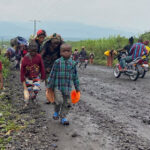
The broader humanitarian toll of the conflict has reached catastrophic proportions, with more than seven million people displaced — making eastern DRC one of the world’s most severe humanitarian crises, according to the UN refugee agency.
Human Rights Watch called on the European Union, the United Kingdom, and regional governments to follow Washington’s lead by imposing targeted sanctions on additional M23 commanders and Rwandan officials, warning that the haphazard and uncoordinated international response has emboldened abusers.
The visa restriction policy marks a further deterioration in a relationship that had, until recently, remained relatively resilient despite years of international censure over Rwanda’s alleged support for armed groups in eastern Congo. Whether Friday’s measures translate into meaningful behavioural change in Kigali — or simply deepen its estrangement from Western partners — will depend largely on whether the diplomatic costs begin to outweigh the strategic and economic benefits Rwanda is alleged to derive from its position in the conflict.