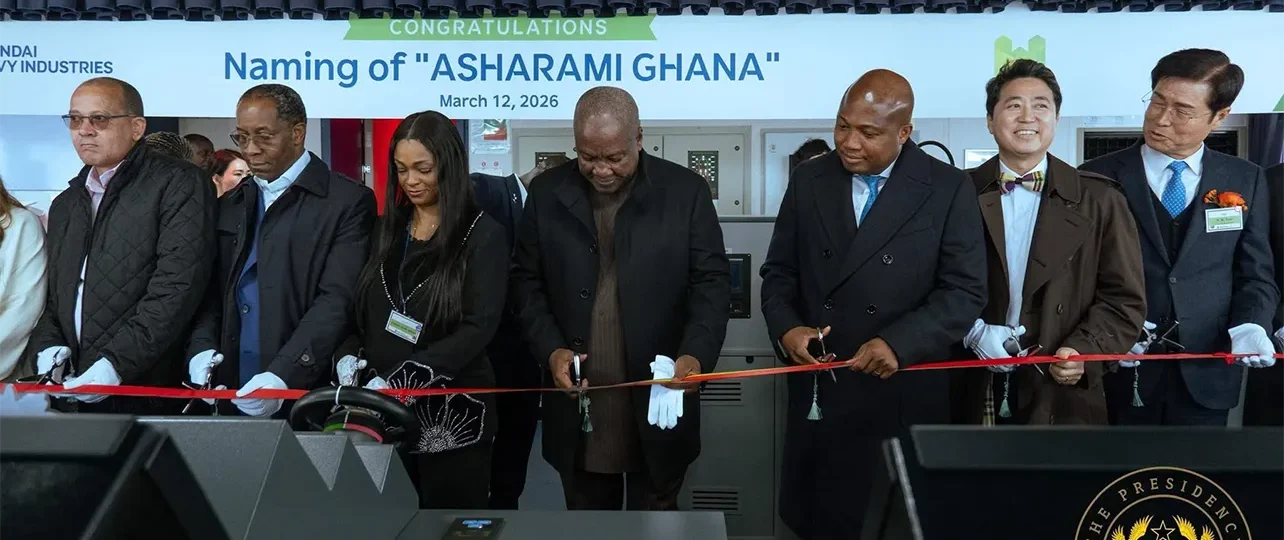

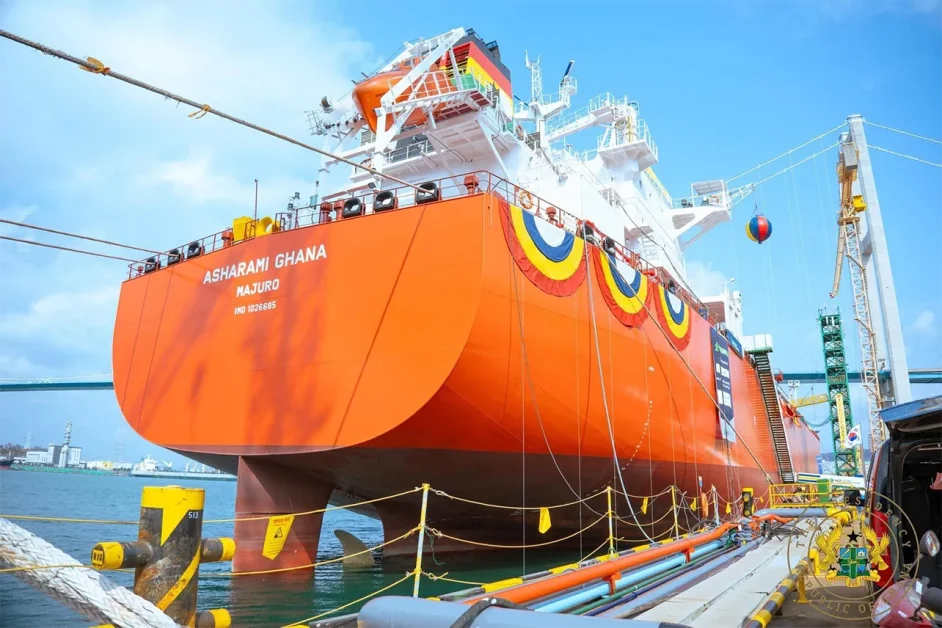
ON 12 March 2026, in the industrial port city of Ulsan – South Korea’s beating maritime heart – a vessel slid into the frigid waters of the Korean Strait to begin a journey that carries the hopes of more than 35 million people. The ship is named the MT Asharami Ghana. And its name is not merely a commercial designation. It is a declaration.
The commissioning ceremony, held at the storied HD Hyundai Heavy Industries shipyard, brought together the President of Ghana, John Dramani Mahama, alongside senior executives of Nigeria’s Sahara Energy Group, representatives of the NNPC-Sahara joint venture WAGL Energy, and Korean maritime engineers who had laboured for months to bring this dual-fuel, fully refrigerated liquefied petroleum gas (LPG) carrier into existence. The gathering was, in microcosm, a portrait of what the Global South can build when it decides to build for itself.
The 40,000-cubic-metre vessel — among the most advanced of its class — will dedicate its operational life entirely to supplying Ghana and its landlocked West African neighbours with LPG: the clean fuel that, for millions of households across the sub-region, represents the difference between smoke-filled kitchens and clear skies, between stunted lungs and healthy children, between deforestation and standing trees.
This is more than a ceremonial occasion. It marks a significant milestone in strengthening the infrastructure that underpins the global LPG supply chain.
President John Dramani Mahama, Ulsan, Republic of Korea, March 12, 2026
THE ARCHITECTURE OF AN AFRICAN DREAM
To understand what the MT Asharami Ghana represents, one must first understand who built it — and why.
Sahara Group was founded in Lagos, Nigeria, in 1996, growing from an oil and gas trading firm into one of Africa’s most formidable energy and infrastructure conglomerates. Today, it operates across more than 42 countries, spanning power generation and distribution, upstream exploration, downstream petroleum, and maritime logistics. Its co-founder, Tonye Cole, once graced the cover of Forbes Africa. But what distinguishes Sahara is not its scale — it is its orientation. This is a Nigerian company that dreams African, operates African, and invests African.
The vessel that now bears Ghana’s name was conceived through WAGL Energy Limited — a strategic joint venture between NNPC Limited, Nigeria’s national oil company, and Sahara Group’s trading arm, Ocean Bed Trading. Incorporated in 2013 and operational from 2014, WAGL was established with a single, clarifying purpose: to serve as a vehicle for the offtake, marketing, and trading of natural gas liquids across the African continent and beyond. With the addition of the MT Asharami Ghana, WAGL and Sahara’s collective LPG carrier fleet now stands at six delivered vessels with a combined capacity exceeding 202,000 cubic metres, with a further 270,000 cubic metres under construction, due for delivery by September 2028.
This is not a one-off transaction. It is a strategic architecture — a deliberate investment in Africa’s energy future, built block by block, ship by ship, terminal by terminal.
MT Asharami Ghana is more than a vessel; it is part of a deliberate strategy to strengthen LPG supply security and support Ghana’s clean energy ambitions.
Wale Ajibade, Executive Director, Sahara Group
GHANA’S BURNING PROBLEM
The politics of energy in Ghana are inseparable from the politics of health, gender, and the environment. Today, nearly half of all Ghanaian households still depend on charcoal or firewood as their primary cooking fuel. In rural areas, that proportion rises dramatically — in the northern regions, the rate exceeds 80 per cent.
The consequences are grave. Indoor air pollution from solid-fuel cooking contributes to an estimated 18,000 premature deaths in Ghana every year and accounts for over 500,000 disability-adjusted life years lost annually. It is women and children who bear the heaviest burden — spending hours collecting firewood, breathing in smoke, developing respiratory conditions that will never be recorded in any development dataset.
Meanwhile, Ghana’s forests — already diminished by 60 per cent since 2000 — continue to recede. Charcoal demand, linked directly to the failure to transition to cleaner fuels, is projected to increase through 2030, deepening an ecological wound that will take generations to heal.
Ghana has set and missed a target of 50 per cent LPG household penetration three times since 2010. The current target — 50 per cent by 2030 — remains ambitious. As of 2021, LPG penetration stood at only 36.9 per cent nationally. The gap between ambition and reality has been, in large part, a supply chain problem. Ghana imports approximately half of the LPG it consumes. When that supply chain is fragile, it is ordinary Ghanaians who feel it first — in rising prices, in empty cylinders, in mothers returning to the firewood their grandmothers used.
That is the problem the MT Asharami Ghana was built to solve.
This vessel represents more than capacity at sea. It represents confidence in Ghana’s growth, confidence in our regulatory framework, and confidence in the long-term sustainability of our downstream sector.
Yaa Serwaa Alifo, Managing Director, Asharami Ghana
KOREA: THE SILENT PARTNER IN AFRICA’S RISE
There is a third flag flying over this story, and it belongs to the Republic of Korea. South Korea’s role in this partnership is neither symbolic nor peripheral. It is structural.
Ulsan is the shipbuilding capital of the world. Korea’s shipyards — particularly those of HD Hyundai Heavy Industries — produce some of the most technically sophisticated marine vessels on the planet. The MT Asharami Ghana is a dual-fuel, fully refrigerated LPG carrier: a vessel designed to operate with the efficiency and environmental credentials that the energy transition demands. Its construction in Ulsan represents Korean engineering excellence in the service of African aspirations.
President Mahama’s working visit to Seoul was framed as part of a broader effort to deepen cooperation between Ghana and Korea in trade, technology, and industrial development. At the commissioning ceremony, a commemorative plaque was unveiled honouring Mahama’s leadership — an unusual gesture that spoke to the depth of goodwill in the room. Ghana is simultaneously pursuing a visa waiver agreement with South Korea, signalling a bilateral relationship that extends well beyond a single vessel.
For Korea, the MT Asharami Ghana is part of a longer history of engagement with Africa — one that has accelerated as Asian economies recognise that the continent’s 1.4 billion people represent not a development challenge, but a development opportunity. For Africa, Korea offers something more immediately tangible: the technical capacity to build the ships, the storage facilities, and the maritime infrastructure that African-owned energy companies need to fulfil their continental mandate.
This is South-South cooperation at its most functional. It does not ask Africa to be grateful. It asks Africa to lead — and provides the tools to do so.
Strategic partnerships such as the commissioning of MT Asharami Ghana demonstrate how innovation, investment and collaboration can bridge infrastructure gaps across Africa.
President John Dramani Mahama
THE NUMBERS THAT CARRY HUMAN WEIGHT
Behind every strategic announcement lies a calculation measured in human lives. The MT Asharami Ghana, when it arrives in Ghana waters, will secure an additional 25,000 metric tonnes of stock security for the Ghanaian economy — a buffer that will smooth the price volatility, supply disruptions, and logistical chokepoints that have historically left households scrambling. Alongside the vessel, a new 12,000-metric-tonne land storage facility in Tema — of which the first 6,000 metric tonnes is soon to be commissioned — will further anchor the supply chain on Ghanaian soil.
Sahara’s investments across the LPG value chain in Ghana are projected to support clean energy access for more than 35 million people — a figure that encompasses not only Ghana’s 33-plus million citizens, but the landlocked nations that depend on Ghanaian ports and distribution networks for their own energy supplies.
The jobs dimension is equally significant. The downstream LPG sector — from maritime logistics and terminal operations to cylinder distribution, retail, and maintenance — is a labour-intensive value chain. Every vessel represents a cascade of employment: skilled maritime workers, port handlers, distribution agents, cylinder technicians, and safety inspectors. President Mahama’s vision of energy security and his government’s commitment to job creation are, in this context, one and the same ambition wearing two faces.
CONGRATULATIONS TO A VISIONARY PRESIDENT
It is fitting that it is President Mahama who stood on Korean soil to commission this vessel. His presence there — alongside Sahara Group executives, WAGL Energy representatives, and the Managing Director of Asharami Ghana, Yaa Serwaa Alifo, a Ghanaian woman whose insistence on dedicating a ship of this magnitude solely to Ghana and its landlocked neighbours deserves every recognition — signals a government that understands energy security as national security.
Mahama did not travel to Ulsan to cut a ribbon. He travelled to forge a partnership. His remarks at the ceremony were those of a leader who grasps the structural dimensions of underdevelopment: that energy poverty is not a symptom of African failure, but a consequence of infrastructure gaps that can be closed with the right investments, the right partnerships, and the right political will.
Ghana under Mahama is positioning itself not merely as a recipient of energy supply, but as a regional hub — a node through which LPG flows to the broader West African sub-region, including landlocked states that have no direct maritime access. That is not just ambition. That is a strategy. And strategy, when backed by the kind of capital commitments represented by the MT Asharami Ghana, has a way of becoming reality.
Through strategic investments and forward-looking partnerships such as the commissioning of MT Asharami Ghana, we are taking practical steps to enhance energy security for Ghana, West Africa, and Africa as a whole.
President John Dramani Mahama
THE BEAUTY OF PARTNERSHIP
There is a tendency in the commentary on African development to focus on what is lacking: the absence of infrastructure, the deficit of capital, the shortfall of political will. The MT Asharami Ghana invites a different gaze.
What we see in Ulsan — a Nigerian company, backed by Nigeria’s national petroleum corporation, constructing a vessel in a Korean shipyard to supply an energy commodity to Ghana — is not a story of dependence. It is a story of interdependence. It is the Global South, in its most practical and purposeful expression, choosing its own partners and building its own future.
Ghana brings its ports, its growing market, its regulatory framework, its political leadership, and its ambition. Nigeria brings its capital, its entrepreneurial energy, its decades of experience in the LPG supply chain, and its institutional muscle through NNPC. Korea brings its engineering excellence, its shipbuilding heritage, and its willingness to serve as a manufacturing partner to African-owned enterprises. None of these three nations could have produced the MT Asharami Ghana alone. Together, they produced something that will outlast the headlines.
This is what solidarity looks like when it is serious. Not declarations. Non communiqués. A ship. Named after the nation it serves. Built by a partner that respects it. Owned by a company that believes in it.
As the MT Asharami Ghana sets sail from Ulsan toward the Gulf of Guinea, it carries more than liquefied petroleum gas. It carries the proof that the African continent, working in concert with the partners it chooses on its own terms, can close its own infrastructure gaps, power its own households, and write its own energy story.
Congratulations to President Mahama. Congratulations to Sahara Energy Group. Congratulations to WAGL Energy. Congratulations to HD Hyundai Heavy Industries. And congratulations to the people of Ghana, for whom this vessel, in the most direct and practical sense, was built.