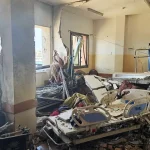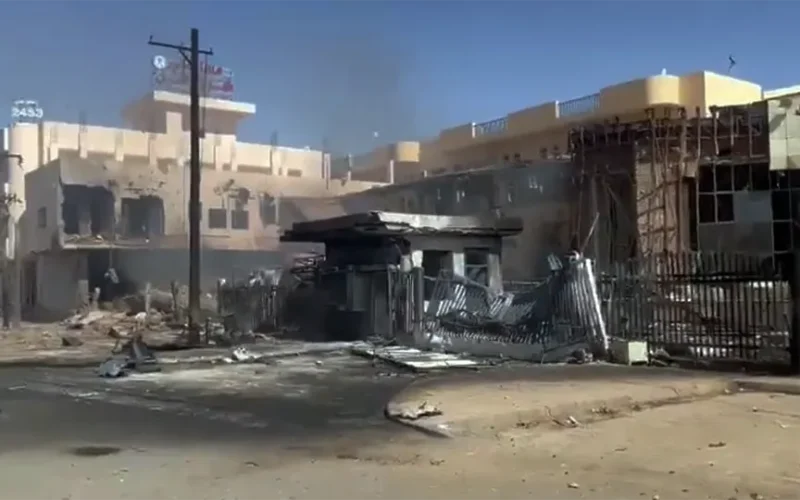
SEVENTY people are dead. Among them: a doctor, two nurses, thirteen children, seven women, and an unspecified number of patients who had done nothing more than seek medical care. The Teaching Hospital in Al Deain, capital of East Darfur, was struck by an air strike late on Friday evening. By Tuesday, the United Nations had confirmed it was no longer functioning. For more than two million people across East Darfur state, the nearest alternative referral facility is now over 160 kilometres away.
This is Sudan in the third year of its civil war – and it is getting worse.
The strike on Al Deain’s Teaching Hospital, which serves as a critical referral centre for nine localities across the state, took place as Ramadan drew to a close and communities prepared for Eid al-Fitr. It was not an isolated incident. The UN World Health Organisation confirmed on Tuesday that the death toll had risen to 70, with injuries climbing to 146, including patients and their accompanying family members. Since the conflict between the Sudanese Armed Forces (SAF) and the paramilitary Rapid Support Forces (RSF) erupted in April 2023, attacks on health facilities have killed more than 2,000 people — a figure that itself represents only those directly linked to facility strikes.
“An attack on a hospital is not only an attack on a building — it’s an attack on people seeking care, on health workers risking their lives, and on the very possibility of survival at times of crisis.”
Dr Hala Khudari, WHO Deputy Representative to Sudan
A Sharp Increase, Not an Anomaly
What makes the Al Deain attack significant — beyond its devastating human toll — is what it represents statistically. The UN Human Rights Office (OHCHR) has documented a sharp surge in drone-conducted airstrikes against civilians in 2026. From 1 January to 15 March alone, more than 500 civilians were killed in drone strikes, the vast majority concentrated in three states in the Kordofan region. The Al Deain hospital attack, which occurred just days before OHCHR released this data, falls within that window.
OHCHR spokesperson Marta Hurtado was precise in her language: this is not simply a continuation of existing patterns but an acceleration, one that “underlines the devastating impact of high-tech and relatively cheap weapons in populated areas.” Drones — commercially available, relatively inexpensive, and increasingly lethal — have become the signature weapon of this phase of the Sudan conflict, deployed by both the SAF and the RSF. When asked which party was responsible for the Al Deain attack specifically, Hurtado declined to assign blame, noting that both sides use drones extensively. Her office’s call was categorical: both parties must immediately stop.
Beyond Borders: Regional Escalation
The implications of this conflict are no longer confined to Sudan’s borders. OHCHR has warned that drone attacks are now “spiralling across Sudan’s borders, with serious risk of further escalation carrying regional consequences.” Last week, deadly strikes struck the town of At Tina, near the Sudan-Chad border, and Tine — a locality inside Chad itself — following earlier ground offensives attributed to the RSF. The internationalisation of Sudan’s conflict, long feared by regional analysts, is accelerating.
Chad, already hosting hundreds of thousands of Sudanese refugees and historically entangled in Darfur’s violence, now finds itself subject to direct military action originating from across its border. The potential for wider regional destabilisation — drawing in neighbours whose own political landscapes are fragile — cannot be overstated.
International Humanitarian Law and the Question of Accountability
OHCHR’s language on Tuesday was among the strongest it has used since the conflict began. The continued targeting of civilians and civilian infrastructure — hospitals, ambulances, health workers, patients — raises “serious concerns about compliance with international humanitarian law” and may, Hurtado said, “amount to war crimes.” The three foundational principles at issue — distinction, proportionality, and precaution — are not optional clauses in the laws of armed conflict. They are binding obligations on all parties.
The repeated, documented, systematic nature of attacks on health facilities in Sudan makes arguments of accident or collateral damage increasingly difficult to sustain. WHO’s Dr Hala Khudari made this plain: “Sudan is approaching its third year of armed conflict, but the attacks on healthcare continue.” Health facilities, ambulances, health workers, and patients have been “repeatedly targeted” — a phrase with specific legal resonance in the context of war crimes prosecution.
OHCHR also renewed calls for an end to arms transfers “that are feeding the conflict” — a pointed reference to the external suppliers and backers without whom neither the SAF nor the RSF could sustain the tempo of operations that have produced these casualty figures. The identity of those suppliers, and the political relationships that protect them, remain among the most consequential and least interrogated dimensions of this war.
Analysis: The Calculus of Impunity
The escalation in drone attacks on civilian infrastructure in Sudan does not occur in a vacuum. It occurs in a conflict that has, for nearly three years, unfolded with minimal external accountability — no ceasefire that held, no arms embargo with teeth, no meaningful international mechanism to compel compliance from either belligerent. In that environment, the cost of targeting a hospital is low. The tactical benefit of destroying an adversary’s rear-area infrastructure — including the medical systems that treat the wounded and sustain civilian morale — may, in the brutal arithmetic of this war, outweigh the reputational risk.
The families of the 70 dead in Al Deain cannot wait for that calculus to change. Nor can the more than two million people for whom the nearest referral hospital is now a gruelling 160-kilometre journey away — for patients requiring specialised care, a journey that may simply not be possible.
Sudan is not short of documentation. It is short of consequences.
KEY FIGURES
70 people killed in the Al Deain Teaching Hospital strike, including 13 children and 3 health workers
146 people injured in the same attack, including patients and family members
2,000+ total fatalities linked to attacks on health facilities since April 2023 (WHO)
500+ civilians killed in drone strikes between 1 January and 15 March 2026 (OHCHR)
160 km minimum distance East Darfur patients must now travel for referral care
2 million+ people who relied on Al Deain Teaching Hospital as their primary referral centre