WHAT began as a late-afternoon social media alert has evolved into a full-scale diplomatic confrontation between the Democratic Republic of Congo and Rwanda, with both governments now publicly accusing the other of distortion, dishonesty, and provocation over an incident that unfolded in the hallways and on the floor of a Washington hotel where senior figures from both countries were simultaneously staying.
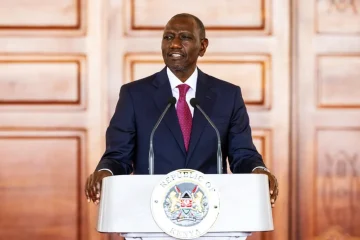
The Rwandan Embassy in Washington issued a detailed statement through its official social media channels — @RwandaInUSA — flatly contradicting the account presented by Kinshasa’s Information Minister Patrick Muyaya at a press conference on Tuesday night. The embassy characterised the incident as an inadvertent encounter between security details in a public hotel corridor, and described the subsequent treatment of Rwandan personnel — who it says were filmed and harassed as they checked out and changed hotels — as a deliberate provocation.
“There has been gross misrepresentation of what transpired, including blatant dishonesty by the DRC Minister of Information in a press conference last night. These contemptible lies should be disregarded and condemned.”
The embassy statement read, in part: “An unarmed member of the security detail of a Rwandan VIP staying in a Washington DC hotel inadvertently encountered security agents of a DRC delegation in a hotel hallway accessible to all guests. Both delegations were staying at the same hotel. The Rwandan detail member was briefly restrained from accessing the elevator by the DRC security agents, which was inappropriate and wrong behaviour in a common area, but the matter was eventually resolved without further escalation.”
Crucially, Kigali confirmed that the Rwandan delegation did subsequently change hotels — but framed this as a proactive de-escalation decision, not a flight from the scene. “Following this incident, the Rwandan party made a decision to change hotels,” the embassy stated, adding that the departure was met with further hostility: “They were harassed and filmed by unknown persons as they checked out and departed.” Videos circulating widely on social media appear to corroborate this element of the account, showing men who are believed to be Rwandan security personnel being followed by camera-holders while attempting to exit a building, with the individuals visible on film asking why they are being filmed.
MUYAYA’S PRESS CONFERENCE: THE DRC’S VERSION
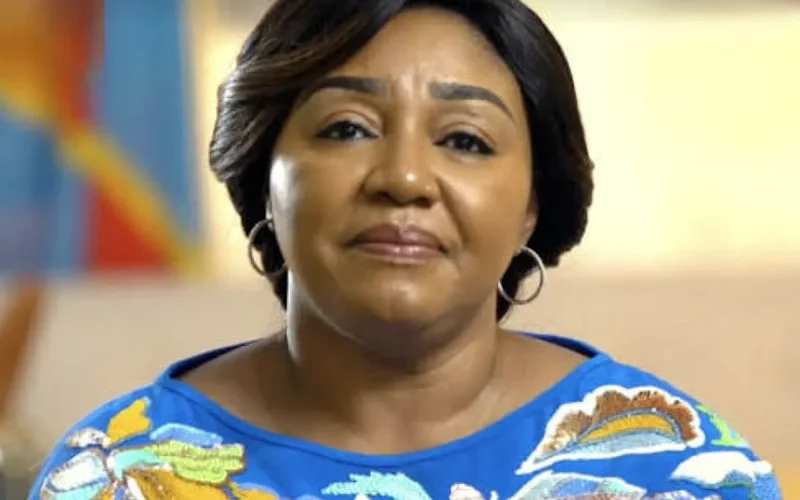
DRC Government Spokesperson and Information Minister Patrick Muyaya told reporters at a Kinshasa press conference that Congolese authorities were treating the incident as a potential security breach targeting the First Lady. Muyaya said Kinshasa was in contact with US officials to establish the circumstances. “We are in contact with the American authorities and will get back to you as soon as we have more details. I want to reassure the public: the First Lady is doing well,” he said.
His remarks went significantly further than the cautious language of the earlier official Kinshasa statement, which had simply confirmed an incident was being investigated. According to reporting by Von Batten-Montague-York, L.C. — the Republican lobbying firm representing DRC interests in Washington — the individuals had been identified by security as Rwandan nationals who attempted a “hostile breach” of the First Lady’s hotel room, and that the escape vehicle was believed to bear official Rwandan government links. The firm had characterised the incident as a possible attempted assassination, intimidation, or surveillance operation.
Rwanda’s embassy singled out Muyaya by name — a pointed move in diplomatic communications — accusing him of “blatant dishonesty” and calling his statements “contemptible lies.” The two men have been engaged in a sustained public information war for months: Muyaya has convened Congolese government communicators specifically to develop strategies for countering what Kinshasa describes as Rwandan disinformation around the eastern Congo conflict, while Rwandan-aligned media have repeatedly targeted him by name.
RWANDA’S COUNTER-CLAIM: PROFESSIONALISM UNDER PROVOCATION
The Rwandan Embassy’s statement emphasised three key points that form the backbone of Kigali’s counter-narrative: that its personnel were unarmed; that the corridor where the incident occurred was a publicly accessible common space in a shared hotel; and that the Rwandan team conducted itself with restraint throughout, including while being filmed during checkout.
“Despite this provocation, the Rwandan team was restrained and professional at all times, and carefully avoided any confrontation,” the statement said. By framing the checkout harassment as a second act of aggression by DRC-linked actors, Kigali attempts to reverse the moral dynamic of the narrative — positioning Rwanda not as the aggressor but as the aggrieved party operating with discipline under deliberate provocation.
The embassy did not specify the identity of the “Rwandan VIP” whose security detail was involved, nor did it address the claim that the detail member attempted to access the floor where the First Lady was staying, which remains a central point of contestation between the two accounts.
“Despite this provocation, the Rwandan team was restrained and professional at all times, and carefully avoided any confrontation.”
WHAT REMAINS CONTESTED AND WHAT IS AGREED
Sifting through the three accounts — Von Batten-Montague-York/Kinshasa, Rwanda’s Embassy, and the independent reporting by XTRAfrica Media Group and ChimpReports — a narrow set of agreed facts emerges: that personnel from both countries were present in the same Washington hotel at the same time; that a physical confrontation of some kind occurred in a shared area; that the Rwandan delegation subsequently changed hotels; and that the First Lady is safe and unharmed.
What remains fiercely disputed: whether the Rwandan detail member was attempting to access the First Lady’s secured floor or was merely seeking the elevator in a shared corridor; whether the confrontation was an accidental misencounter or a deliberate hostile act; whether the individuals involved were acting on state instructions or independently; and whether the vehicle used in departure had official Rwandan government links, as Von Batten-Montague-York alleged. US authorities have not publicly characterised the incident, and diplomatic sources said security measures around the First Lady had been tightened as a precaution.
THE BROADER STAKES: WASHINGTON ACCORDS UNDER STRESS
The incident erupts at a moment of acute fragility in the Washington-brokered peace process. On March 17-18, 2026, DRC and Rwandan representatives met in Washington and agreed to concrete steps toward implementation of the Washington Accords — including mutual commitments on sovereignty, a scheduled Rwandan force disengagement from defined DRC territory, time-bound DRC action against the FDLR militia, and civilian protection measures. An April 15 implementation review deadline has been set.
That diplomatic progress, however fragile, now risks being overtaken by an information war in the corridors of a Washington hotel. The US State Department has made clear it is prepared to use all available tools to ensure both parties honour their Washington Accords obligations — and a state-linked security incident on American soil involving a head of state’s spouse would represent precisely the kind of escalatory provocation that Washington has repeatedly warned against.
Just weeks ago, the US Treasury sanctioned the Rwanda Defence Force and four senior RDF officers for their direct operational support to M23, including the seizure of provincial capitals Goma and Bukavu and strategic mining sites in eastern DRC. Rwandan government spokesperson Yolande Makolo had called those sanctions unjust, saying they misrepresent the reality of the conflict — the same register of language now deployed by the Rwandan Embassy over the hotel dispute.
For the DRC’s Washington lobbying infrastructure, the incident — however it is ultimately characterised — provides a powerful new narrative: that Rwanda’s reach extends beyond eastern Congo into the corridors of the American capital itself. For Rwanda, the counter-narrative is equally potent: that Kinshasa manufactures crises, weaponises diplomatic incidents, and targets Rwanda with disinformation as a substitute for delivering on its own peace process obligations.
INVESTIGATION ONGOING — NO US VERDICT YET
The US investigation into the incident continues. No American law enforcement or government agency had publicly issued a finding at the time of publication. The involvement of local police has been confirmed by multiple reports. The State Department, the Secret Service — which provides protection to foreign heads of state and their immediate families during US visits — and the Metropolitan Police Department of Washington, DC did not respond to requests for comment from The African Mirror by deadline.
The African Mirror will continue to follow this story as the investigation develops and as official responses from US authorities become available.