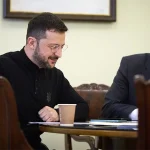
IN a world accustomed to framing Africa as the perpetual recipient — of aid, of intervention, of development finance dispensed from the global North — the diplomatic exchange between Mozambique and Ukraine this week arrives as something of a quiet disruption. When Presidents Volodymyr Zelensky and Daniel Chapo spoke by telephone on Monday and agreed to explore a swap of Mozambican liquefied natural gas for Ukrainian security expertise, they sketched the outline of a relationship that defies the tired scripts of dependency and patronage.
For Kyiv, the imperative could not be more urgent. Before Russia launched its full-scale invasion in February 2022, Ukraine’s domestic gas production was sufficient to meet almost all of the country’s energy needs — a rare energy independence that set it apart from much of Eastern Europe. That self-sufficiency is now a memory. Central Bank Governor Andriy Pyshnyi confirmed late last year that Ukraine has lost approximately half its gas output, the consequence of a methodical Russian campaign targeting production facilities concentrated in the frontline regions of the northeast and centre of the country. With winter returning each year as an additional weapon in Moscow’s arsenal, Kyiv has been scrambling across the globe for new supply lines.
The scramble has already taken Ukraine to the Americas and the Baltic. Last November, Naftogaz — the country’s state energy company — signed a memorandum with Poland’s Orlen to import US LNG via Baltic terminals. In February this year, the first US LNG cargo arrived at Greece’s Revithoussa terminal, bound for Kyiv via a newly approved corridor through Bulgaria, Romania and Moldova. Ukraine is now looking south — to Africa — completing what amounts to a remarkable geographic diversification of its energy supply chain under wartime conditions.
“Ukraine is interested in additional energy supplies. Mozambique is interested in Ukraine’s experience and technologies to strengthen its internal security and protect people from terror.”
President Volodymyr Zelensky
THE AFRICAN OFFER: GAS FOR GUARANTEES
Mozambique is today one of Africa’s most consequential gas stories — and one of its most complicated. The Rovuma Basin, stretching across the northern province of Cabo Delgado, contains some of the largest offshore gas discoveries in the world. French supermajor TotalEnergies holds the flagship project, a $20.5 billion LNG facility with a design capacity of 13 million metric tonnes per annum — enough to transform Mozambique into a top-tier global LNG exporter. Italy’s Eni is further advanced: its 3.4 mtpa Coral Sul FLNG vessel has been producing and exporting since 2022, with a second vessel, Coral Norte, under construction. ExxonMobil is eyeing a final investment decision in 2026 on its rival $30 billion Rovuma LNG project, which would be the largest such facility on the African continent.
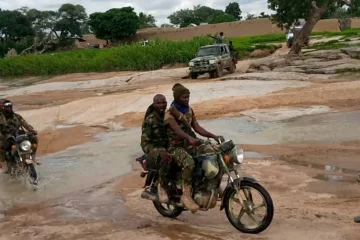
But the gas beneath Cabo Delgado has never been Mozambique’s to exploit freely. Since 2017 — within years of the first major discoveries — an Islamist insurgency linked to the Islamic State Central Africa Province (ISCAP) has terrorised the province, displacing more than one million people, killing thousands, and demonstrating a lethal aptitude for targeting the economic arteries of the region. In April 2021, militants stormed the town of Palma, just kilometres from TotalEnergies’ construction site, abducting gas workers and triggering a mass evacuation. The company declared force majeure and halted all construction. Nearly five years of paralysis followed.
The recovery has been partial, contested and expensive. Rwandan forces — now numbering between 2,500 and 5,000 troops — deployed in July 2021 under a bilateral status-of-forces agreement, providing the security architecture that eventually persuaded TotalEnergies to lift its force majeure in late 2025. The Southern African Development Community’s multilateral mission, SAMIM, drew down through 2024, with most South African and Tanzanian contingents withdrawing by March 2025, exposing the limits of regional collective security. The insurgency, though pushed back from urban centres, has not been extinguished: in September 2025, militants staged a raid on Mocímboa da Praia — once the symbolic capital of the insurgency — demonstrating continued capacity to regroup and strike.
TotalEnergies’ return comes at a heavy price. The company has presented Mozambique with a bill of $4.5 billion in additional costs incurred during the four-and-a-half-year shutdown, demanding these be absorbed as part of the recognised investment — a move that would substantially reduce Mozambique’s future tax revenue. It has also demanded a 10-year extension of its exploration and production contract under the existing Build-Own-Operate-Transfer (BOOT) model, meaning Mozambicans will wait even longer for ownership of these assets to revert to the state. The project will operate from a fortified ‘green zone’, largely insulated from surrounding communities — an arrangement analysts warn may deepen local grievances and further fuel the insurgency.
The gas beneath Cabo Delgado has never been Mozambique’s to exploit freely. An Islamist insurgency has terrorised the province since 2017, displacing more than one million people.
A SWAP ROOTED IN MUTUAL VULNERABILITY
It is in this context — a nation sitting on vast energy wealth but unable to secure the conditions for its extraction — that Zelensky’s overture carries particular resonance. Ukraine is not merely buying gas. It is, in Zelensky’s own framing, offering something Mozambique urgently needs: the knowledge, technology and doctrinal experience of a country that has been fighting an asymmetric war against a determined adversary for more than four years. Ukrainian forces have developed sophisticated drone warfare capabilities, intelligence tradecraft, electronic countermeasures and civilian protection protocols in conditions of sustained conflict. Some of this expertise — adapted for counterinsurgency rather than conventional warfare — could be of direct relevance to Mozambique’s own theatre.
Zelensky also flagged cooperation in digitalisation and food security, both areas where Ukraine has demonstrated capability and where Mozambique faces genuine deficits. The two sides have agreed that technical teams will take forward the discussions, suggesting the outline of a multi-dimensional bilateral partnership rather than a simple commodity trade.
For Mozambique, the diplomatic value of this engagement extends beyond any single deal. President Chapo — who came to office amid bitterly contested 2024 elections and the political violence that accompanied them — faces the challenge of demonstrating that Mozambique can command respect and generate partnerships on its own terms. A security-for-energy framework with a European wartime power, conducted between equals, offers a different kind of optics from the familiar spectacle of African governments negotiating under the shadow of Western conditionality.
AFRICA’S NEW ENERGY GEOPOLITICS
The Mozambique-Ukraine conversation is, in one sense, a product of the particular chaos of this moment. Russia’s war against Ukraine has fractured the European energy order, forcing a continent-wide scramble for alternative gas sources that has, in turn, elevated Africa’s strategic importance in ways that the continent’s leaders are beginning to leverage. Nigeria, Algeria, Angola and now Mozambique have all found themselves the subjects of intensified European courtship since 2022, reversing — at least partially — the historical dynamic in which African resource states were price-takers rather than price-setters.
There are, however, honest questions to be asked about the deal’s practicality. No volumes have been agreed. No timelines have been set. Mozambique’s flagship TotalEnergies project, even in its most optimistic projections, is unlikely to deliver its first LNG cargo before 2029 or 2030. Eni’s existing Coral Sul facility already has its offtake committed under long-term contracts. And transporting LNG from southern Africa to Ukrainian regasification terminals — via the established route through Greece and the Balkans, or by a new European corridor — would require infrastructure investment and logistical coordination that are far from trivial.
Security risk remains the fundamental variable. The continued presence of ISCAP-linked fighters in Cabo Delgado — and the fragility of the security architecture built around Rwandan bilateral deployments rather than a durable multilateral framework — means that the gas reserves underpinning any prospective deal remain subject to disruption. Any serious agreement would presumably require Kyiv to make credible and sustained commitments to Mozambique’s internal security, not merely to offer technical consultations.
THE OPTICS OF SOLIDARITY
Yet the political significance of the engagement should not be measured solely against its near-term commercial viability. For years, African states have navigated the Russia-Ukraine war under intense pressure from Western capitals to take sides in a conflict most Africans regard as geographically and historically distant. The African Union’s peace diplomacy missions, the South Africa-led panel of heads of state, the abstentions at United Nations votes — all have been met with frustration and, at times, open hostility from European and North American governments who expected unconditional alignment.
The Mozambique-Ukraine conversation suggests a different and more sustainable form of engagement. Rather than being asked to take sides in a proxy contest defined by others, African states are increasingly finding positions of active agency — as potential energy suppliers, as security partners, as mediators — that allow them to engage the conflict on their own terms and to extract concrete value from doing so.
This is not altruism. It is pragmatic statecraft. Mozambique’s gas is worth more if it can be sold to a buyer motivated by strategic need rather than purely market price. Ukraine’s security technologies and drone warfare doctrine have value that will outlast the current conflict. The coincidence of these needs is not a charity transaction; it is the architecture of a new bilateral relationship between two nations that have more to offer each other than the old geography of dependence would suggest.
African states are increasingly finding positions of active agency — as potential energy suppliers, as security partners, as mediators — that allow them to engage the conflict on their own terms.
THE WIDER LESSON
What Zelensky and Chapo have opened — however tentative, however beset by obstacles — is a conversation about African agency in a new global energy order. The continent that has historically been the site of extraction is beginning, province by province and barrel by barrel, to assert the terms of its own participation in global markets. Mozambique’s gas does not belong to TotalEnergies or ExxonMobil or any prospective Ukrainian buyer; it belongs to Mozambicans and to the continent, to be deployed in service of African development and African security, in partnership with those who can offer genuine reciprocity.
Whether the Zelensky-Chapo framework matures into a signed agreement, a pilot project, or merely a diplomatic footnote will depend on the hard work of technical teams, the volatility of security conditions on the ground in Cabo Delgado, the pace of LNG project construction, and the state of the war itself. But the opening has been made, and it matters. In a world convulsed by conflict, it is Africa — carrying wounds of its own — that is extending a hand to a country under fire.