
IMAGINE you are a District Mayor. Or perhaps a Provincial Governor. You have made the two-hour drive to Gako, deep in Bugesera, for what has been billed as a high-level consultative meeting at the Rwanda Military Academy — Rwanda’s premier institution for forging discipline. You have settled into your seat. The morning is long. The speeches are longer. Your eyelids are, shall we say, conducting their own private referendum on whether consciousness is strictly necessary.
Then — in that precise, calamitous moment that your career did not warn you about — the man at the front of the room notices you. Not in the polite, encouraging way that speakers notice audiences. In the other way. The way a hawk notices a field mouse. The way a headmaster notices a student who forgot to revise. The way President Paul Kagame — warrior, architect of a nation, man who does not own a snooze button — notices someone who is not paying attention in his meeting.
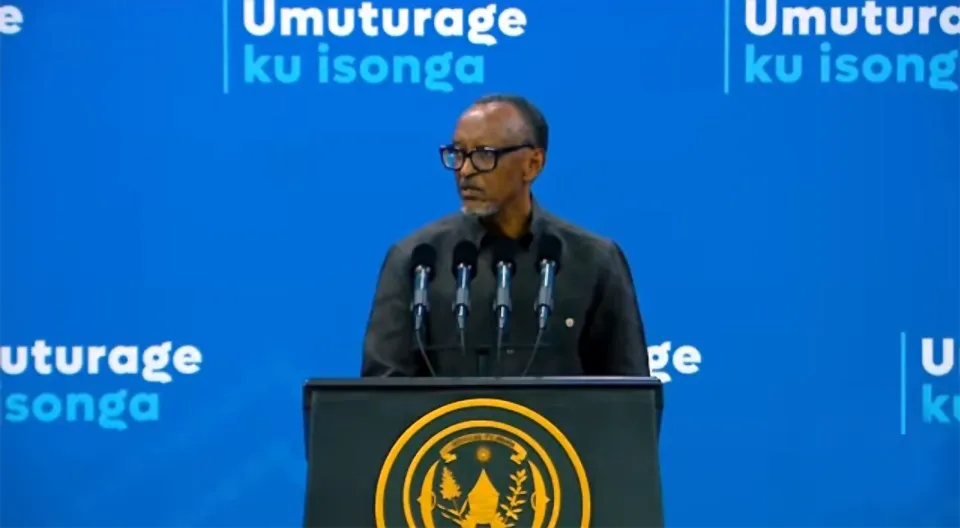
On 23 March 2026, in a hall filled with Cabinet Ministers, Provincial Governors, District Mayors and government agency heads gathered under the lofty theme “Citizens First” (Umuturage Ku Isonga), President Kagame looked out at a room of grown adults — senior leaders of a sovereign nation — and told them, in words that would reverberate across social media from Kigali to Kampala and beyond, to stand up.
Not metaphorically. Not in the motivational-poster sense. Literally. On your feet. Now. All of you.
“If you cannot handle these responsibilities, why don’t you resign? Bad things happen under your watch, and no one steps up to stop them.”
President Paul Kagame, Gako, 23 March 2026
The clip went viral with the speed that only truly extraordinary public events achieve — the speed of people saying, ‘You have to see this.’ By the time Monday’s sun had set over the Bugesera hills, the video was bouncing around X (formerly Twitter), WhatsApp groups across the continent, and living room television screens from Johannesburg to Lagos to London. Reactions? Divided. Which, of course, is precisely the point.
The Room Where It Happened
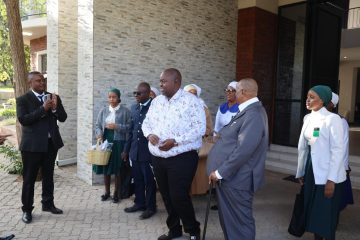
The setting was appropriately unforgiving. The Rwanda Military Academy in Gako is not a venue that whispers comfort. Its architecture says discipline. Its function says excellence. Its history says Rwanda does not do things by half-measures. This was not a nice hotel conference room with good coffee and biscuits. This was the national conversation about governance, and you were expected — required — to be present. Mentally. Physically. Spiritually.
Hundreds of leaders had converged for what officials described as the first gathering of its kind since the COVID-19 pandemic — a rare collective audit of Rwanda’s performance at the intersection of central and local government. Prime Minister Justin Nsengiyumva opened proceedings. The agenda was heavy: coordination failures, repeated mistakes, project implementation gaps, and service delivery crises. Rwanda’s fast-approaching targets — upper-middle-income status by 2035, a 9.4% GDP growth rate already notched in 2025 — were the backdrop. The stakes, in other words, were not low.
So when a man — or indeed several — apparently succumbed to the considerable pull of gravity upon the eyelids, Kagame’s reaction was not so much anger as a kind of forensic disappointment. The face in the viral clip tells you everything. This is a man whose expression does not so much frown as file a formal complaint.
The Anatomy of a Dressing-Down
What followed was, by any standard, a masterclass in what political scientists might cautiously call ‘motivational corrective communication’ and what the rest of us call being told off in front of your colleagues. Kagame demanded that the offenders rise. They rose. He then proceeded to interrogate the fundamental premise of their professional existence.
The questions were rhetorical, but they hit like an exam you had not revised for: Why are you here if you cannot pay attention? What are you doing in this job if the same mistakes repeat themselves, once, twice, three times? If you are tired of working for your country, you are free to leave. This last line — the presidential door held open with forensic courtesy — was both the most gentle and the most devastating thing said at Gako that day.
“You cannot be like cows to be herded. Leaders must think independently and use their judgment in solving problems.”
President Kagame
The broader rebuke was a catalogue of institutional sins. There was the Muvumba irrigation project — brilliantly designed to provide both agricultural water and clean drinking water to citizens — which was implemented with one component and forgotten entirely about the other. When the Eastern Province Governor, Prudence Rubingiza, admitted to Kagame’s face that, yes, they had simply overlooked the water distribution component, the President’s response was a quiet study in disbelief. How, he asked, does a critical project component that directly affects whether citizens have water to drink get simply… forgotten?
Then there was the case in Karongi District. A woman, urgently ill, presented herself for medical care — turned away because of a technical irregularity in her community health insurance registration. She went home. She later died. Kagame called it, without flinching, criminal. ‘Systems exist to serve people,’ he said, ‘not the other way around.’
It was at this point that anyone in the room still drowsy would have achieved a condition of acute alertness.
The Internet Weighs In
The social media reaction was, predictably, a continent’s worth of contradictions compressed into 280 characters and TikTok comment threads. Rwanda’s famously efficient public communications machine — a country that consistently tops African governance and business environment rankings — found itself both praised and critiqued by a global audience that saw in the clip whatever it had already decided to see.
For Kagame’s supporters — and they are numerous — the clip was a vindication of everything they believe Rwanda’s post-1994 reconstruction has been built on: relentless accountability, zero tolerance for mediocrity, and a president who asks of his officials nothing he has not asked of himself across three decades of building a nation from unimaginable ruin. ‘This is why Rwanda works,’ ran the sentiment across one camp. ‘Other African leaders hold funerals, Kagame holds standards.’
For his critics — also numerous, and increasingly vocal beyond Rwanda’s borders — the images were a different kind of evidence: a president who confuses authority with command, accountability with humiliation, and governance with fear. ‘Dictatorship dressed up as efficiency,’ they countered. ‘No amount of clean streets justifies political theatre at the expense of human dignity.’
“Other African leaders hold funerals. Kagame holds standards.”
Social media reaction, X/Twitter, March 2026
Both camps were, in the manner of all online debates, arguing past each other. What they were each responding to was not simply one morning at a military academy in Bugesera. They were responding to Paul Kagame himself — a figure who has always defied comfortable categorisation, who rebuilt a genocide-shattered nation with remarkable speed and without particularly caring whether his methods received international applause.
The Kagame Doctrine — Known, Yet Always Surprising
Here is what every senior Rwandan civil servant knows, and yet somehow occasionally needs to be reminded of: Paul Kagame is not running a bureaucracy. He is running a project. The project is a national resurrection, pursued with the urgency of someone who watched his country nearly cease to exist. Thirty-two years on from 1994, the project remains unfinished. The targets are specific, the timelines are real, and the president’s patience with under-delivery is inversely proportional to his ambition for Rwanda’s future.
Rwanda has, under its watch, climbed to remarkable positions in global governance indices. The country regularly tops Africa’s charts in government effectiveness, ease of doing business, and public sector transparency. Kigali is held up as a model of urban planning. The national health insurance system — yes, the same one whose bureaucratic failure cost that woman in Karongi her life — covers the vast majority of the population. These are not accidents. They are the product of exactly the kind of relentless, uncompromising demand for performance that was on full display in Gako.
Which does not make the Gako moment any less extraordinary as a piece of political drama. Because here is the thing: when Kagame stood before those hundreds of leaders and told them that arrogance would destroy their country, that leadership cannot be passive, that officials who need to be herded like cattle have misunderstood the nature of their office — he was not departing from script. This is the script. This is the doctrine, delivered live and on camera, for anyone who needed to be reminded.
The Men Who Had to Stand Up
Spare a thought, if you will, for the individuals who found themselves on their feet that morning at Gako. Civil servants, in most countries, are trained to manage risk. Their professional superpower is the ability to last a career without ever personally becoming news. Anonymity is the calling. Longevity is the reward.
These men — or women — have now been watched by several hundred thousand strangers. Their involuntary moment of inattention has been screenshotted, clipped, replayed, and shared in group chats from Nairobi to New York. Somewhere in Rwanda today, a civil servant is sitting in a meeting with the posture of someone who has resolved, with profound conviction, never to let their eyes close again in a public forum as long as they shall live.
In one sense, that is precisely the point. Accountability, Kagame has always argued, should not require a presidential visit to have effect. It should be internalised. The problem, he told his audience, is that the same errors keep recurring — not because people lack the intelligence to know better, but because the habits of complacency persist. The meeting at Gako was, in some respects, the latest iteration of that argument: made in person, made loudly, and made in a way that would not be easily forgotten.
“Even if you improve five out of ten cases, there must be real effort.”
President Kagame
What the clip will not settle — what no clip ever fully settles — is the question of whether this mode of leadership produces the results it claims to produce because of its intensity, or in spite of it. Whether the fear of a presidential dressing-down on camera is what actually drives Rwanda’s civil service to perform, or whether it is training, systems, culture, and consequence — and the Gako theatrics are simply the live broadcast of something that already exists in more structural form.
What Remains
What is not in dispute, even among the most hardened critics, is this: Rwanda is not, by the standards of the region or the continent, a country where the citizen is invisible to the state. The grievances Kagame articulated at Gako — the woman denied healthcare, the irrigation project with a missing component, the official too proud to admit failure, the leader who waits to be told what is obvious — are real grievances. They are the kind of mundane, structural failures that cost real people real lives and real futures across Africa every single day, in countries whose presidents are not watching.
Whether a president publicly summoning officials to their feet is the optimal tool for addressing them — that debate will continue, vigorously, on the internet and in the halls of governance institutions. But the image itself, the tightly pulled face, the quiet thunder of a man for whom Rwanda’s survival has never been an abstraction — that image says something true about the cost of building a country and the relentlessness it demands.
Somewhere in Gako on 23 March 2026, a civil servant found their feet. They stood. They were awake.
Which, when you think about it, is probably what the meeting was for in the first place.