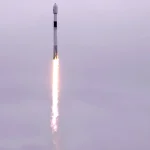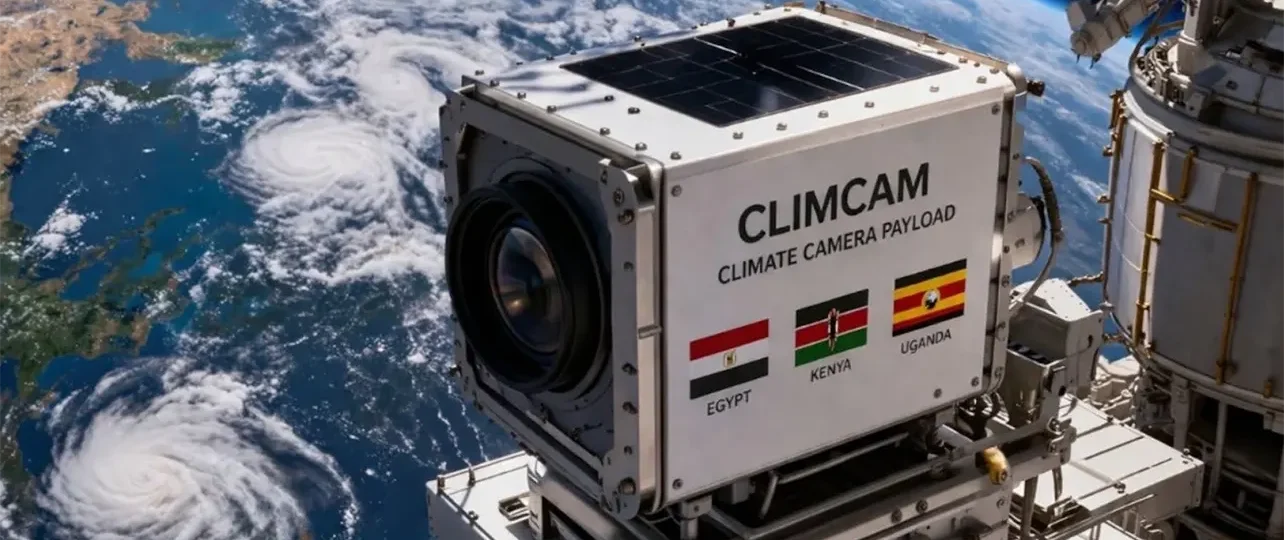

ON the same day that NASA’s Artemis II capsule, Integrity, splashed down in the Pacific Ocean – completing humanity’s first crewed journey to the vicinity of the Moon since 1972 – a SpaceX Falcon 9 rocket was climbing through the Florida night sky carrying something of equal consequence for a continent long told that space was not its domain. Aboard that rocket was ClimCam: a compact, AI-powered climate observation payload built collectively by three African nations, now en route to a permanent berth on the International Space Station.
It is a coincidence of timing that carries the weight of symbolism. As the world applauded the spectacle of four astronauts arcing around the Moon at a record-breaking 252,021 miles from Earth, Africa was quietly inscribing its own coordinates in the story of human spacefaring. The ClimCam mission – a trilateral collaboration between the Kenya Space Agency (KSA), the Egyptian Space Agency (EgSA) and the Uganda National Space Programme – launched successfully on 11 April 2026 aboard the Cygnus NG-24 resupply mission from Cape Canaveral Space Force Station in Florida. The continent did not send an astronaut to lunar orbit. It sent intelligence – watching eyes trained on its own land, its own floods, its own droughts, its own future.
These are not small things.
“Africa did not wait for permission to reach for the stars. It built something, competed globally, won, and launched it. That is sovereignty made real.”
THREE COUNTRIES. ONE PAYLOAD. A CONTINENTAL STATEMENT.
ClimCam – the Climate Camera Payload – is a 3.5-kilogram instrument that will be mounted on the Airbus Bartolomeo external platform, attached to the European Columbus Module on the ISS. From an altitude of approximately 400 kilometres, it will capture daily high-resolution colour imagery of at least 20 square kilometres over Eastern Africa, with a ground sampling distance of 10 metres and up to four imaging opportunities per day. Its core purpose is earthly and urgent: to deliver near-real-time, AI-processed weather and climate data that will sharpen disaster management, strengthen natural resource planning and build climate resilience across a region routinely ravaged by floods and drought with inadequate early-warning infrastructure.
The project originated through a competitive Announcement of Opportunity issued by the United Nations Office for Outer Space Affairs (UNOOSA) in partnership with Airbus Defence and Space, under the UNOOSA Access to Space for All Initiative. The three African agencies responded, competed against proposals from across the globe, and won. The payload was then assembled, integrated and tested at EgSA facilities in Cairo, before undergoing final end-to-end validation at Airbus facilities in Houston, Texas, and receiving full clearance for spaceflight. That pipeline – from Nairobi to Cairo to Houston to orbit — is itself a statement about African technical capacity in the 21st century.
Uganda’s Minister for Science, Technology and Innovation, Monica Musenero, underlined the practical stakes of the mission: the camera will pass directly over East Africa, generating the very data that communities need to anticipate extreme weather events, and that governments need to plan food security, protect water bodies, and respond to environmental emergencies in real time. The Commission’s six-month initial operational period is scheduled to begin with commissioning in August 2026, with data transmission expected before the year is out.
“The successful assembly, integration and testing of the payload in Cairo, followed by validation in Houston, show that African space agencies can compete on the global stage.”
A CONTINENT IN ASCENT: THE NEW AFRICAN SPACE ARCHITECTURE
The ClimCam launch does not arrive in isolation. It is the highest-profile output yet of a sustained, continent-wide acceleration in space capability that has been building quietly but decisively for several years.
The African Space Agency, established in 2025 under the African Union, has provided the institutional spine for what is becoming a genuine continental space programme. National agencies from Egypt, Nigeria, Rwanda, Zimbabwe, Namibia, Kenya and others have been deepening coordination, sharing technological expertise and aligning their ambitions with the continent’s development imperatives through forums such as the NewSpace Africa Conference — most recently held in Cairo in 2025, themed around ‘Empowering Africa’s Innovation Through Space-Driven Solutions.’
Kenya has emerged as a particularly dynamic actor within this ecosystem. In January 2026, the Kenya Space Agency became the only African country selected to host the prestigious 2026 Amateur Radio on the International Space Station (ARISS) programme — meaning that between July and December this year, Kenyan students, industry professionals and citizens will communicate directly with astronauts aboard the ISS in live radio exchanges, a rare global distinction. Kenya has simultaneously joined the Space Climate Observatory network led by France’s CNES and, in December 2025, announced a search for a Space Systems Expert to guide plans for a national spaceport. The country will host the Global Data Festival and Kenya Space Expo and Conference 2026 in Nairobi in June, cementing its position as a regional hub for space-led innovation.
Kenya’s space history, moreover, stretches further than many realise. In 1964, Kenya and Italy collaborated to establish a satellite launching and tracking base in Malindi — from which more than 20 sounding rockets and nine satellites were launched between 1967 and 1988. Kenya’s first university nano-satellite was deployed from the ISS in 2018. The arc from Malindi to ClimCam is one of continuous, if often underreported, accumulation.
Egypt brings deep institutional infrastructure to the partnership, providing the engineering facilities that built and tested ClimCam. Uganda, with a newer but fast-maturing programme, brings the political commitment of a government that has made space science a national priority. Together, the three nations demonstrated something the Global South has consistently been told it cannot do: they assembled a space-qualified instrument, validated it to international standards, and launched it successfully to humanity’s foremost orbital laboratory.
“This is what pan-African solidarity looks like when it stops being a slogan and becomes a rocket on a launchpad.”
THE ARTEMIS CONTEXT: HISTORY MADE ON BOTH SIDES OF THE EQUATOR
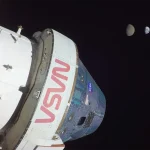
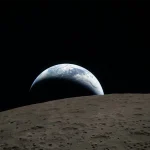
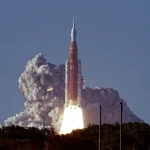
The timing of ClimCam’s launch against the backdrop of Artemis II is not merely poetic — it is analytically important. Artemis II launched on 1 April 2026, sending Commander Reid Wiseman, Pilot Victor Glover, Mission Specialist Christina Koch and Canadian astronaut Jeremy Hansen on a 695,081-mile journey around the Moon and back. Splashdown occurred on 10 April — just hours before Africa’s own payload lifted off. The mission set a new human distance record from Earth, surpassing the Apollo 13 record by 3,366 miles, and for the first time in over 50 years, human beings have seen our Moon up close.
Artemis II is, by any measure, historic: the first crewed lunar flyby in more than half a century; the first time a Black astronaut has flown to the vicinity of the Moon; the first time a woman has done so; the first non-American to make that journey. These are genuine firsts. NASA’s deputy associate administrator called it ‘a new era of human space exploration,’ with Artemis IV planned to land a crew on the lunar surface by 2028.
But as the world — rightly — celebrated those firsts, Africa was writing its own. ClimCam will not carry an astronaut. It will carry data: AI-processed, near-real-time imagery that could save the lives of farmers in the Rift Valley, flood-threatened communities in Uganda’s river basins, and climate planners across Eastern Africa who have long operated with inadequate satellite coverage. That is a different kind of giant leap — one measured not in distance from Earth, but in proximity to the people the technology serves.
The question that Artemis II raises for the Global South is one of access and agency: as humanity prepares to return permanently to the Moon, and ultimately to extend its reach to Mars, who gets to be part of that future? Africa’s answer, expressed through ClimCam, through the African Space Agency, through Kenya’s ARISS selection, through the NewSpace Africa ecosystem, is increasingly clear: not as passengers, not as observers, but as builders.
WHEN NO ONE ELSE COULD HEAR THEM, SOUTH AFRICA LISTENED
Buried beneath the global spectacle of Artemis II was a quieter, equally consequential African contribution — one that most of the world’s media entirely missed. While NASA’s astronauts were looping the Moon at record-breaking distance, the ground station that kept them tethered to Earth during critical phases of that journey was not in Houston, not in Madrid, not in California. It was in Hartebeesthoek, in the Magaliesberg mountains of Gauteng, South Africa.
The South African National Space Agency’s (SANSA’s) Hartebeesthoek Ground Station — the largest in the southern hemisphere and on the African continent — was contracted as part of the global network of tracking stations that monitored Orion throughout its 10-day mission. As the Earth rotates, different stations come into and fall out of range of a deep-space spacecraft. When other stations could not see Orion, Hartebeesthoek could. When the four astronauts needed to be heard by Mission Control, South Africa was listening.
SANSA’s Chief Engineer for Space Operations, Eugene Avenant, confirmed the scope of the agency’s involvement. The Hartebeesthoek facility tracked the Orion spacecraft’s signal continuously during its visible passes, relaying telemetric data — the health of the crew module, the state of the spacecraft’s systems, its position and velocity — to the mission’s communications network. ‘Our ground station has been tracking the signal,’ Avenant said, ‘and apart from relaying telemetry, it has also been making extremely accurate measurements of the frequency of the return signal.’ That frequency data, compiled with readings from multiple ground stations around the world, allowed scientists to calculate Orion’s precise position and orbital trajectory — the kind of navigational certainty on which astronauts’ lives depend.
The precision instrument enabling those measurements is a hydrogen maser atomic clock — technology capable of measuring time with extraordinary accuracy, and essential for the Doppler frequency analysis that determines how fast a spacecraft is moving and in what direction. For a crewed mission travelling farther from Earth than any human since 1970, operating in the gravitational and electromagnetic environment of deep space, that level of precision is not a technical nicety. It is the difference between a spacecraft that hits its re-entry corridor and one that does not.
Big news! Egypt, Kenya, and Uganda have officially launched the #ClimCam to the ISS via Cygnus NG-24! ??????????????
— Abdelrahman ELGhawas ???? (@Kellar999) April 11, 2026
?This tri-national AI-powered camera will monitor climate change & extreme weather across East Africa. A massive leap for African space tech#Egypt#Kenya#Uganda#ISS pic.twitter.com/W7gTF74aOS
SANSA Space Operations Executive Director Raoul Hodges offered a characteristically understated account of the contribution: ‘We are a small fish in this pond. But it is wonderful to be part of a historic event. It is a huge team effort to get the spacecraft into space and to get the astronauts back safely.’ The Hartebeesthoek station used two antennas for the mission — one dating to 1963, one to 1988, both updated and maintained to modern operational standards — with one serving as backup throughout. The facility tracked Orion from launch on 1 April through to the spacecraft’s final approach home.
The historical resonance is not incidental. Hartebeesthoek was originally built by NASA in 1963 and handed over to South Africa in 1976. It supported missions during the Apollo era — including the Apollo 11 Moon landing — before consolidating into SANSA after the agency’s establishment in 2011. The station that helped put humans on the Moon more than half a century ago helped bring them safely back from lunar vicinity in 2026. That continuity matters. South Africa has not been a spectator in the story of human space exploration. It has been, quietly and consistently, part of the infrastructure that makes it possible.
“When other stations were out of range, South Africa kept humanity’s lunar crew connected to Earth. That is not a footnote. That is the story.”
SANSA is already looking ahead. A new ground station is under construction in Matjiesfontein in the Western Cape, designed to provide critical services for Artemis IV — now confirmed as the mission that will return humans to the lunar surface. The Matjiesfontein station will extend South Africa’s deep-space tracking capacity, securing the country’s role in the architecture of humanity’s return to the Moon and its eventual push toward Mars. South Africa is not merely a participant in the current chapter of space exploration. It is investing in its seat at the table for the chapters yet to come.
SOVEREIGNTY THROUGH SCIENCE
There is a deeper political logic at work in Africa’s space push that mirrors the continent’s broader assertions of sovereignty across energy, trade and governance. The argument that space is a luxury Africa cannot afford has always been a false one — and African space agencies have systematically disproved it.
ClimCam’s purpose — monitoring climate, strengthening disaster response, supporting agriculture and water management — is not ancillary to development. It is development. The Global South’s climate vulnerability is acute, its data infrastructure is chronically underfunded, and its dependence on satellite imagery controlled by external powers has structural costs that rarely feature in diplomatic conversations. A continent with its own eyes in orbit is a continent with greater command of its own information environment. That matters for sovereignty just as much as it matters for meteorology.
The African space economy, meanwhile, is growing rapidly. It is projected to reach $22.64 billion by 2026, driven by advances in satellite technology, Earth observation, navigation services and downstream applications in agriculture, urban planning and natural resource management. The continent is not investing in space for prestige — it is investing in it because space-based tools increasingly underpin the decisions that determine whether economies grow and whether communities survive.
Brigadier Hillary Kipkosgey, Acting Director General of the Kenya Space Agency, framed Kenya’s ambitions plainly: space technology as a frontier for economic opportunity, for STEM investment, for national capability that compounds over time. ‘Joining the SCO network is a transformative milestone for Kenya,’ he said earlier this year, in language that could stand for the continent. ‘By harnessing space technology, we can address climate vulnerabilities with precision and innovation.’
“A continent with its own eyes in orbit is a continent with greater command of its own information environment — and that is sovereignty.”
WHAT COMES NEXT
ClimCam is scheduled to be commissioned in August 2026. Once operational, it will transmit daily imagery of Eastern Africa — flood events, agricultural conditions, weather patterns — that African governments and communities can use in real time. The Nairobi Space Expo in June will convene the ecosystem of policymakers, entrepreneurs and scientists who are building the next layer of that infrastructure. Kenya’s ARISS hosting window, running from July through December, will bring the ISS into direct radio contact with Kenyan schoolchildren and citizens — turning space into a lived experience rather than a distant abstraction.
Further out, the trajectory points toward a continent that will not merely consume space services but generate them. The African Space Agency provides the governance structure. Individual national programmes provide the engineering talent. Competitive wins like ClimCam provide proof of concept. And the generation of young Africans who will watch a Kenyan student speak to an astronaut in orbit later this year will draw their own conclusions about what is possible.
As Artemis II demonstrated, the pull of the heavens is universal. What ClimCam demonstrates — with its 3.5 kilograms of African ambition, now floating toward the International Space Station — is that the response to that pull need not be the exclusive domain of the powerful.
Africa is rising. It is rising toward the stars, on its own terms, with its own hands, and for its own people. Through ClimCam’s 3.5 kilograms of East African ambition now orbiting aboard the ISS, through Hartebeesthoek’s atomic clocks keeping lunar astronauts connected to Earth, through the institutions and engineers and scientists who showed up and did the work — that is not a metaphor. That, as of 11 April 2026, is a fact confirmed by telemetry.