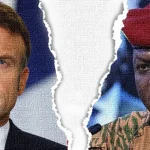
IN the morning of 26 May 2026, Burkina Faso’s minister of territorial administration signed a decree that revealed, with the clarity of a confessional, exactly what kind of government Captain Ibrahim Traoré is running in what the country’s own name declares to be the Land of the Upright People.
The target was the General Union for Burkina Students – known by its French initials, UGEB – the country’s largest student organisation, founded in 1960. The offence, according to the junta’s prosecutors: “glorification of terrorism.” The actual provocation: a public statement in which UGEB dared to point out that Traoré’s government, nearly four years after seizing power, had failed to restore security despite what the students described as “excessively publicised consignments of military equipment.”

The decree suspended UGEB’s activities for a renewable period of three months, with no further explanation offered. Within hours, a prosecutor in the capital Ouagadougou announced a criminal investigation against “the author or authors as well as any potential accomplices” of the student statement. The legal mechanism deployed was the same one increasingly used across the Sahel to silence critique: anti-terrorism statutes repurposed as instruments of political censorship.
“The leopard cannot change its spots. Every time Traoré reaches for Sankara’s ghost to legitimise his rule, reality reaches back — and the spots show.”
Sankara’s Name, Sankara’s Antithesis
There is a particular cruelty in watching this drama play out under the banner of Thomas Sankara, the revolutionary leader who renamed the country in 1984, who mobilised students and workers into the very civic fabric that UGEB has long represented, and who was assassinated in 1987 – with the complicity, many historians believe, of the very regional and international forces whose descendants now whisper in junta ears across the Sahel.
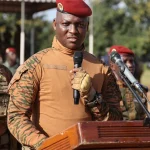
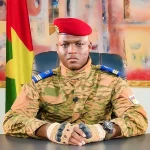
Traoré and his coterie have built their public image around Sankara’s iconography: the red beret, the anti-imperialist rhetoric, the nationalist bravado, the staged photographs in military fatigues at rallies carefully curated for the cameras. They have expelled French forces, courted the Wagner Group’s successor operations, and positioned themselves as the vanguard of Pan-African sovereignty against neo-colonial interference.
But Sankara did not suppress student unions. Sankara – whatever one’s full assessment of his governance — believed in the political engagement of youth. He spoke of the lumpen intelligentsia’s obligation to serve the people. He would not have recognised, let alone celebrated, a government that criminalises students for asking: why, after four years of military rule and a river of weapons, are our people still dying at the hands of jihadist insurgents?
The answer, of course, is that Traoré’s junta is not Sankara’s revolution. It is its photocopy – a photocopy of a photocopy, washed out and distorted, wearing the colours without the content.
A Pattern Written in Ink and Fear
The suppression of UGEB is not an isolated moment of authoritarian irritation. It is the latest data point in a systematic dismantling of Burkina Faso’s civic space that has accelerated in lockstep with the junta’s political consolidation.
Since seizing power in September 2022 — itself the second coup within that year — the Traoré administration has suspended independent media outlets, banned civil society organisations, restricted political pluralism, and deployed a broadening toolkit of repression against anyone who has stepped into the light of public disagreement. Journalists have been disappeared. Opposition figures have been abducted. Civil society activists have been subjected to enforced disappearance and torture. Prosecutors and judges who showed insufficient deference to the junta’s agenda have been conscripted into military service — a form of punishment that turns the legal system itself into a weapon against the rule of law.
A Burkinabè human rights activist living in exile – because remaining in-country is no longer a safe option for critics – characterised the investigation against UGEB’s leadership as evidence that the judiciary had been “increasingly subordinated to the junta’s political and security agenda.” That is a polite formulation for what, in plainer language, amounts to the weaponisation of law enforcement against free thought.
UGEB was founded in 1960. It has survived colonial rule, single-party governance, coups, and structural adjustment. It may survive this, too. But the cost accumulates.
The Security Argument Collapses Under Its Own Weight
Every authoritarian government that has ever suppressed civil society has done so under the rationale of security. Burkina Faso’s junta is no different, and no more honest about it. The Islamist insurgency that Traoré’s government promised to defeat has, by virtually every independent measure, expanded its territorial reach and its body count since the military took over. Large swathes of the north and east remain under insurgent control or siege. Humanitarian access is curtailed. Civilian casualties mount.
It is precisely this failure – the gap between the junta’s martial posturing and its on-the-ground impotence against the insurgency – that UGEB’s statement identified. That is the statement for which students now face criminal investigation. The junta did not refute the argument. It criminalised the act of making it.
This is the tell. Governments that are winning do not need to silence their critics. Governments that are governing do not need to shut down sixty-year-old student unions for noting that the emperor’s new military hardware has not stopped the bleeding. The instinct to suppress is, in this context, an admission – a confession dressed up in a legal decree.
What the World Should Be Saying
The African Union, ECOWAS, and the broader international community face a deepening credibility deficit when it comes to the Sahel juntas. Having already demonstrated limited appetite or capacity to reverse the military takeovers in Mali, Niger, and Burkina Faso, these institutions now confront the question of what, if anything, they will say when student unions are criminalised for asking about security failures.
The answer matters not just for Burkina Faso but for the continent’s democratic project more broadly. A silence here – a diplomatic shrug dressed up as respect for sovereignty — is read by juntas everywhere as permission. And juntas, once granted permission, do not moderate. They escalate.
The UGEB must be allowed to resume its activities immediately. The criminal investigation against its leadership must be dropped. The three-month suspension, renewable at the junta’s pleasure, must not be renewed. These are not radical demands. They are the minimum threshold for a government that wishes to be taken seriously as a legitimate political actor rather than a military clique with brand consultants.
The Spots on the Leopard
There is an old observation, so widely attributed it has become its own kind of wisdom: the leopard cannot change its spots. What is meant, of course, is that fundamental character is not amenable to cosmetic revision. A government that rules by fear does not become one that governs by consent simply because its leader quotes Sankara at rallies.
Every time Traoré and his inner circle attempt to present themselves to the continent and the world as the authentic heirs of a liberatory tradition, something happens. A journalist disappears. A judge is conscripted. A civil society organisation is banned. And now – a student union, one older than the junta’s entire philosophical framework, suspended for the crime of asking the questions that every citizen in a democracy has the right to ask.
The spots show. They show every time. And the students of Burkina Faso – the inheritors of a tradition of youth activism that stretches back to the independence era – deserve better than a government that answers their questions with a prosecutor’s docket.
So, one is compelled to note, does the memory of Thomas Sankara. He was many things. He was not this.