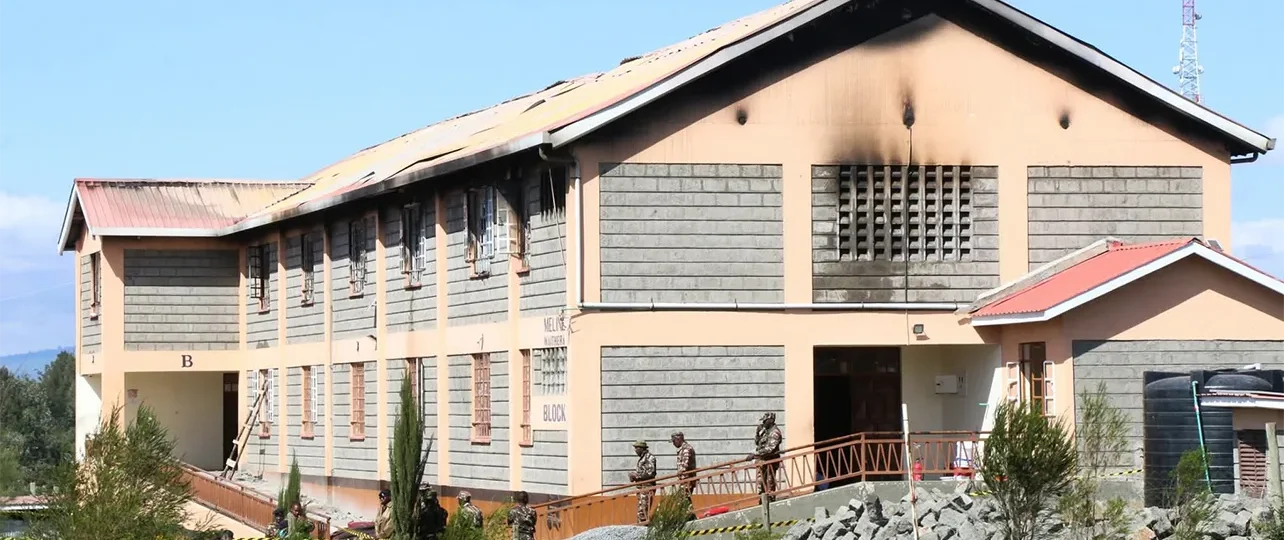

ON the dead of night, while their families slept hundreds of kilometres away, the girls of Utumishi Girls Academy awoke to smoke and flame. It was barely past midnight. The fire tore through one of the school’s dormitories in Gilgil, in Nakuru County, central Kenya, with a ferocity that gave many students no time to think — only to run, jump, or be consumed.
By dawn on Thursday, 28 May 2026, at least 16 young students were confirmed dead. Seventy-nine others had been rushed to hospitals across the region – some with severe burns, others with broken limbs sustained as they leapt from upper-storey windows in a desperate bid to escape the inferno below.
Kenyan authorities have announced the arrest of eight students on suspicion of arson over the fire. “Preliminary investigations have identified eight students as persons of interest in connection with the planning and execution of the suspected arson attack. The eight girls have since been arrested and are currently in police custody,” the Directorate of Criminal Investigations said in a statement.
Kenya’s Education Cabinet Secretary Julius Ogamba, speaking later in the day, confirmed the death toll and reported that seven students remained hospitalised in critical condition. Emergency responders from the Kenya Red Cross, police and civil authorities had been deployed to the scene after the fire was officially reported at approximately 3:30 am, though witnesses and parents at the school said it had broken out as early as 1:00 am — a gap in response time that survivors and anguished parents were already demanding answers about.
“Those who were on the upper floor were jumping, and that is why most of them were hurt. We have heard that some of them were burnt and are in the hospital.”
Parent outside Utumishi Girls Academy
The cause of the blaze had not been officially determined as of Thursday evening. The school was cordoned off to allow investigators from the Directorate of Criminal Investigations (DCI) to examine the scene. Interior Cabinet Secretary Kipchuma Murkomen and DCI Director Mohammed Amin arrived at the institution by helicopter, underscoring the gravity with which the government was treating the incident. But for the parents who had flooded the school gates in the early hours, frantic and unable to reach their daughters, the arrival of government officials offered little immediate comfort.
‘A DOOR THAT SHOULD HAVE SAVED THEM WAS LOCKED’
In the horrifying hours after the fire, a devastating detail began to emerge — one that has become grimly familiar in Kenya’s long catalogue of school fire tragedies. A parent speaking to journalists at the scene alleged that an emergency exit in the dormitory had been locked during the fire, forcing students in the upper section of the building to jump rather than evacuate through designated safety exits.
“The dormitory is divided into upper and lower sections,” the parent recounted. “The matron opened one of the emergency doors to allow students to leave during the incident. But he gave the learners a signal and immediately left the dormitory, leaving the students inside.” The parent alleged the door to the upper section remained locked, leaving students trapped with no option but to hurl themselves from the height to escape the flames.
Kenya Red Cross spokesperson confirmed that first responders, ambulances, and psychosocial support teams had been mobilised. Injured students were evacuated to multiple medical facilities across the region and were reported to be in varying but stable conditions. Teachers, meanwhile, conducted roll calls in the school grounds as authorities attempted to account for every student. Currently, parents are divided into different groups as teachers work through the exercise.
KEY FACTS
▸ Death toll confirmed: 16 students killed
▸ Injured: 79 students, 7 in critical condition
▸ Fire reported at approx. 3:30 am; began approx. 1:00 am
▸ Location: Utumishi Girls Academy, Gilgil, Nakuru County
▸ School closed pending investigation
▸ DCI, Interior CS, Education CS deployed to the scene
▸ Cause of fire: under investigation

A PRESIDENT’S CONDOLENCES — AND A NATION’S GRIEF
President William Ruto broke his silence in a statement issued Thursday morning, expressing what he described as unimaginable grief at the loss of young lives. His words were measured, yet carried the weight of a nation that has heard similar condolences too many times before.
“Our hearts and prayers are with the families who have lost their beloved daughters in the tragic fire at Utumishi Girls Academy in Gilgil. No words can truly ease the pain of losing young lives filled with promise, hope, and dreams for the future.”
President William Ruto
The President confirmed that investigations had been launched into the cause of the fire and that security and education officials had been deployed to the institution to coordinate rescue efforts and provide psychosocial support. “Our immediate attention is focused on the rescue of those affected, the treatment of the injured, and support for their families, while investigations continue into the cause of the fire,” he said. “As a nation, we mourn with the parents, guardians, teachers, and fellow students who are enduring this unimaginable tragedy. Poleni sana.”
Government Spokesman Isaac Mwaura said the state had received the reports with “deep shock and profound sadness”, and urged Kenyans to remain calm and refrain from sharing unverified information or disturbing images on social media. In a country with high smartphone penetration, graphic photographs and videos from the scene had already begun circulating widely before authorities issued the warning.
Among the political leaders who spoke out was former Democratic Party chair Eugene Wamalwa, whose statement captured the raw emotional reality facing the nation’s parents. “My heart bleeds this morning as our country comes to terms with the horrifying tragedy at Utumishi Girls Academy in Gilgil,” he said. “It is difficult to find words strong enough to comfort parents whose daughters left home in pursuit of education and dreams, only for their lives to be tragically cut short. Today, Kenya mourns. Today, parents cry. Today, hearts are broken.”
Nairobi MP Esther Passaris also called for urgent national reflection on systemic failures. The tragedy, she said, had once again brought to the fore concerns around school fire safety, emergency preparedness, dormitory standards, and mental health support in learning institutions — concerns that she and others have raised repeatedly after prior tragedies, and which, critics say, have been met with task forces and tough talk rather than structural reform.
A HAUNTING PATTERN: KENYA’S GRIM ROLL-CALL OF SCHOOL FIRES
The fire at Utumishi Girls Academy is the latest in a devastating and recurring pattern of school dormitory fires that has claimed hundreds of young Kenyan lives over the past three decades. Each tragedy has been met with national mourning, official investigations, and promises of reform. And yet the fires keep coming.
The worst school fire in Kenya’s history — indeed, one of the worst on the African continent — occurred on the night of 25 March 2001, when a dormitory at Kyanguli Secondary School in Machakos County was set ablaze in a deliberate act of arson. Sixty-seven boys perished in the inferno, killed by two 16-year-old students whose grievances against the school’s new principal — over food quality, fee demands, and the cancellation of national exam results — had curdled into catastrophic violence. A memorial park now stands in place of the dormitory.
In 1997, 26 girls were killed in a fire at Bombolulu Girls Secondary School in Kwale County — another arson attack, in another dormitory where one of the two exits had been locked from the outside, and where barred windows left the trapped students no means of escape. The chilling architectural detail — locked doors and grilled windows — that parents at Utumishi described on Thursday is the same detail that haunted Bombolulu three decades ago.
The horror repeated itself in August 2012, when eight young pupils died in a fire at Asumbi Girls Boarding Primary School in Homa Bay County. Here too, the dormitory windows were barred and there was no emergency exit — a design so dangerous it had already been cited after Bombolulu. The doors were reportedly locked from the outside. The bodies of the victims were burnt beyond recognition.
In September 2017, ten girls were killed at Moi Girls High School in Nairobi — a fire later attributed to arson by a disgruntled Form 1 student. In 2024, the cycle resumed with particular brutality: on 5 September, 21 boys — some as young as nine years old — burned to death in a dormitory at Hillside Endarasha Academy in Nyeri County, a private school housing over 800 students. President Ruto declared three days of national mourning and vowed those responsible would be held to account. Days later, another fire broke out at Isiolo Girls High School, and yet another at Nija High School in Meru County. The fires of September 2024 shocked the nation into a brief frenzy of national discussion about school safety — and then it subsided.
“Tough talk from all concerned bodies, the Ministry of Education and government leaders follows after every tragedy. And then, the fires keep coming.”
The Standard, Kenya
The pattern is clear, and it is damning. Investigations are launched. Reports are filed. Recommendations are made — better fire safety equipment, emergency exit protocols, and dormitory inspection regimes. Task forces are constituted. And then, slowly, the urgency fades. Until the next fire.
THE QUESTIONS THAT CANNOT WAIT
For the families of the 16 girls who died at Utumishi on Thursday, abstract policy debates are secondary to inconsolable grief. These were daughters who had left home for school — that most fundamental of parental acts of hope — only to be buried in smoke and flame while their parents slept. The anguish outside the school gates on Thursday morning, as parents arrived to find the gates cordoned off and roll calls still underway, was the anguish of every parent who has ever sent a child to boarding school and understood, at some primal level, that trust was placed not just in teachers but in the very bricks and beams of the building that would house their child.
The questions the nation must now ask are the ones that should have been resolved in 1997, in 2001, in 2012, in 2017, and in 2024. Why are dormitory emergency exits still being found locked? Why are windows still being barred? Why is there a gap of more than two hours between when a fire begins and when emergency services are notified? Why have the recommendations of successive government task forces on school fire safety not been implemented and enforced?
The Education CS Julius Ogamba and Interior CS Kipchuma Murkomen arriving by helicopter on Thursday is a powerful image of government responsiveness. But for communities that have watched the same helicopter descend on the same kind of scene too many times, what matters now is not the symbolism of arrival — it is the substance of action.
The school has been closed pending investigation. Investigations are underway. Psychosocial support teams are deployed. These are the correct immediate steps. But the girls of Utumishi — those who survived, and those who did not — deserved a school system that had already learned these lessons before Thursday morning.
Whether Kenya, as a nation, will finally move beyond mourning and condolence into durable, enforceable reform of its boarding school safety infrastructure is a question this tragedy has once again placed before the country’s conscience — and its government.