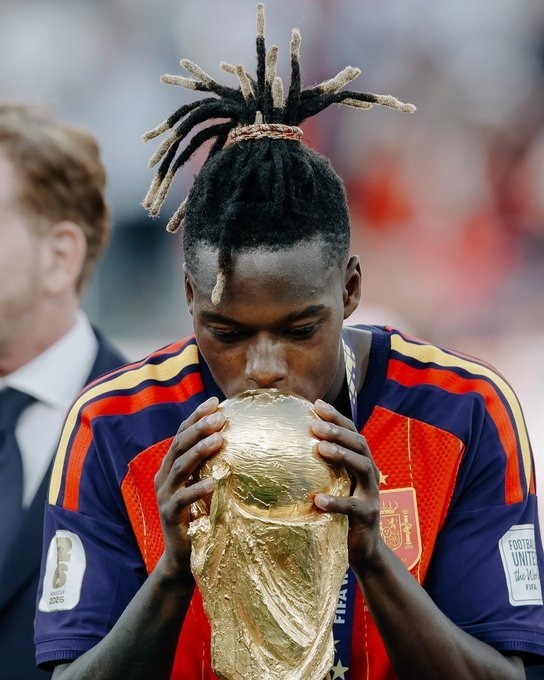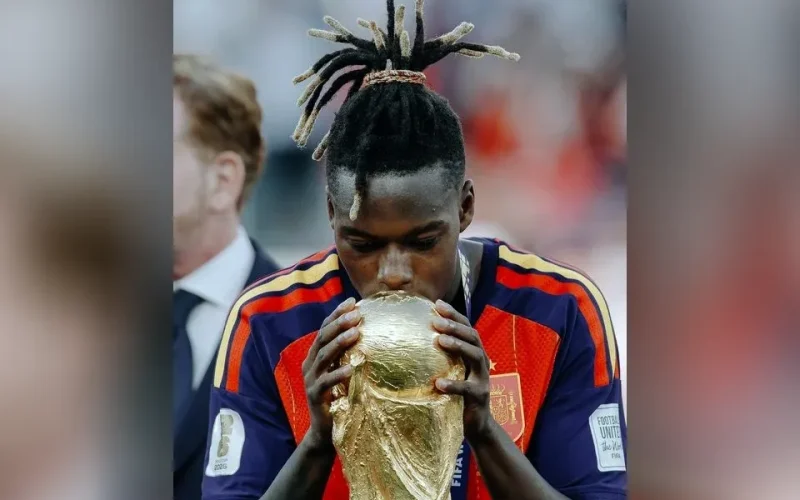
EXTRA time in a World Cup final has a way of stripping football down to its essence. Legs are gone. Ideas thin out. What remains is instinct, inheritance, and whoever still has one more run left in them. In the 106th minute at MetLife Stadium, with Spain’s relentless pressure having produced shot after shot and Argentina’s goalkeeper Emiliano Martínez somehow still standing between his posts, it was Nico Williams who found that last run.
A ball dropped into the Argentine box. Williams rose above Nahuel Molina, Martínez already committed the wrong way, and rather than force a header goalward himself, he glanced it backwards into space. Ferran Torres did the rest, driving the ball past a stranded Martínez for the only goal of the match. Spain 1, Argentina 0. A second World Cup for La Roja, their first since 2010, sealed on a night when they became the first champions in the tournament’s history to lift the trophy having conceded just a single goal across the entire competition.
Football will remember Torres’ finish. History should remember Williams’ assist for what it truly was: the closing act of a story that began three decades earlier, in the Sahara Desert, at the hands of two people the world had never heard of – Felix and Maria Williams.
In 1993, Felix and Maria left Ghana and paid smugglers to take them toward Europe. Maria was pregnant with the couple’s first son. Part of the route was covered crammed into the open back of a truck with dozens of others; much of the rest was on foot, across the Sahara, through heat that has never fully left Felix’s body – to this day, he has little feeling left in the soles of his feet from walking on burning sand for days without food or water. Some who travelled with them did not survive the crossing.
They reached Melilla, the Spanish enclave on Africa’s Mediterranean coast, and were arrested for lacking papers, facing deportation. A lawyer intervened, advising them to present themselves as Liberians fleeing that country’s civil war – a claim that opened the door to asylum. It was granted. The couple settled in the Basque Country, taken in by a local Catholic priest, Iñaki Mardones, who housed them, saw to their care, and became godfather to the son Maria was carrying – a boy they named Iñaki, born in Bilbao in 1994. Eight years later, in Pamplona, Nico arrived.
What football has since done with that inheritance is the stuff screenwriters dream of and rarely deliver. Iñaki Williams, capped for Spain’s youth sides and briefly the senior team, chose in 2022 to represent Ghana, the land his parents fled hardship from rather than rejection – a tribute, not a repudiation. Nico stayed loyal to the country of his birth. The brothers have since met as rivals on football’s biggest stages, a family split only ever by shirt colour, never by love.
Sunday’s final was the latest chapter. Ghana’s own World Cup run ended in the last 16, so it fell to the younger brother alone to carry the Williams name into the final – and he delivered the pass that won it.

A MEDAL, RETURNED TO ITS RIGHTFUL OWNER
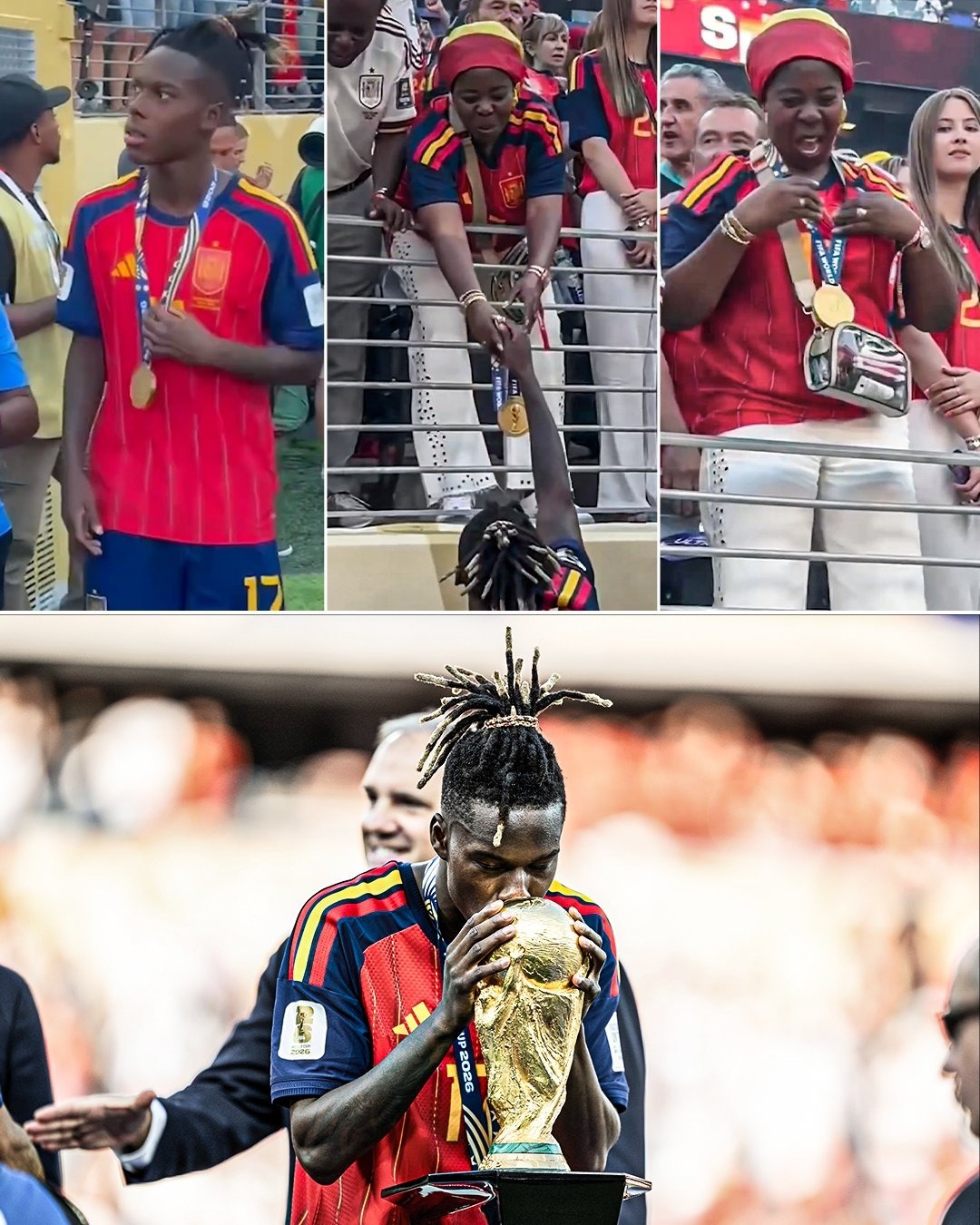
Then came the image that will outlast the scoreline. Amid the golden confetti and the delirium of a nation celebrating in the stands of MetLife Stadium, Nico Williams sought out one person: his mother. He found Maria, lifted his winner’s medal from around his own neck, and placed it around hers.
It was not the first time. After Spain’s Euro 2024 triumph, Williams performed the same gesture and later explained it in words that have travelled further than most things said in a mixed zone: he can run fast, he said, but never as fast as the mother who once outran death itself, crossing the Sahara to bring her family to safety. He plays, he has said, because of what she survived.
Two years on, on the biggest stage the sport has, the son did it again – not for the cameras, but because some debts are best repaid in public, where a world that has spent a generation debating migration as a policy problem is forced, if only for a moment, to watch what migration actually looks like: a family, a sacrifice, a boy who became a champion because his parents refused to let a desert be the end of their story.
There will be plenty in Accra and beyond ready, fairly, to note that this is also Ghana’s trophy by blood, by heritage, by two feet that once bled walking toward a border for their children’s sake – even if it is Spain’s crest on the shirt and Spain’s anthem that played. Africa does not need to own the shirt to own the story. It is written into the fact of Nico Williams standing on that pitch at all, into Iñaki’s choice of jersey, into Maria’s tears and Felix’s scarred soles.
At a moment when African migrants across the continent and beyond continue to be cast, too often and too carelessly, as burdens rather than as the parents, workers, and dreamers they are, the Williams family’s Sunday night stands as its own quiet rebuttal – delivered not in a policy paper, but in a header, a finish, and a medal placed around a mother’s neck.
Nico Williams is 24 years old. He is a European champion. He is, now, a world champion. And somewhere between the Basque Country and the stands of a New Jersey stadium, a woman who once walked across a desert without food or water carries the proof that it was worth it.