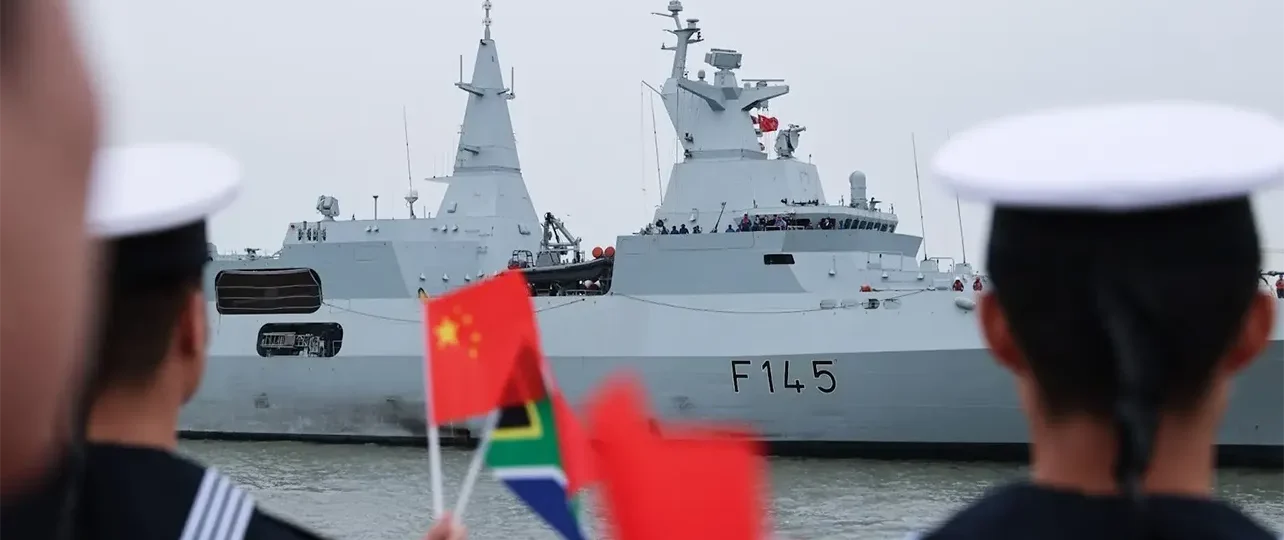

WHEN the South African Navy frigate SAS Amatola glided into a naval port on China’s eastern seaboard on 15 March 2026, it carried with it the weight of eighteen years of diplomatic distance and a decade of deferred ambition. The vessel’s arrival in Shanghai, the first visit by any South African warship to this particular city, and only the second visit by a South African naval vessel to China since 2008, has been welcomed by Beijing as a practical affirmation of the two nations’ deepening strategic partnership.
The five-day goodwill visit, which concludes on 20 March, features cross-deck exchanges, professional engagements, joint activities, and bilateral dialogue spanning maritime security, interoperability, and training cooperation. According to PLA Navy officers Ni Zhiyuan, Deng Zhaolan, and Chen Zhihuan, the visit is specifically aimed at deepening practical exchanges between the Chinese PLA Navy and the South African Navy, enhancing strategic mutual trust, and jointly maintaining regional peace and stability. The framing is carefully calibrated – but the strategic architecture behind it is impossible to miss.
A Deployment a Decade in the Making
To fully appreciate what the Amatola’s presence in Shanghai represents, one must understand the institutional strains the South African Navy has endured. Sea hours dropped by close to fifty percent between 2013 and 2025, the consequence of chronic budgetary pressure, maintenance backlogs, and a series of cancelled or aborted foreign deployments. In 2024, a planned participation in Russia’s Navy Day celebrations in St. Petersburg had to be abandoned when the Amatola could not complete the necessary sea trials. A scheduled mission to Cuba and Brazil by the fleet replenishment vessel SAS Drakensberg similarly fell away due to serviceability constraints.
The turnaround began in 2023, when the navy received a targeted allocation of R1.4 billion for the refit of its frigate and submarine fleets. The Amatola’s current deployment – which departed Simon’s Town on 25 January 2026, traversed the Indian Ocean to Visakhapatnam, participated in India’s International Fleet Review and Exercise MILAN 2026, and is now proceeding through China before heading to Malaysia, Kenya and Tanzania on the homeward leg – is the most ambitious overseas mission by a South African surface combatant since a commemorative voyage to the United Kingdom in early 2017. The South African Navy has described it, with understandable pride, as a demonstration of “operational readiness and institutional resilience.”
Will for Peace 2026: The Exercise that Set the Stage
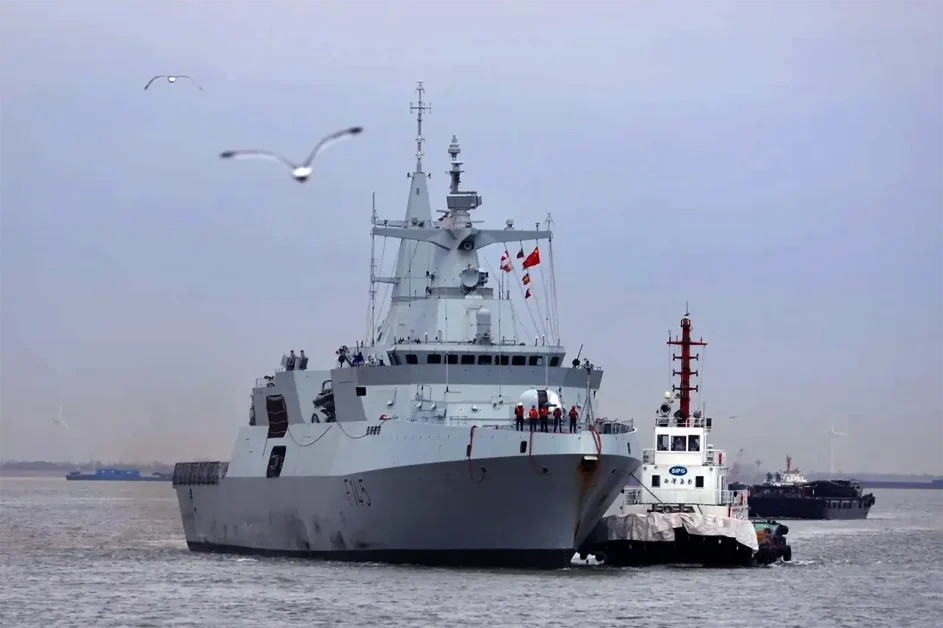
The Shanghai visit does not exist in a vacuum. It is the diplomatic continuation of Exercise Will for Peace 2026, the landmark BRICS Plus maritime drill that unfolded in South African waters from 9 to 16 January. Hosted at Simon’s Town Naval Base under Chinese leadership, the exercise brought together naval assets from South Africa, China, Russia, Iran, and the United Arab Emirates, with Brazil, Egypt, Ethiopia and Indonesia participating as observers. The Amatola herself sailed alongside the People’s Liberation Army Navy vessels CNS Tangshan and CNS Taihu during that week’s joint operations.
The exercise represented an evolution of the earlier bilateral Mosi drills of 2019 and 2023. The rebrand to “Will for Peace” and the expansion to the full BRICS Plus membership signal Pretoria’s deliberate alignment with an emerging multilateral maritime security architecture rooted in the Global South rather than in NATO or Western-led frameworks. Captain Ndwakhulu Thomas Thamaha, South Africa’s Joint Task Force Commander for the exercise, was direct about its significance: the drills were “more than a military exercise” – they constituted a “statement of intent.”
The stated operational focus – protecting shipping lanes, combating piracy, coordinating search and rescue, and building interoperability in hybrid threat environments – carries particular relevance for BRICS nations. Middle East instability has pushed a growing volume of global commercial traffic away from the Suez Canal and back around the Cape of Good Hope, restoring South Africa’s strategic maritime corridor to a prominence it had not enjoyed in decades. For BRICS economies that depend on unimpeded oceanic trade routes, a capable and cooperative network of Southern Hemisphere navies is a concrete, practical interest.
“SAS Amatola continues to fly the South African flag abroad and strengthen international partnerships, demonstrating the South African Navy’s enduring commitment to maritime cooperation.”
South African Navy statement, March 2026
Shanghai as Strategic Symbol
The choice of Shanghai as the port of call is worth examining beyond its logistical convenience. As China’s commercial capital and a global hub of finance and trade, Shanghai carries a symbolic weight that Beijing and Pretoria both understand. This is not a call at a purely military installation at the edge of the country; it is a visit to the heart of Chinese economic power. For the BRICS audience – from Beijing to Brasilia, from Moscow to Mumbai, from Riyadh to Johannesburg – the optics are deliberate.
The last South African warship to visit Chinese waters before Amatola was the SAS Spioenkop in 2008, during a six-country Far East deployment in which Spioenkop conducted joint exercises with the PLAN alongside stops in Singapore, Malaysia and Vietnam. That visit was itself historic—the first by an African warship to the People’s Republic of China. The gap of nearly two decades before the second such call reflects the turbulent trajectory of South Africa’s defence capacity, but also an opportunity long deferred. That Amatola is now in Shanghai, following joint exercises in the very waters Spioenkop never reached, signals both the durability of the relationship and the depth of what has changed.
The programme for the Shanghai visit mirrors the architecture of Will for Peace 2026: cross-deck visits, professional knowledge exchanges, joint sporting activities, and substantive dialogue on maritime security cooperation and training. There is nothing accidental about this continuity. Each element builds institutional familiarity between two navies that are increasingly operating in the same strategic spaces – from the South Atlantic to the Indian Ocean to the western Pacific.
Pretoria’s Strategic Calculus
South Africa’s foreign policy posture has long been defined by a commitment to non-alignment and diplomatic autonomy, but that principle has never precluded strategic choice. Under President Cyril Ramaphosa, Pretoria has pursued a calibrated balancing strategy – maintaining economic relationships with Western capitals while progressively deepening engagement within the BRICS framework. The Will for Peace exercise, the ICJ genocide case against Israel, and now the Amatola’s multi-nation deployment represent points along a coherent, if contested, arc of foreign policy.
Vice-Admiral Monde Lobese, Chief of the South African Navy, has been explicit that the Amatola’s deployment is strategically aligned with South Africa’s national interests and long-term defence partnerships. Lobese, who attended the IONS Conclave of Chiefs in Visakhapatnam alongside the vessel’s India port call, framed the mission not as a ceremony but as “a credible contribution to regional security architectures” within the Indian Ocean Region. The Shanghai leg extends that framing into the Indo-Pacific more broadly.
Domestically, the exercise drew pointed criticism from the Democratic Alliance, the largest opposition partner within South Africa’s Government of National Unity, which demanded a parliamentary briefing on the BRICS Plus drills. The DA’s objections – that hosting Chinese, Russian and Iranian vessels risks compromising South Africa’s non-aligned posture and straining ties with Washington—represent a live tension in Pretoria’s coalition politics. Yet the ANC-led executive has remained resolute, and the Amatola’s current journey is the most visible expression of that resolve.

What This Means for the BRICS Maritime Agenda
For BRICS nations, the Amatola’s Shanghai visit is a data point in an accelerating trend. The Forum on China-Africa Cooperation (FOCAC) Beijing Action Plan for 2024–2027 carries more security and military commitments than any previous iteration, including joint exercises and the training of thousands of African military and police personnel. The PLA has conducted three major military exercises on the African continent in the past eighteen months. Will for Peace 2026 was the most expansive, but it will not be the last – Beijing has already indicated plans for a subsequent BRICS Plus naval exercise.
The practical significance for BRICS members extends well beyond flag-showing. As the Cape Route regains its place as a major artery of global commerce, the ability of BRICS navies to coordinate on maritime safety, anti-piracy operations, and the protection of shipping lanes is an economic as well as a security matter. A South African frigate calling at Shanghai – and agreeing with its PLAN counterparts on protocols, joint training frameworks, and shared doctrine – is the kind of incremental, working-level cooperation that sustains strategic relationships across political cycles.
For those who have argued that BRICS remains primarily an economic construct without the institutional cohesion to act in the security domain, Amatola’s visit to Shanghai offers a qualified but meaningful counter-narrative. It does not signal a military alliance; South Africa’s non-alignment doctrine is not a mere formality. But it does signal a growing willingness among Global South states to construct their own security partnerships, on their own terms, outside the frameworks that have long been dominated by Western capitals.
Homeward Bound – and What Lies Ahead
After Shanghai, the Amatola will proceed to Malaysia before making port calls in Kenya and Tanzania—a return leg that reads as a survey of South Africa’s relationships across the Indian Ocean littoral. Expected back at Simon’s Town in early May, the frigate will return to a navy that, despite its fiscal travails, has demonstrated it can still project presence and sustain a credible long-range deployment.
The harder questions will follow the homecoming. South Africa’s mid-life update for the Amatola is currently scheduled for 2027. Whether the political momentum generated by this deployment translates into sustained defence investment – or whether the navy slides back into the maintenance-and-retrenchment cycle of the past decade – will determine whether this voyage is a turning point or a well-executed exception.
For now, SAS Amatola stands at a pier in Shanghai, a grey warship flying a flag that carries its own geometry of history: the democratic arc of the sunburst, the colours of compromise and transformation. In the context of a reordering world – where BRICS is no longer just a financial acronym but an emerging geopolitical reference point – the frigate’s presence in this port tells a story that extends far beyond the South African Navy’s institutional recovery. It speaks to where Africa’s most industrialised economy is positioning itself for the next chapter of the twenty-first century.