AS the sun set over Cape Town’s Table Mountain, President Cyril Ramaphosa seized the moment to display leadership qualities expected from a head of state during a crisis. Hours earlier, the Parliament had witnessed something unthinkable in the post-apartheid era: the postponement of the national budget speech. Yet where some saw chaos, the President saw opportunity.
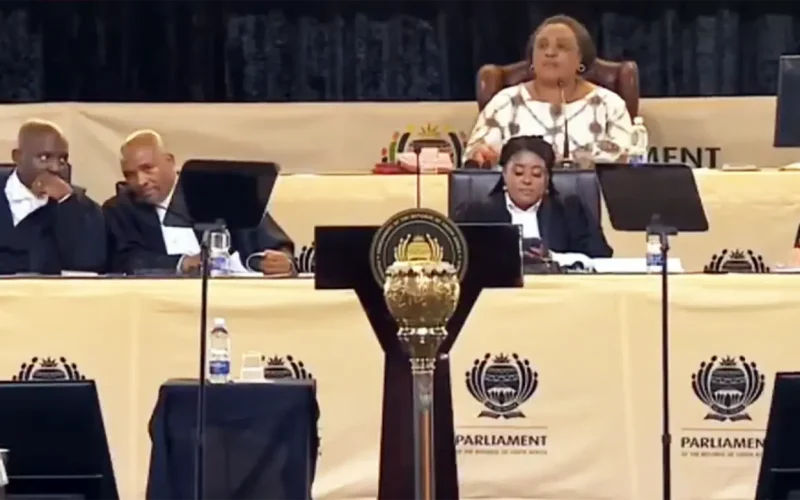
The historic Parliament building had earlier buzzed with tension as Speaker Thoko Didiza announced the delay. Opposition MPs had erupted in protest, their voices echoing through the chamber’s ornate corridors. The rand had wobbled, and headlines screamed crisis. But behind the scenes, a different story was unfolding.
“We are called upon as the national leadership to pursue all initiatives aimed at growth,” Ramaphosa’s words cut through the noise of the day, offering a steady hand in turbulent waters. This wasn’t just about numbers on a spreadsheet – it was about the soul of South Africa’s consensus-building democracy.
Earlier, in the Parliamentary precinct’s meeting rooms, representatives from ten political parties – once fierce adversaries – now sat around tables strewn with budget documents and coffee cups. The Democratic Alliance’s concern over VAT increases had sparked intense debate, but instead of forcing through a contested budget, something remarkable happened: dialogue prevailed.
“The Government of National Unity will intensify our efforts,” the President promised, his words resonating with both the business community and ordinary citizens. It was a delicate balance – maintaining investor confidence while protecting the nation’s most vulnerable. The postponement to March 12th wasn’t a failure of governance but rather evidence of its maturation.
As night fell over Cape Town, the lights in ministerial offices burned bright. Inside, members of the coalition government worked to thread the needle between fiscal constraint and social responsibility. The message was clear: better to take time and get it right than rush through a budget that could harm the nation’s fragile economic recovery.
The morning’s market jitters had begun to stabilize as Ramaphosa’s assurances reached investors. His emphasis on “collegial and mature consensus” transformed the narrative from one of crisis to one of careful deliberation. This wasn’t the ANC of old, pushing through its agenda with brute parliamentary majority. This was something new: a genuine coalition working through real differences.
“We are working as partners,” the President had said, and in those words lay the future of South African democracy. In the chambers where once only one voice had dominated, now eleven parties sought common ground. The postponement until March 12th wasn’t just about financial planning – it was about proving that South Africa’s democracy had grown strong enough to embrace disagreement, debate, and ultimately, true consensus.
As the city settled into evening, the message was clear: South Africa’s democracy wasn’t weakening – it was evolving. In choosing careful deliberation over rushed decisions, in prioritizing consensus over convenience, the Rainbow Nation was writing a new chapter in its democratic journey. And this time, all voices would be heard.