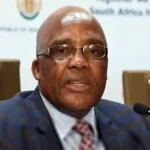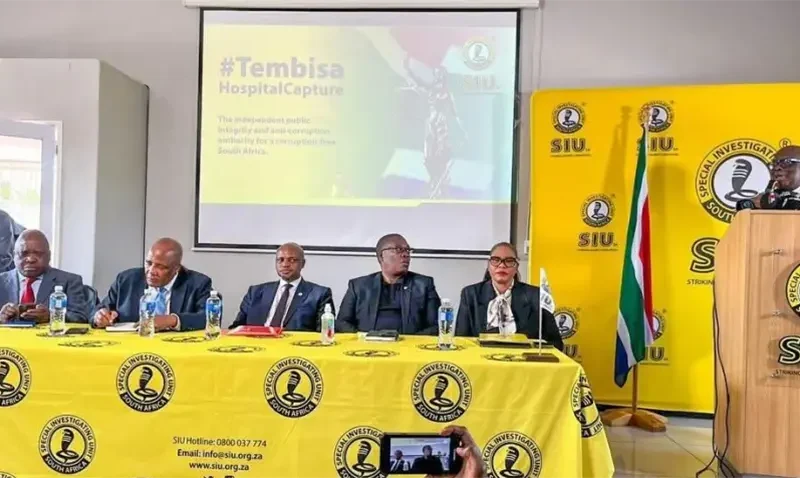
THE auditorium fell silent as Advocate Andy Mothibi, Head of the Special Investigating Unit, stood before a bank of cameras and microphones to deliver findings that would shock the nation. Flanked by Minister of Health Dr Aaron Motsoaledi, Gauteng Premier Panyaza Lesufi, and Health MEC Nolontu Ralehoko, Mothibi prepared to unveil one of South Africa’s most devastating cases of coordinated corruption.
“This staggering sum, intended for the provision of healthcare to the most vulnerable, was instead ruthlessly siphoned off through a complex web of fraud and corruption, representing an egregious betrayal of the nation’s trust,” Mothibi declared, his words cutting through the room as he presented the SIU’s progress report on the Tembisa Hospital investigation.
The scale of the theft he was about to detail defied comprehension: over R2 billion stolen through three sophisticated criminal syndicates, dozens of corrupted officials, and a procurement system so thoroughly compromised that every single investigated transaction bore the hallmarks of fraud.
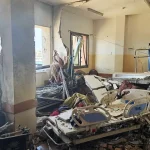
In the sterile corridors of Tembisa Provincial Tertiary Hospital, where patients queued for life-saving care, a different kind of operation had been underway. Behind closed doors and buried in procurement files, criminal networks were systematically bleeding the public healthcare system – money meant for medicine, equipment, and care for Gauteng’s most vulnerable citizens was instead financing Lamborghinis, R75 million mansions, and the lavish lifestyles of those who had sworn to serve the public.
The Red Flags That Started It All
The investigation began with a report that would cost its author her life. In August 2021, Babita Deokaran, then Chief Director of Financial Accounting at the Gauteng Department of Health, compiled an analysis that sent shockwaves through the provincial administration. Her findings were damning: between April and July 2021 alone, 63% of all purchase orders valued between R400,000 and R500,000 were linked to Tembisa Hospital – an expenditure level grossly excessive for a facility of its size compared to much larger provincial hospitals.
Deokaran had identified 224 service providers trading with the hospital within that narrow period and value range. The pattern was too consistent, too concentrated to be coincidental. She was shot and killed outside her home in August 2021, just days after submitting her report.
Her legacy, however, would live on. The Special Investigating Unit, working initially through a secondment agreement with the Office of the Premier signed in September 2022, would eventually uncover a corruption scheme so vast and so brazen that it demanded the highest level of political attention—hence the presence of the Minister, Premier, and MEC at Mothibi’s media briefing.
The Anatomy of Systematic Theft
As Mothibi detailed the findings to the assembled officials and media, the sophistication of the criminal operation became clear. When SIU investigators began analysing the procurement bundles at Tembisa Hospital, they discovered a nearly perfect criminal system. The investigation now encompasses 207 service providers operating under 4,501 purchase orders, with a total value exceeding R2 billion.
But these weren’t merely irregular appointments—they were blatantly fraudulent from conception to execution, Mothibi explained. Each purchase order was linked to what appeared to be a legitimate three-quote procurement process, supposedly involving three competing bidders. In reality, investigators discovered that the entire system was a meticulously crafted illusion.
To date, the SIU has analysed 2,207 procurement bundles. Every single one was irregular. Not some. Not most. All of them.
The fraud wasn’t confined to a single department or a handful of rogue officials. It infected every link in the procurement chain: officials who identified needs, those who sourced providers, adjudicators who recommended appointments, approvers who signed off on contracts, those who certified regulatory compliance, administrators who issued purchase orders, inspectors who confirmed deliveries, and finance officials who authorised payments. Each checkpoint that should have prevented fraud had been compromised. Each safeguard had been neutralised by corruption.
The Three Kingpin Syndicates
Syndicate X: The R596 Million Operation
Mothibi walked through the briefing of the first major syndicate, which operated with clinical efficiency. Investigators are reviewing 1,237 procurement bundles valued at R596 million linked to this network. The SIU has completed analysis of 646 bundles so far, and each one revealed “countless procurement irregularities and blatant fraud.”
The syndicate’s sophistication became clear as investigators traced the money. Funds flowed from service providers through numerous secondary conduit accounts designed to launder money, acquire assets, and make corrupt payments to officials. The web was intricate, deliberately complex, and designed to obscure the ultimate beneficiaries.
But the SIU investigators were persistent. They identified assets linked to Syndicate X worth approximately R150 million. More damning still, they traced corrupt payments flowing directly or indirectly from the syndicate to at least 32 accounts belonging to current and former Gauteng Department of Health officials—totalling R56.45 million in bribes.
The Maumela Syndicate: Living Large on R816 Million
If Syndicate X was sophisticated, the Maumela Syndicate was ostentatious—a fact that drew audible reactions from those gathered at the briefing. Operating through 1,728 procurement bundles valued at R816 million, this network didn’t just steal—it flaunted its theft in properties and luxury vehicles that screamed wealth.
The SIU identified assets worth approximately R520 million linked to the syndicate—a sum that represents nearly two-thirds of the money they received from Tembisa Hospital contracts. Through a trust account and two companies, the syndicate principals went on a spending spree that would have impressed oligarchs.
The property portfolio alone is breathtaking in its audacity. Investigators identified holdings worth R293 million, including estates in Port Zimbali’s exclusive coastal enclave, a R75 million mansion in Cape Town’s elite Bantry Bay neighbourhood, and various properties in Johannesburg’s most prestigious addresses—Sandhurst and Hurlingham—valued at R151 million.
But the syndicate’s taste for luxury didn’t stop at real estate. They amassed a fleet of exotic vehicles worth R223 million. Multiple Bentleys. Multiple Lamborghinis. The kind of cars that turn heads on any street in the world, purchased with money meant to save lives in a public hospital.
The Mazibuko Syndicate: R283 Million in Calculated Theft
The third major syndicate, Mothibi continued, was linked to 651 procurement bundles worth R283 million, displaying a similar pattern of systematic fraud and asset accumulation. Investigators have analysed 392 bundles, finding the same tale of procurement irregularities and fraudulent activity in every single file.
The Mazibuko Syndicate used a trust structure to purchase properties across the Western Cape and Gauteng worth R42.6 million. While their asset accumulation appears more modest compared to the Maumela Syndicate, the fraud was no less systematic, the corruption no less corrosive.
The Smaller Fish in a Toxic Pond
Beyond the three major syndicates, Mothibi detailed how investigators identified at least six smaller networks, each operating with values ranging from R3.4 million to R76 million. Syndicates A through F brought the total number of criminal networks operating at Tembisa Hospital to nine distinct groups, all working to exploit the same corrupted system.
Some of these smaller syndicates had direct links to current or former department officials who served as directors or received payments through the companies. Others appeared to function as conduits for the larger syndicates, facilitating payments to officials while providing an additional layer of obfuscation. The networks made payments to unsuccessful bidders—a telltale sign of collusion and bid-rigging. Money circulated among companies within each syndicate through electronic transfers, pointing to coordinated fronting operations.
The Corrupted Officials: Guardians Turned Thieves
Perhaps the most disturbing aspect of the Tembisa scandal, as Mothibi outlined to the Minister, Premier, and MEC, is the systematic corruption of public servants entrusted with protecting taxpayer funds and ensuring patient care. The SIU has prepared 116 disciplinary referrals against 13 officials, with 108 already delivered to the Gauteng Department of Health.
These weren’t senior officials operating from plush offices in Johannesburg. Many were lower-level employees at Tembisa Hospital itself—people who worked where patients struggled and died, who saw firsthand the impact of inadequate resources, and who nevertheless chose to divert funds meant for medical care into their own pockets.
The officials played crucial roles in fraudulently appointing service providers, manipulating procurement processes, and facilitating irregular expenditure. They received millions in corrupt payments for their betrayal. Each became a node in a criminal network that treated a public hospital like a private cash machine.
The SIU report, as presented by Mothibi, doesn’t mince words about these officials: “Through their actions, these officials showed a ruthless disregard for the law, their employer, their community and their patients. They run Tembisa Hospital like their own private business, wheeling and dealing with corrupt service providers to support their lavish lifestyles at the expense of human life and the dignity of the patients.”
The money was never intended for patient care. From the moment it was allocated, it was destined for personal enrichment.
The Paper Trail of Fraud
The investigation revealed that virtually all documentation related to procurement and receiving of goods at Tembisa Hospital was fictitious—purposely generated by officials to create an illusion of legitimacy, Mothibi explained. The three-quote system, designed to ensure competitive pricing and prevent favouritism, had been completely subverted.
Even officials serving as end-users, who should have been verifying that goods were actually received, participated in the fraud. They signed documents confirming deliveries that may never have occurred, or acknowledged receipt of goods that bore no relationship to what was actually needed or used.
The SIU made an additional damning discovery that Mothibi shared with the briefing: none of the service providers were even legally authorised to operate in their supposed business. Twenty-five matters were referred to the South African Health Products Regulatory Authority after investigators confirmed that not a single Tembisa Hospital service provider was licensed to manufacture or supply medical goods and medicines as required by law. The entire operation was fraudulent from top to bottom.
Following the Money: Laundering at Scale
The syndicates employed sophisticated money laundering techniques to disguise the origin and destination of stolen funds, as detailed in Mothibi’s presentation. Money flowed from the Gauteng Department of Health to fraudulent service providers, then cascaded through networks of secondary conduit accounts before emerging as luxury properties, exotic vehicles, and cash payments to officials.
The SIU’s financial analysis revealed patterns consistent with large-scale money laundering operations: rapid movement of funds between accounts, use of trusts and shell companies, purchases of high-value assets shortly after payments were received, and complex webs of transfers designed to break the chain of evidence linking stolen funds to their beneficiaries.
Four matters totalling R42.2 million have been referred to the National Prosecuting Authority for corruption charges involving officials and implicated service providers. These represent only the cases where the evidence trail is complete enough to support criminal prosecution—the tip of a much larger criminal iceberg.
The Human Cost Behind the Numbers
As Mothibi stood before Minister Motsoaledi, Premier Lesufi, and MEC Ralehoko—the very officials responsible for healthcare delivery in Gauteng—the human dimension of the theft was inescapable. His words about the “egregious betrayal of the nation’s trust” resonated because the victims were sitting in hospitals across the province at that very moment.
Behind every rand stolen from Tembisa Hospital lies an immeasurable human cost. Every fraudulent purchase order represented medical supplies not purchased, equipment not maintained, staff positions not filled, and treatments not provided. In a province where public hospitals struggle with overcrowding, supply shortages, and inadequate resources, the R2 billion looted from Tembisa could have transformed healthcare delivery.
Consider what R2 billion could have meant: thousands of hospital beds, millions of doses of essential medicines, modern diagnostic equipment, training for healthcare workers, improved facilities for patients. Instead, it bought Lamborghinis for criminals and mansions for the corrupt.
The patients at Tembisa Hospital, many among South Africa’s poorest and most vulnerable citizens, were the ultimate victims of this grand corruption. They waited longer for treatment because resources were diverted. They suffered from inadequate care because money went to fraudulent providers rather than legitimate medical supplies. Some may have died because the healthcare system was systematically undermined by those sworn to protect it.
A Multi-Disciplinary Response
The presence of Minister Motsoaledi, Premier Lesufi, and MEC Ralehoko at Mothibi’s briefing underscored the gravity of the findings and the commitment to accountability at the highest levels of government. As Mothibi presented the progress report mandated by the Special Investigating Units and Special Tribunals Act, it was clear that the investigation required—and was receiving—support from multiple agencies and spheres of government.
The SIU’s work, initiated through Proclamation 136 of 2023, published on September 1, 2023, represents a multi-disciplinary effort involving various agencies working in collaboration. The investigation covers the period from January 1, 2020, to September 1, 2023, but also authorises investigation of matters outside these dates where relevant to the core findings.
The Investigation Continues
As Mothibi made clear in his briefing, the SIU investigation remains ongoing, with numbers constantly updated as new companies are identified through the flow of funds involving irregularly appointed service providers. The unit is deliberately withholding certain details—the identity of Syndicate X, suspected kingpins, additional corrupted officials—because the investigation is active and there is genuine concern about asset dissipation and threats to those involved in the probe.
Babita Deokaran paid with her life for exposing the initial red flags. Her courage in compiling that August 2021 report set in motion an investigation that has revealed one of South Africa’s most significant corruption scandals. The work continues in her memory and in the service of the patients who depend on a healthcare system that should serve them, not enrich those who exploit it.
A Test for Justice and Political Will
The Tembisa Hospital investigation, as presented by Advocate Mothibi to the nation’s health leadership, represents a test not just for South Africa’s justice system but for the political will to ensure accountability. The presence of Minister Motsoaledi, Premier Lesufi, and MEC Ralehoko at the briefing signals commitment at the highest levels—but commitment must translate into consequences.
The evidence is extensive, the paper trail documented, the assets identified. The SIU has done its work with thoroughness and precision, as Mothibi’s comprehensive presentation made clear.
Now comes the harder part: ensuring that those responsible face consequences, that stolen assets are recovered, that officials who betrayed public trust are held accountable, and that systems are reformed to prevent such systematic corruption from recurring.
The syndicates operated with brazen confidence, apparently believing they were untouchable. The officials participated without apparent fear of consequences. The service providers accumulated vast wealth openly, as if the fraud would never be uncovered.
They were wrong. The question now, as the Minister, Premier, and MEC absorb the full scope of the devastation, is whether exposure will lead to justice, whether documentation will result in prosecution, and whether identified assets will be recovered and returned to public coffers.
As Advocate Andy Mothibi’s words echoed through the briefing room—words about staggering sums ruthlessly siphoned off, about egregious betrayal, about trust violated—the officials beside him and the nation watching understood: this was not just about money. It was about the fundamental social contract between government and governed, about whether those entrusted with caring for the vulnerable would be held to account when they chose instead to prey upon them.
The patients at Tembisa Hospital, the taxpayers of Gauteng, and the citizens of South Africa deserve nothing less than full accountability for those who turned a house of healing into a den of thieves.