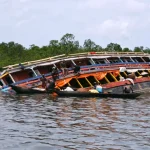
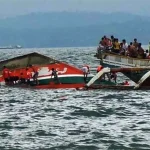
AS fireworks illuminated skies across the world to welcome 2025, darkness descended on the waters off Gambia’s coast. A boat carrying more than 200 people – mothers, fathers, young dreamers – capsized near the village of Jinack. By the time rescue teams arrived, seven bodies had been pulled from the Atlantic. Over a hundred survivors clung to life. Dozens more simply vanished into the unforgiving sea.
This was not an accident. This was inevitable.
The New Year’s Eve capsizing represents far more than a single maritime disaster. It is a microcosm of a grinding humanitarian catastrophe that repeats itself with numbing regularity along one of the world’s most lethal migration corridors. The Atlantic route from West Africa to Europe’s shores has become a graveyard where desperation meets indifference, where the pursuit of dignity ends in anonymous death.
The Cruel Mathematics of Despair
The numbers tell a story of systematic tragedy. More than 3,000 people died attempting to reach Spain by sea in 2025 alone. That figure represents not just statistics but individual human calculations – the moment when staying home seemed more dangerous than risking everything on open water. Each person who boarded that boat off Gambia’s coast had weighed their options and concluded that a chance at drowning was preferable to the certainty of their current circumstances.
Gambian President Adama Barrow called the incident “a painful reminder of the dangerous and life-threatening nature of irregular migration.” But this framing misses the essential truth: for many, there is nothing irregular about seeking survival. When legitimate pathways to opportunity are sealed shut, when borders become impenetrable fortresses, when poverty and violence and climate collapse make home unlivable, people will find a way – or die trying.
The Sandbank That Tells a Larger Story
The Defence Ministry reported that the vessel was found “grounded on a sandbank,” a detail that reveals the desperate inadequacy of these journeys. These are not cruise ships with modern navigation systems. They are overcrowded, unseaworthy vessels piloted by those with more courage than equipment, carrying human cargo that wealthy nations have decided they can ignore until bodies wash ashore.
The rescue effort itself, a mixture of emergency services, local fishermen, and volunteers, demonstrates both the best and worst of our collective response. Ordinary people risk their own lives to save strangers, while the international community that could address root causes remains largely unmoved by yet another predictable disaster.
Europe’s Moral Reckoning, Perpetually Delayed
The Canary Islands route, which many of these migrants attempt, has become synonymous with death. Yet Europe continues to treat migration primarily as a security issue rather than a humanitarian one, investing in border enforcement while offering little to address the conditions that drive people to undertake these desperate voyages.
President Barrow pledged to “strengthen efforts to prevent irregular migration” and create “safer and more dignified opportunities for young people to fulfil their dreams.” These are necessary commitments, but they ring hollow without acknowledgement of the global inequities that make Gambia a launching point for these fatal journeys. When the gap between continents in terms of opportunity, safety, and basic human dignity remains so vast, no amount of domestic opportunity creation will stem the tide entirely.
The Dreams That Refuse to Drown
What drives someone to board a boat like this? The answer is not ignorance of the risks – everyone knows the dangers. It is the cold calculation that the odds of dying at sea may actually be better than the certainty of a slow death by economic starvation, political persecution, or environmental collapse. It is the belief that their children deserve better. It is the fundamental human instinct to seek survival and dignity.
The 102 survivors now receiving urgent medical care will carry the trauma of this journey forever. Some will attempt the crossing again. Others will return home, their dreams weighted down by survivor’s guilt and the ghosts of those who didn’t make it. The dozens still missing will likely join the countless unnamed dead whose families will never know for certain what happened, suspended in a purgatory of grief without closure.
Not the First, Not the Last
This tragedy was entirely predictable. Another boat will capsize next week, next month, next year. More desperate people will make the same calculation. More bodies will be recovered or lost to the sea. More politicians will express condolences and promise investigations. And the fundamental conditions that create these death traps will remain largely unchanged.
Until wealthy nations recognise that fortress borders cannot coexist with vast global inequality, until the international community addresses migration as a shared humanitarian responsibility rather than a problem to be externalised and militarised, the Atlantic will continue to claim lives. The question is not whether another boat will capsize, but when – and whether we will finally decide that the cost in human life is too high to bear.
The seven confirmed dead from the New Year’s Eve capsizing deserved better. The dozens still missing deserved better. The survivors, traumatised and forever changed, deserved better. And the next group of desperate people who will board an overcrowded boat on an impossible journey deserve better than a world that watches them drown and calls it inevitable.
It is not inevitable. It is a choice – one we make collectively every time we accept another tragedy as simply the cost of doing business in an unequal world.