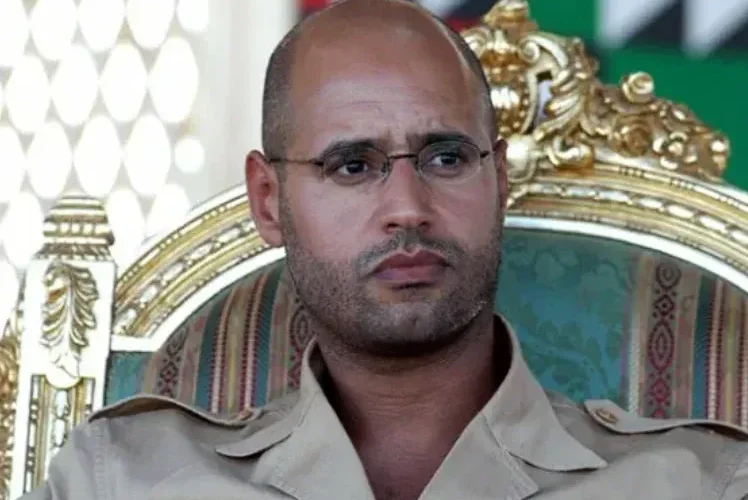
SAIF al-Islam Gaddafi (53) is dead. The news, confirmed by family sources, his lawyer, and Libyan media, marks the end of a singular political life – one that traced Libya’s own arc from oil-rich autocracy to failed state.
Unlike his siblings who fled into comfortable exile, Saif al-Islam gambled everything on a promise made amid the ruins of his father’s regime: “We fight here in Libya, we die here in Libya.” Twelve years later, in a remote corner of the fractured nation he once helped rule, that vow has been kept.
The decision to remain was not inevitable. In 2011, as rebels stormed Tripoli and summarily executed his father Muammar Gaddafi, Saif al-Islam had an escape route. Disguised as a Bedouin tribesman, he attempted to flee to neighboring Niger – a well-worn path for deposed African strongmen.
He didn’t make it. The Abu Bakr Sadik Brigade militia captured him on a desert road, betrayed by a Libyan nomad. Flown to the western hill town of Zintan, he faced a choice that would define his remaining years: cooperate with Libya’s new order, or bet on its failure.
“I’m staying here,” he told his captors as hundreds of armed men surrounded the transport plane. “They’ll empty their guns into me the second I go out there.”
It was a calculation rooted in both defiance and analysis. Saif al-Islam had predicted exactly this outcome during the 2011 uprising, warning that without the Gaddafis’ iron grip, Libya would dissolve into warring fiefdoms. “All of Libya will be destroyed,” he told Reuters, wagging his finger at the camera. “We will need 40 years to reach an agreement on how to run the country.”
From Reformer to Architect of Repression
The transformation was breathtaking in its speed. Just months before the uprising, Saif al-Islam was the Western-educated face of a regime attempting rehabilitation. London School of Economics-trained, fluent in English, mingling with British high society – he had brokered Libya’s abandonment of weapons of mass destruction and negotiated compensation for Lockerbie victims.
He spoke the language of reform: constitutions, human rights, Libya’s emergence from pariah status. Western governments saw in him an acceptable interlocutor, perhaps even a future leader who might liberalize his father’s authoritarian state.
When protest erupted in February 2011, those illusions shattered. Saif al-Islam immediately chose “family and clan loyalties over his many friendships,” becoming what prosecutors would later call an architect of brutal repression. He warned that “rivers of blood would flow” and called rebels “rats” – the same dehumanising rhetoric his father deployed to justify crackdowns.
The International Criminal Court issued an arrest warrant for murder and persecution. A Tripoli court sentenced him to death by firing squad for war crimes in 2015.
Six Years in Zintan: The Waiting Game
His captivity in Zintan was a strange half-life. No longer the man with pet tigers who hunted with falcons, Saif al-Islam spent six years in solitary confinement, missing a tooth, isolated from the world. Human Rights Watch found no evidence of torture, but documented the psychological toll of isolation.
Yet he also had satellite television and books. And crucially, he had time to watch his predictions come true.
Libya fractured exactly as he warned. Two rival governments emerged, backed by competing militias and foreign powers. The country that once boasted Africa’s highest standard of living became a watchword for state failure—a haven for human traffickers, a battleground for proxy wars, its oil wealth fought over by warlords.
In 2017, the Zintan militia released him under an amnesty law. Rather than flee, Saif al-Islam went deeper underground in the same town, calculating that Libya’s chaos would eventually create an opening.
The Failed Comeback
That moment seemed to arrive in 2021. Wearing traditional Libyan robes and turban, he emerged in the southern city of Sabha to register as a presidential candidate – a stunning reappearance after years of speculation about his whereabouts and health.
The strategy was transparent: tap into nostalgia for the “relative stability” before 2011, when Libyans had predictable electricity, functioning institutions, and hadn’t yet experienced a decade of civil war. “I’ve been away from the Libyan people for 10 years,” he told The New York Times Magazine. “You need to come back slowly, slowly. Like a striptease. You need to play with their minds a little.”
But Libya’s new power brokers – the armed groups that emerged from the 2011 uprising – had no interest in a Gaddafi restoration. His candidacy became a flashpoint. Though disqualified over his 2015 conviction, his attempt to appeal the ruling triggered armed confrontations. Fighters blockaded the courthouse. The entire electoral process collapsed, returning Libya to political paralysis.
Saif al-Islam had inadvertently proved that he remained too toxic for reconciliation, too divisive for the national unity Libya desperately needed. Yet he also demonstrated that Libya’s post-Gaddafi order had failed to produce anything better.
The Legacy of the Last Gaddafi
The circumstances of his death remain unclear. But its location – still in Libya, not in the comfortable exile his siblings chose – validates the core of his identity: a man who bet his life that Libya’s dysfunction would vindicate his father’s regime.
He was wrong about that vindication. But he was right about the dysfunction.
Libya today remains split between rival governments, its oil production hostage to militia politics, its citizens subject to arbitrary violence and economic collapse. The 2011 revolution removed a dictator but unleashed forces no subsequent government has managed to control.
Saif al-Islam’s death closes a chapter that began with his father’s lynching in 2011. But it resolves nothing about Libya’s future. The battles over the country’s “heart, soul, and oil riches” that he both predicted and embodied continue without him.
His final contribution may be symbolic: a reminder that in Libya’s zero-sum politics, there are only victors and casualties—and sometimes, those willing to stay become both.