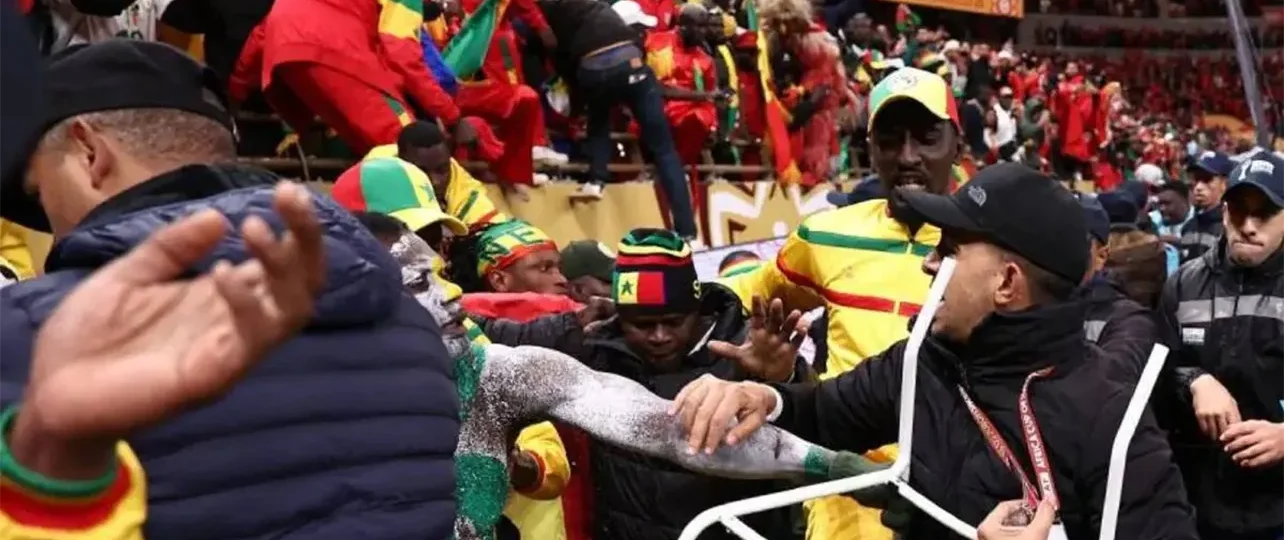

THEY crossed borders, braved long journeys, and poured their hearts into supporting the Lions of Teranga on the grandest stage African football has to offer. They came to celebrate. Instead, 18 Senegalese football supporters now stare at the walls of a Moroccan prison – casualties not just of a chaotic night of football, but of the raw, uncontrollable passion that the beautiful game ignites across the continent.
This is what love for football looks like when it collides with the cold machinery of the law.
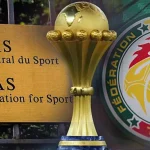
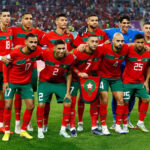
The setting was the Total Energies Africa Cup of Nations final in January – Morocco versus Senegal, two footballing giants, two proud nations, two sets of fans burning with desire. When a controversial penalty decision went against Senegal mid-match, something snapped in the stands. Supporters, already wound tight with emotion, surged toward the pitch. Clashes broke out with Moroccan security personnel. Players briefly abandoned the field in scenes of extraordinary confusion. It was the kind of moment football has always flirted with – when passion tips over into pandemonium.
Senegal would ultimately win the match 1-0 in extra time, a triumph that should have defined the night. But for 18 men in the crowd, the final whistle brought no joy, no celebrations – only handcuffs.
A Moroccan court has delivered its verdict with an iron hand. The 18 Senegalese supporters were convicted of violence and causing damage during the pitch invasion. Sentences ranged from three months to a full year behind bars, with fines reaching as high as $545. For men who had travelled to Morocco carrying nothing but scarves, flags, and hope, it is a devastating outcome – and one that has reverberated far beyond the stadium.
The question that now hangs in the air like an unanswered referee’s whistle is simple: Does the punishment fit the crime? Or has a moment of football frenzy been made to carry political and judicial weight it was never meant to bear?
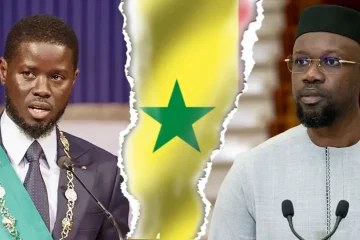
Senegal’s firebrand Prime Minister, Ousmane Sonko, rarely does anything quietly – and his response to the sentences was no exception. Standing before parliament, his words were measured but pointed, carrying the unmistakable sting of diplomatic rebuke.
“It seems this matter goes beyond the realm of sport, and that is regrettable,” Sonko declared. “For two countries that call each other friends, like Morocco and Senegal, things should not have gone this far.”
It was a remarkable statement – a sitting prime minister publicly suggesting that a neighbour and ally had overstepped, that the scales of justice had been tipped by something other than blind fairness. He went further, asserting that Morocco’s handling of the case “does not honour” the relationship between the two nations, and that Senegal had done “all it should” to secure the supporters’ release through diplomatic channels.
The subtext was impossible to miss. This is no longer just about football. It never really was.
Morocco and Senegal are not adversaries. They share deep historical, cultural, and economic ties – the kind of brotherhood forged over decades of cooperation. They are both pillars of African diplomacy, both proud members of a continent striving to assert its place on the world stage. That two such nations now find themselves on opposite sides of a growing diplomatic dispute – over a pitch invasion at a football match – reveals something uncomfortable about how sport can expose the fault lines even between friends.
Sonko’s appeal to King Mohammed VI for a royal pardon was both a gesture of diplomatic grace and a quiet ultimatum. “If they do not,” he warned parliament, “we have agreements that bind us and allow us to request that the supporters serve their sentences in their own country.” The velvet glove, yes – but there is a fist inside it.
The ball is now firmly in Morocco’s court.
Across Africa, football is more than entertainment. It is identity, it is community, it is a language spoken by millions who have no other platform. When the Lions of Teranga take the field, those 18 men in the stands are not merely spectators – they are participants in a collective dream, ambassadors of a nation’s pride stitched onto terraces thousands of miles from home.
That dream has now landed them in a foreign prison, and a friendship between two nations is being tested in ways no one anticipated when the tournament kicked off.
Football has a long memory. So does diplomacy. How Morocco and Senegal resolve this – whether through a royal pardon, a prisoner transfer, or something messier – will say much about what African brotherhood truly means when it is put under pressure.
For now, 18 men wait. The final whistle has blown, but the match, it seems, is far from over.