THE wheels of justice have begun to turn, slowly but unmistakably, in one of Nigeria’s most high-profile medical negligence cases. Nigeria’s Medical and Dental Council (MDCN) has provisionally suspended three doctors linked to the death of Nkanu Adichie-Esege, the 21-month-old son of internationally acclaimed novelist Chimamanda Ngozi Adichie, as formal investigations gather momentum and a coroner’s inquest looms.
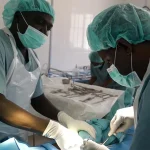
The MDCN has announced that the medical director of Euracare Hospital in Lagos, alongside two other physicians, has been barred from practising medicine pending a full hearing before a professional disciplinary tribunal. The regulator’s investigative panel concluded there is sufficient preliminary evidence to suggest possible medical negligence in the handling of the child’s treatment – a finding that marks the first formal institutional reckoning in a case that has gripped Nigeria and reverberated far beyond its borders.
Nkanu died on 7 January, one of a set of twins, after complications reportedly emerged during preliminary medical procedures at Euracare. The Adichie family has alleged that staff failed to administer oxygen when it was urgently needed and administered excessive sedation to the infant – actions they contend directly triggered a cardiac arrest. Atlantis Hospital, which was also involved in aspects of the child’s care, has similarly come under scrutiny in the MDCN’s inquiry.
“The final outcome will depend on the tribunal once it reviews the evidence and hears the case.”
— Dr Munir Bature, Nigerian Medical Association
The tribunal now holds the doctors’ fates in its hands. If the panel upholds the findings of negligence, the physicians face the permanent revocation of their licences — a career-ending sanction rarely invoked in Nigeria’s medical system. Dr Munir Bature, spokesperson for the Nigerian Medical Association, confirmed the suspensions are temporary pending the review. None of the three physicians has publicly responded to the allegations. Euracare Hospital, while expressing condolences to the Adichie family, has maintained that it acted appropriately in the child’s care.
A separate and parallel reckoning awaits in the courtroom. A formal coroner’s inquest is scheduled to begin on 14 April at the Yaba Magistrate Court in Lagos, where medical specialists and hospital officials will be called to testify. The inquest will seek to establish an official cause of death – and in doing so, may either strengthen or complicate the disciplinary tribunal’s eventual conclusions. The dual-track nature of the accountability process, running through both the professional regulator and the judiciary, represents an unusually robust institutional response by Nigerian standards.
A SYSTEM ON TRIAL
The case has done more than expose alleged failings at two private Lagos hospitals. It has forced a national conversation about the structural vulnerabilities of Nigeria’s healthcare sector – and about who, if anyone, is held responsible when patients die under contested circumstances. Calls for accountability have been amplified by the identity of the grieving mother: Adichie is among the most celebrated writers Africa has produced in a generation, author of Half of a Yellow Sun and Americanah, and a global voice on feminism and identity whose work transcends continents. Her personal grief has given public urgency to a systemic failure that ordinarily might have faded into silence.
Nigeria’s health ministry has acknowledged that the country’s clinical governance architecture is inadequate and announced plans to establish a national task force focused on strengthening patient safety standards. Whether those commitments translate into durable structural reform – or dissipate once public attention moves on — remains to be seen. The gap between ministerial announcements and on-the-ground healthcare realities is a familiar and often bitter refrain in Nigerian public life.
For now, the significance of the MDCN’s action cannot be overstated in context. The provisional suspension of senior physicians pending a disciplinary hearing signals a willingness – however nascent – by Nigeria’s medical establishment to subject its own to scrutiny. Whether the tribunal delivers accountability proportionate to the gravity of a child’s death will be watched closely, not only by the Adichie family, but by a Nigerian public increasingly unwilling to accept impunity in institutions that hold lives in their hands.