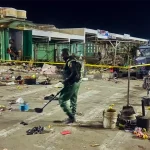
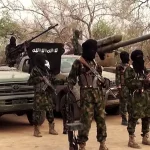
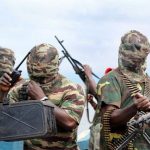
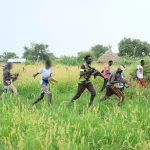
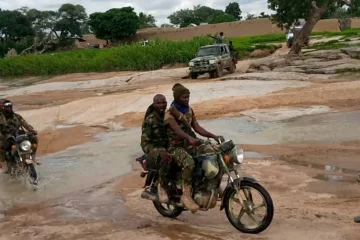
BOKO Haram fighters swept into the Ngoshe community in Borno State’s Gwoza Local Government Area last week, killing civilians and military personnel, abducting an unspecified number of residents, and mounting simultaneous assaults on Nigerian Army formations at Konduga, Marte, Jakana, and Mainok — a coordinated multi-front offensive that has shaken a region long scarred by insurgent violence and forced a swift, high-level response from the federal government.
President Bola Ahmed Tinubu extended condolences to the government and people of Borno State and described the attacks as a “heartless assault on hapless citizens.” He directed the Armed Forces to intensify civilian protection nationwide and charged security agencies to work urgently to rescue those kidnapped. He commended the military for its swift counter-response, which, according to official statements, resulted in the killing of scores of insurgents and forced their retreat.
Compounding the horror of the initial assault, the Nigerian Air Force’s aerial interdiction of fleeing terrorists resulted in friendly fire casualties — deaths among civilians that the President acknowledged with sympathy and which underlined the brutal complexity of fighting an enemy that routinely exploits civilian presence as operational cover.
Vice President Kashim Shettima, a former governor of Borno State and a figure whose personal history is woven into the region’s long agony, issued one of the administration’s sharpest security warnings in recent memory. Confirming that additional tactical assets and intelligence-driven reinforcements were already being deployed to the affected areas, Shettima declared that Nigeria would not be broken by what he called “despicable acts of cowardice.”
“We are not just fighting a war. We are defending the very soul of our humanity against those who preach a toxic rhetoric of hate,” the Vice President said. “This madness will be brought to an end — not with empty words, but with the decisive and overwhelming force of the Nigerian State.”
The attacks represent one of the most brazen insurgent operations in Borno in recent months and raise hard questions about the pace of recovery by Boko Haram’s successor factions, particularly the Islamic State West Africa Province (ISWAP), which has demonstrated renewed operational capability across the Lake Chad Basin following its absorption of Boko Haram remnants after the 2021 death of founder Abubakar Shekau. The coordination of simultaneous strikes on four separate military formations — rather than purely civilian soft targets — bears the tactical signature of a force that has rebuilt its command structure.
Speaking at an interfaith breaking of fast with Armed Forces personnel at the Presidential Villa on Friday, President Tinubu sought to anchor the security messaging within a broader narrative of national resilience, praising the “courage, sacrifice, and professionalism” of troops on the frontlines and promising continued investment in equipment and welfare. The Chief of Army Staff, Lt. Gen. Waidi Shaibu, confirmed the President had recently approved salary increases, enhanced allowances, and new equipment procurement — upgrades the military said would directly improve operational effectiveness.
Borno Governor Babagana Zulum, whose administration has borne the primary burden of managing displacement, reconstruction, and civil-military relations in the state, was praised by Shettima for his resilience. Zulum has repeatedly called for deeper federal engagement and more robust support for community self-defence in areas where conventional military presence remains thin.
The abducted civilians — their number has not been publicly confirmed — remain in insurgent hands. The Vice President pledged that the administration would not rest “until abducted citizens safely reunite with their families.”
Nigeria’s North East has been the theatre of one of the world’s most protracted Islamist insurgencies, one that has killed tens of thousands, displaced millions, and devastated the social and economic fabric of Borno, Yobe, and Adamawa states since the late 2000s. Despite years of declared military gains, the events of the past week serve as a sobering reminder that the conflict’s final chapter has not yet been written.