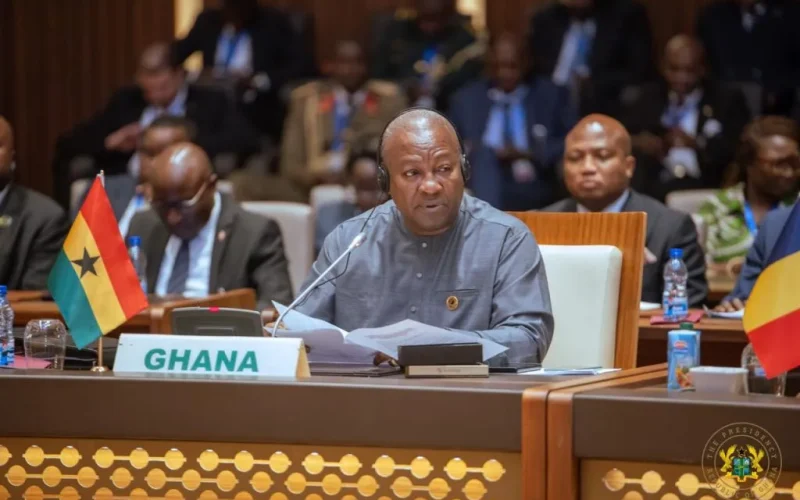
A few days from now, in a chamber that has witnessed many of the defining declarations of the modern era, Ghana’s President John Dramani Mahama will walk to the podium of the United Nations General Assembly and table a resolution that a continent, a diaspora, and the conscience of history have been awaiting for centuries.
The resolution – the Declaration of the Trafficking of Enslaved Africans and Racialised Chattel Enslavement of Africans as the Gravest Crime Against Humanity – is scheduled for consideration and adoption on Wednesday, 25 March 2026, a date the Ghanaian president has deliberately chosen: the International Day of Remembrance of the Victims of Slavery and the Transatlantic Slave Trade.
If adopted, it will be the first comprehensive UN resolution on slavery and the transatlantic slave trade in the 80-year history of the United Nations. It will also be the most consequential act of collective African diplomatic agency since the continent’s founding generation assembled under the stars of Addis Ababa in 1963.
“The date is intentional. It connects memory with action.”
Ghana is tabling the resolution in its capacity as the African Union’s Champion on Reparations, in collaboration with CARICOM and all peoples of African descent. The draft rests, in President Mahama’s own words, on “three core pillars: historical accuracy, legal defensibility, and continental and diaspora alignment.”
A Pledge Made, A Pledge Kept
The origins of this moment lie in September 2025, when President Mahama addressed the 80th Session of the UN General Assembly in New York. It was there that he made the announcement that reverberated across the continent and its diaspora.
“At the 80th Session… I announced that Ghana would lead the effort to table a resolution declaring slavery and the transatlantic slave trade as the gravest crime against humanity.”
Barely five months later, in February 2026, on the margins of the 39th AU Summit in Addis Ababa, Mahama confirmed the March timeline and laid out the legal architecture underpinning the draft text.
“We have ensured that the text reflects rigorous scholarship, moral clarity, and diplomatic credibility.”
The resolution formally declares the trafficking of enslaved Africans and racialised chattel enslavement as the gravest crime against humanity by reason of what Ghana’s Ministry of Foreign Affairs describes as “the definitive break in world history, scale, duration, systemic nature, brutality and enduring consequences that continue to shape socio-economic realities and structural inequalities across the world.”
Informal consultations on the draft text ran from 23 February to 12 March 2026. The stated objective, as Mahama put it at the Addis Ababa briefing held under the theme “Ancestral Debt, Modern Justice: Africa’s United Case For Reparations”, was unambiguous:
“Our objective is simple — to build a broad consensus behind this resolution.”
The Moral Weight of the Slave Forts
No country carries the physical memory of the transatlantic slave trade with more searing immediacy than Ghana. From Cape Coast Castle to Elmina, from Fort Amsterdam to Fort Metal Cross, Ghana is home to more slave dungeons, forts, and castles than any other country on the continent — the stone testimonies through which over 12 million enslaved Africans were trafficked to the Americas, and through whose holding cells millions more were broken, tortured, raped, or killed before they ever reached the water’s edge.
It is this geography of suffering — this landscape of dungeons that UNESCO has inscribed as world heritage sites — that lends Ghana both the historical standing and the moral obligation to lead this charge. President Mahama has been explicit about this burden of geography.
Addressing the African Union Assembly in Addis Ababa, he called on this generation of African leaders to rise to a moment their predecessors could only dream of:
“I urge the forthcoming 39th Assembly of the AU to lend full and unflinching support of this resolution. Let Addis Ababa 2026 mark a turning point. Let it be said that in 2026 in Addis Ababa, Africa chose to honour its past and to define its future. Let it be said that we transformed memory into policy, that we converted the grievances of our past into a collective strategy and that we turned our history into sovereign action. Let us not defer justice, let us not postpone dignity, let us act and let us act together.”
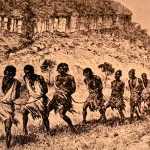
The transatlantic slave trade, which lasted from the 15th to the 19th century, forcibly transported more than 12 million Africans to the Americas. Historians are unambiguous that the trade devastated African societies while generating enormous wealth in Europe and the Americas — wealth that became the foundation of modern capitalism, industrial revolution, and global financial infrastructure.
“Reparatory justice will not be handed to us. Like political independence, it must be asserted, pursued, and secured through determination and unity.”
Not Condemnation — Acknowledgement
Critics and sceptics — most of whom are expected to be found among certain European delegations at the UN — have raised concerns that the resolution amounts to a targeted indictment of specific nations. President Mahama has consistently and deliberately foreclosed that interpretation.
“This initiative is not directed against any nation. It is directed toward truth, recognition, and reconciliation.”
He has been equally clear about the limits and the purpose of what adoption would mean:
“The adoption of this resolution will not erase history. But it will acknowledge it.”
The Pan-African Lawyers Union (PALU), which issued a solidarity statement on 18 March 2026, echoed this framing. The resolution, PALU noted, is “descriptive, an articulation of truth, rather than a hierarchical assessment.” The union’s statement was blunt about the stakes for nations that choose to sit on the fence: abstaining, PALU warned, risks placing countries on the wrong side of history.
PALU’s framing of the crime was unsparing: “The trafficking and racialised chattel enslavement of Africans was not merely an isolated crime, but a foundational rupture that reshaped the world for all peoples. It generated the wealth that fueled the rise of the current global infrastructure and fundamentally transformed political, legal, and economic systems.”
The Long View: Beyond 25 March
President Mahama and the AU have been at pains to communicate that 25 March is not a destination but a departure point. Ghana’s Ministry of Foreign Affairs confirmed that following adoption, Ghana will continue to advance multilateral reparations efforts within the framework of the African Union’s Decade of Action on Reparations and African Heritage (2026–2036).
Mahama himself has mapped out the post-resolution trajectory, pledging sustained engagement with the UN Secretary General, the African Union Commission, and interested member states.
“Adoption is not the end. This is about sustained dialogue on reparatory justice and healing.”
He has also placed the resolution within the broader architecture of African agency — not as a plea to former perpetrators but as an assertion of continental sovereignty:
“This initiative presents us a historic opportunity — an opportunity to affirm the truth of our history, an opportunity to recognise the gravest injustice in human history, an opportunity to lay a stronger foundation for genuine reconciliation and equality. While the past cannot be undone, it can be acknowledged and acknowledgement is the first step towards justice.”
The movement enjoys broad continental legal backing. PALU’s statement recognises that the erasure of African history during and after slavery has caused lasting harm across legal, cultural, and economic systems. The AU’s own February 2026 summit in Addis Ababa produced a landmark resolution recognising slavery and colonialism as crimes against humanity — providing the institutional foundation for the UN submission.
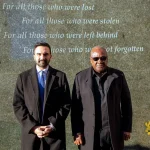
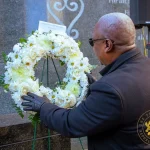
Ahead of the 25 March tabling, a solemn wreath-laying ceremony will be held on 24 March at the African Burial Ground in New York at 8:00 am, followed by a High-Level Event on Reparatory Justice at UN Conference Room 3 at 10:00 am.
Analysis: What Is Really at Stake
The significance of what Ghana is attempting on 25 March cannot be measured only in diplomatic terms. The resolution, if adopted, would for the first time in the history of the United Nations formally classify the transatlantic slave trade as the gravest crime against humanity — a designation that carries legal, moral, and political weight far exceeding any prior UN pronouncement on the subject.
The legal framing is deliberate. By establishing the crime at the apex of international wrongdoing — by grounding that designation in scale, duration, systematic legalisation, and enduring structural consequence — Ghana and the AU are constructing the doctrinal foundation upon which reparations claims can be advanced within the international legal system. This is not sentiment. It is strategy.
That strategy is grounded in a recognition that the socio-economic inequalities of the modern world — the debt asymmetries, development gaps, climate vulnerability, and extractive financial architecture that continue to define the Global South’s position in international economic relations — are not accidents of geography or culture. They are the accumulated compound interest of historical crime.
For Mahama, who has framed this as a generational obligation, the test is simple — and he has put it to Africa’s leadership directly:
“Let us be remembered not for hesitation, but for courage in advancing justice, restoring dignity, securing restitution, and shaping a future grounded in truth.”
Ghana has called on all UN member states to be on the right side of history and justice. The world will be watching on 25 March. The descendants of 12 million trafficked Africans — and the countless millions who perished in the dungeons of Elmina and Cape Coast before they ever reached the ships — will not be forgotten.
“All peoples of African descent have been waiting for this day. The truth cannot be buried. The legal foundations are sound; the moral imperative is undeniable.”