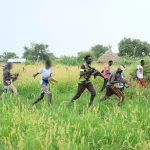
THE dead lay in the open. Dozens of them, their bodies scattered across a dust-red hillside at Jebel Iraq, a gold mining site just beyond the capital’s outskirts, filmed and shared online before Juba had even confirmed the attack. By Monday, police spokesperson Kwacijwok Dominic Amondoc could offer only this: more than 70 dead, many more injured, gunmen unknown. In a country sliding back toward civil war, the bare minimum statement was its own kind of eloquence.
The massacre at Jebel Iraq on 29 March was not an isolated crime. It was a symptom – raw and unignorable – of what happens when a state abandons the duty to govern the wealth buried in its own ground, and when political collapse makes every hill worth dying for.
“Jebel Iraq lies within a zone that is entirely under the exclusive control of the SSPDF. Consequently, full responsibility for the massacre rests with the SSPDF forces that control the area.”
SPLM/A-IO statement, 30 March 2026
A RESOURCE UNGOVERNED IS A RESOURCE AT WAR
South Sudan’s gold mining sector has long operated in a regulatory void. State governments run their own mineral extraction independently of national oversight, with no unified licensing framework and no meaningful security presence in many extraction zones. Jebel Iraq, in Central Equatoria State, has been the site of repeated violent clashes among illegal miners over the years – a powder keg the authorities have chosen not to defuse.
The Nile Institute for the Study of Human Rights and Transitional Justice condemned Sunday’s killings and called for “effective governance and oversight in resource-rich areas.” The language was measured; the indictment was damning. The institute described the attack as “a grave violation of the fundamental right to life” that “highlights the continued vulnerability of civilians in areas affected by a weak security presence and unregulated resource exploitation.” That is the polished language of a civil society organisation. Translated into plain terms: the government has known about this danger and done nothing.
Gold has become a survival currency in a country where oil revenue has collapsed, and the formal economy has all but evaporated. Artisanal and illegal miners flock to sites like Jebel Iraq precisely because they have no other options. Where the state has failed to provide livelihoods, it has also failed to provide protection. The result is not a gap – it is a killing field.
THE SHADOW OF WAR
To understand Jebel Iraq, you must understand South Sudan in March 2026: a country that has slid, by almost every credible measure, back into full-scale civil war. The 2018 Revitalised Agreement on the Resolution of the Conflict – the R-ARCSS, brokered with immense international effort – is functionally dead. President Salva Kiir had First Vice President Riek Machar arrested in 2025 on charges of murder, treason, and crimes against humanity. The SPLM/A-IO declared the peace deal void. The world’s youngest nation is, once again, at war with itself.
Aerial bombardments by the South Sudan People’s Defence Forces (SSPDF) have struck opposition-held territories in Jonglei. Armed youth militias have massacred civilians in Abiemnom County. A February attack there killed 178 people – men, women, and children cut down in their sleep before government forces could restore any semblance of order. In January, the government ordered civilians and UN peacekeepers to evacuate three counties ahead of a military offensive. The International Crisis Group has said what analysts dare not soften: “It is now indisputable: South Sudan has returned to war.”
Against this backdrop, the SPLM/A-IO’s attribution of Monday’s massacre to government forces carries both political weight and a plausible claim. The opposition’s statement was unambiguous – Jebel Iraq falls entirely within SSPDF-controlled territory, and the responsibility for what happened there belongs with those who control the ground. The army spokesperson declined to comment. That silence, too, speaks.
In a country sliding back toward civil war, the bare minimum statement was its own kind of eloquence.
THE ACCOUNTABILITY DEFICIT
The December 2026 elections – already postponed multiple times and constitutionally imperilled by Kiir’s unilateral amendments stripping the requirement for a permanent constitution — now loom as either a salvage operation or a trigger for further violence. The UN Commission on Human Rights, the AU’s C5 Committee, and the Security Council have all sounded alarms. Machar remains on trial in Juba, his imprisonment hardening opposition resolve and eliminating the one figure regional mediators believe could bring the SPLM/A-IO back to the table. Kenya’s attempt at a fresh diplomatic framework collapsed in February when the opposition made Machar’s release the non-negotiable precondition for talks.
UNMISS, the UN’s largest peacekeeping mission in East Africa, has had its budget cut by 15 percent and faces repatriation of a quarter of its uniformed personnel. The international community is, in effect, drawing down its presence at the precise moment the country needs it most.
South Sudan has been here before — in 2013, in 2016, in the slow grind of the years between. The 2013-2018 war cost an estimated 400,000 lives. Four million people were displaced. The world promised it would not happen again. It is happening again.
WHAT JEBEL IRAQ TELLS US
The massacre at Jebel Iraq is the intersection of two catastrophes: a resource governance failure and a political governance failure. They have been reinforcing each other for years. When the state cannot regulate what lies in the ground, those with guns decide who digs. When the state is itself at war, the gunmen answer to no one.
That more than 70 people can be killed at a mine on a Sunday, on the outskirts of the capital, and that the official response is a spokesperson saying he will share more details “once he gets more details” – this is the state of South Sudan in 2026. The dead of Jebel Iraq deserve more than a count. They deserve an accounting. And that accounting begins with naming what Jebel Iraq really is: not an isolated mining dispute, but the face of a failed peace, a looted economy, and a government that has chosen power over people.
The African continent cannot afford to look away. As Sudan burns next door, as South Sudan slides back into the abyss it was supposed to have left behind, the silence of African institutions – and the fatigue of international ones — is itself a political choice. Jebel Iraq is not a remote tragedy. It is a warning from the heart of the continent.