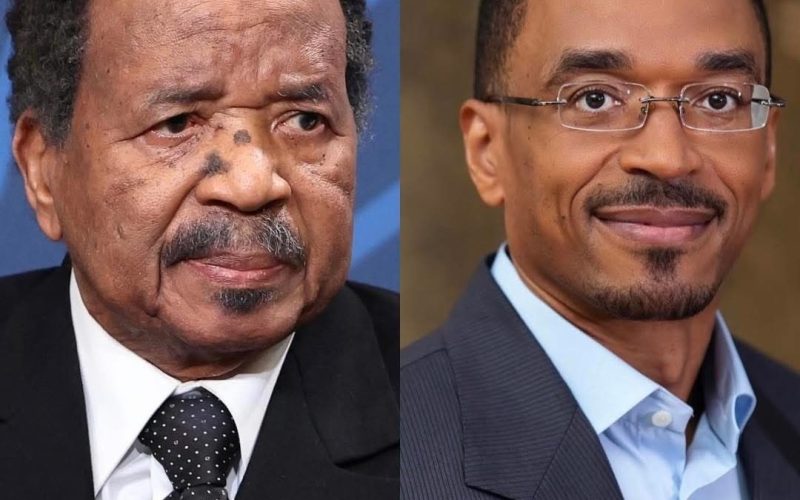
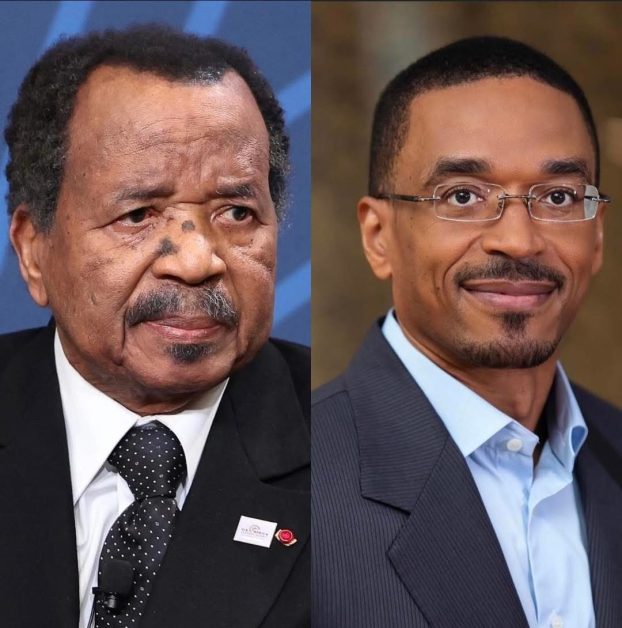
PAUL Biya has never been a man in a hurry. He has, after all, had 44 years to get things done. So when Africa’s longest-serving non-royal president finally decided to settle the small matter of what happens when he is no longer around – or, more accurately, when he is no longer even more conspicuously absent than usual – he did not leave it to chance, the electorate, or, heaven forbid, the Senate. He left it to his son.
In a presidential decree dated 4 April 2026, the 93-year-old patriarch of Cameroonian politics appointed Franck Emmanuel Biya – his adopted son, aged 55, and until last week a man who had never held a single day of public office – as Vice President of the Republic, Head of the Armed Forces, and Minister Delegate at the Ministry of Defence. Three hats in a single decree. Not bad for a Monday.
The timing, naturally, was immaculate. Just two days before the appointment, a pliant parliament – voting 200 to 18, a margin that would impress even the most theatrical of Soviet-era rubber-stamping sessions – had approved a constitutional amendment reinstating the office of Vice President, a position Cameroon had quietly retired back in 1984. The ink on that vote was barely dry before Franck’s name was being fitted into the slot. One is tempted to ask which came first: the vacancy or the candidate. One suspects both were decided on the same evening.
“The ink on the constitutional amendment was barely dry before Franck’s name was being fitted into the slot. One wonders which came first — the vacancy or the candidate.”
THE ART OF THE PRESIDENTIAL DECREE
Let us appreciate the elegance of the operation. For four decades, Cameroon’s constitution had placed the President of the Senate next in the line of succession – a safeguard theoretically designed to keep executive power out of any single family’s hands. That arrangement, however, had one fatal flaw: it was not the arrangement Paul Biya preferred. And so, with the brisk efficiency that only an authoritarian legislature can muster, the constitutional architecture was remodelled in 48 hours.
Under the new dispensation, the Vice President will be appointed by – and dismissible at the pleasure of – the Head of State. Should the elder Biya become permanently incapacitated, resign, or shuffle off this mortal coil, Franck will complete the presidential mandate. No election. No popular mandate. No inconvenient ballot box. Just continuity, Biya-style.
The decree was signed in Yaoundé and marked for immediate implementation. The presidency, in a burst of understatement, said the appointments were made ‘in the interest of service.’ Whose service, exactly, was left as an exercise for the reader.
A DYNASTY BY ANY OTHER NAME
To his credit, Biya has not invented anything. He has merely refined it. Across the continent, the formula for converting a republic into a family enterprise has become well-established, and Cameroon is only the latest to add its name to a growing registry of dynastic aspirations masquerading as institutional reform.
In Equatorial Guinea, Teodoro Obiang Nguema Mbasogo – who, at 46 years in power, makes even Biya look like a newcomer – appointed his son, Teodorin, as Vice President back in 2016. Teodorin, for his part, has also found time to accumulate a Malibu mansion, a private jet, and a Bugatti collection, all financed, according to multiple international courts, through the creative redistribution of his country’s oil revenues.
In Uganda, Yoweri Museveni has spent 40 years in office while elevating his son, General Muhoozi Kainerugaba, to Chief of Defence Forces – a role Muhoozi has supplemented with a fondness for geopolitically combustible tweets and the leadership of the Patriotic League of Uganda, a vehicle widely regarded as his personal presidential launchpad.
In the Republic of Congo, Denis Sassou Nguesso – who recently concluded his 42nd year in power with an election observers described as ‘widely discredited’ – has installed his son Denis-Christel as Minister of International Cooperation. In Eritrea, Isaias Afwerki deploys his son Abraham as a diplomatic proxy. Even in Tanzania, President Samia Suluhu Hassan, following a bruising 2025 election, has appointed her son-in-law as Health Minister and her daughter as Deputy Education Minister — a development that startled a country historically known for its political modesty.
“Across the continent, the formula for converting a republic into a family enterprise has become well-established. Cameroon is only the latest to add its name to a growing registry of dynastic aspirations.”
THE SUCCESSION ANXIETY HYPOTHESIS
Political scientists searching for a unifying theory of this trend need look no further than the most primal of human anxieties: the terror of accountability without armour. Ageing autocrats who have spent decades at the apex of extractive systems understand, with crystalline clarity, that the moment power leaves their hands, the lawyers arrive. Post-incumbency prosecution – from The Hague to domestic truth commissions – has concentrated the minds of many a long-ruling president wonderfully.
The logic, therefore, is elegant in its cynicism: if you cannot eliminate the risk of succession, you control who succeeds you. And who better to trust with the machinery of state – the army, the treasury, the attorney-general’s office – than a child who shares your surname, your interests, and, crucially, your legal exposure? A son will not commission an investigation into his father’s assets. A son will not sign an extradition order. A son is, in the calculus of the ageing strongman, the ultimate insurance policy.
Biya, who has spent much of his recent presidency ensconced in the palatial embrace of the Intercontinental Hotel in Geneva rather than in Yaoundé, presumably understands this arithmetic better than most. A man who governs largely by remote control has every reason to ensure the relay station – when the time comes – is a trusted one.
THE CONSTITUTIONAL SLEIGHT OF HAND
What makes the Cameroonian manoeuvre particularly audacious is its procedural veneer of legitimacy. This was not a coup. This was not a midnight edict. This was a parliamentary democracy, moving at the speed of a presidential wish list. The constitutional amendment was passed in a joint session of the National Assembly and the Senate. The bill was tabled two days before the vote. The ruling party’s MPs, demonstrating the kind of institutional loyalty that makes one wonder whether they were paid by the syllable or by the raised hand, delivered a 200-to-18 majority.
Opposition voices, predictably, were thunderous. Joshua Osih of the Social Democratic Front demanded a system in which the president and vice president are jointly elected – a proposal so radical in its embrace of democratic principle that it was dismissed before it had time to warm a seat. Samuel Hiram Iyodi, who ran against Biya in October’s disputed election, called the day of the vote ‘a dark day for Cameroonian democracy.’ He was not wrong. He was also, unfortunately, vastly outnumbered.
Meanwhile, in Cameroon’s restive Anglophone northwest and southwest — where a separatist civil conflict has raged since 2017, claiming thousands of lives and displacing hundreds of thousands more – the news of a francophone dynasty consolidating its grip on the armed forces landed with particular bitterness. The silence of Anglophone parliamentarians, observers noted, was deafening.
“This was not a coup. This was parliamentary democracy, moving at the speed of a presidential wish list.”
THE REPUBLICAN MONARCHY: A GROWTH INDUSTRY
There is something almost postmodern about the terminology these regimes deploy. They are, without exception, ‘Republics.’ They hold elections. They have constitutions. They have parliaments that meet, vote and adjourn. The machinery of democratic form is meticulously maintained — the bunting, the ballot boxes, the constitutional articles — even as the substance is quietly hollowed out and replaced with something altogether more medieval.
The republican monarchy, it turns out, is one of the growth industries of 21st-century African governance. Unlike its medieval European predecessors, it requires no crown, no coat of arms, no formal declaration of dynastic succession. It requires only a sympathetic parliament, a compliant constitutional court, a loyal military — and, ideally, a son who knows when to keep his head down until the moment arrives.
Franck Biya, to his credit, has been impeccably discreet. Unlike Uganda’s Muhoozi, who has used social media to conduct what amounts to a one-man foreign policy offensive, Franck has maintained a studied silence, appearing occasionally at party functions and in family photographs, offering little by way of ideology, programme, or vision. He has, in a sense, been the perfect candidate for an appointed office: present enough to be known, quiet enough to be unthreatening, and loyal enough to be trusted.
WHAT COMES NEXT
Paul Biya, born in 1933, is now 93 years old. He has ruled Cameroon since 1982. More than 70 percent of Cameroon’s 30 million citizens have never lived under any other president. He has, if he serves his current term to its conclusion, a date with 2032 — by which point he would be 99 years old and, one imagines, leaving most of the governing to others.
The question Africa’s democratic movements and international partners must now confront is not whether what happened in Yaoundé last week was democratic. It patently was not. The question is whether the international community — so reliably animated by elections in Europe and North America — has the appetite to say so loudly enough to matter.
History suggests not. France, which trains Cameroon’s military, invests heavily in its economy, and maintains the kind of intimate Franco-African relationship that Pan-Africanists have long identified as neocolonialism in a bespoke suit, has offered nothing resembling a rebuke. The African Union, which has grown increasingly adept at issuing statements that combine maximum verbosity with minimum consequence, will likely observe, note its concern, and move on.
And so, barring some dramatic unforeseen development, Cameroon appears set to join the lengthening roll-call of African republics in which the ballot box has been comprehensively outmanoeuvred by the birth certificate. The People’s Democratic Republic of Biya & Son, Inc. — a republic in name, a dynasty in deed — is open for business.
AFRICA’S REPUBLIC-DYNASTIES: THE LEDGER
| COUNTRY | PATRIARCH | YEARS | DESIGNATED HEIR | HEIR’S ROLE |
| Cameroon | Paul Biya | 44 yrs | Franck Emmanuel Biya | Vice President, Head of Armed Forces, Min. of Defence |
| Equatorial Guinea | Teodoro Obiang | 46 yrs | Teodorin Nguema Obiang | Vice President, controls defence & security |
| Uganda | Yoweri Museveni | 40 yrs | Gen. Muhoozi Kainerugaba | Chief of Defence Forces; leader, Patriotic League |
| Congo-Brazzaville | Denis Sassou Nguesso | 42 yrs | Denis-Christel Nguesso | Minister of International Cooperation |
| Eritrea | Isaias Afwerki | 33 yrs | Abraham Afwerki | Diplomatic proxy & strategic advisor |
| Tanzania | Samia Suluhu Hassan | — | Mohamed Mchengerwa (son-in-law) | Minister of Health |
Source X