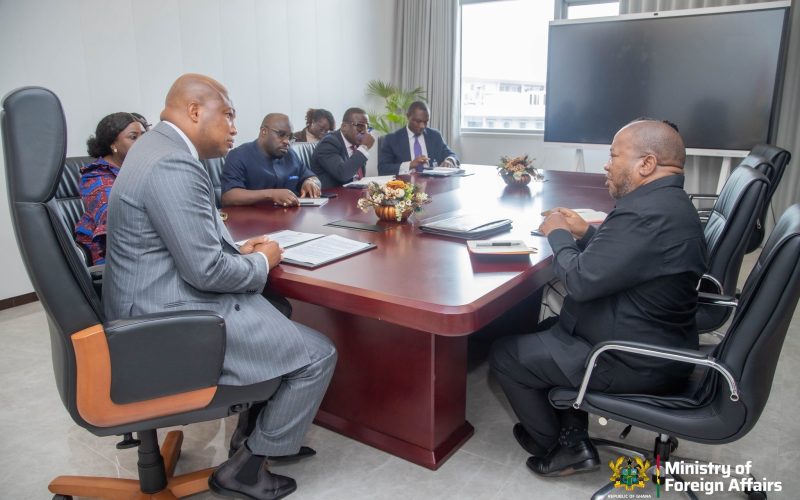
IN a dramatic escalation of diplomatic tensions, the Government of Ghana formally summoned South Africa’s Acting High Commissioner in Accra, Thando Dalamba, to the Ministry of Foreign Affairs for a face-to-face confrontation over violent xenophobic attacks targeting Ghanaian nationals in KwaZulu-Natal – marking one of the most serious bilateral ruptures between the two West and Southern African powers in recent memory.
The summons, confirmed in a ministerial press release, came just twenty-four hours after Ghana’s Foreign Affairs Minister, Samuel Okudzeto Ablakwa, had held a telephone conversation with his South African counterpart, International Relations and Cooperation Minister Ronald Lamola, in what initially appeared to be a successful exercise in diplomatic containment. It was not enough.
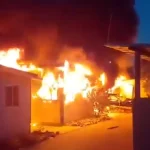
The images that sparked the crisis were unambiguous. Viral videos circulated on social media platforms this week showing foreign nationals – among them Ghanaians – being assaulted on the streets of Durban by members of anti-immigrant groups, confronted and demanded to produce documentation, and told in blunt terms to leave South Africa. At least one incident in KwaZulu-Natal showed a Ghanaian resident being stopped, ordered to prove his legal status, and threatened with expulsion. These were not images any African government could absorb in silence.
“Unprovoked attacks on foreign nationals are contrary to the principles of African unity and peaceful coexistence.”
Minister Ablakwa, summoning SA’s Acting High Commissioner
THE MARCH AND MARCH THREAT
The violence is the most visible face of a sustained anti-immigrant campaign led by the March and March Movement, a Durban-based civic organisation founded by radio personality and activist Jacinta Ngobese-Zuma. For nearly two weeks, the group has conducted what it calls ‘clean-up campaigns’ across the Durban central business district and KwaZulu-Natal – campaigns that on multiple occasions have descended into mob violence, looted shops, vigilante detentions, and the forced closure of businesses owned by foreign nationals from across Africa.
Joining March and March in the protests have been members of the uMkhonto we Sizwe Party (MKP) and other civic formations, lending the movement a political weight that has alarmed refugee organisations and foreign governments alike. The Southern Africa Refugee Organisations Forum (SAROF) has described the events as a ‘well-coordinated wave of xenophobic attacks’ sweeping across KwaZulu-Natal, alleging that armed vigilante groups are operating in collaboration with local government authorities.
‘A silent xenophobia has been ongoing for several months, with no response from government authorities,’ SAROF said in a detailed statement, warning that administrative, educational, and health-based discrimination against sub-Saharan African migrants had now evolved into a form of visible street violence ignored by mainstream media because, in the forum’s words, ‘the targets are Black Africans.’
KwaZulu-Natal police commissioner Lt-Gen Nhlanhla Mkhwanazi publicly condemned the vigilante documentation checks. ‘Citizens do not have the responsibility to check whether people are documented or not,’ he told Newzroom Afrika. ‘They lack the necessary skills to determine if the documents a person is holding are legitimate.’ South Africa’s Department of Home Affairs reported that deportations surged by a cumulative 46 percent over the past two financial years, reaching 109,344 by March 31, 2026 – a figure anti-immigrant groups cite as justification, and which rights groups insist is being weaponised to normalise the persecution of all foreigners.
ACCRA’S ESCALATING RESPONSE
Ghana moved with unusual speed. On Wednesday morning, Minister Ablakwa placed his call to Minister Lamola, receiving expressions of empathy and a commitment to full-scale investigations. Lamola also pledged that the South African government would brief African ambassadors in Pretoria. By that evening, Ghana’s High Commissioner in South Africa, Benjamin Quarshie, had coordinated with the Accra ministry to locate the primary victim featured in the most widely shared of the viral videos. Consular officials reached him; he was confirmed safe.
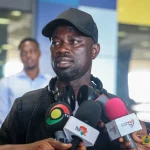
But by Thursday, the diplomatic temperature had risen sharply. Minister Ablakwa summoned Acting High Commissioner Dalamba and delivered Ghana’s formal protest in person. In a statement posted to social media, Ablakwa set out the terms of the encounter in unambiguous language:
Earlier today, I summoned the Acting South African High Commissioner to Ghana, Mr. Thando Dalamba. At the meeting, I conveyed the Government of Ghana’s strong condemnation of the continuous xenophobic attacks on Ghanaians and other Africans living in South Africa. We are urging South African authorities to take decisive action in protecting the human rights and dignity of our nationals and all Africans. Ghana equally expects that the promised investigations be expedited and all perpetrators punished to serve as an adequate deterrence. The Ministry of Foreign Affairs will communicate other steps we have taken in due course.
Samuel Okudzeto Ablakwa, Minister of Foreign Affairs, Republic of Ghana
The phrase ‘other steps we have taken in due course’ was not elaborated upon – deliberately so. It signals that Accra has reserved further measures and is watching Pretoria’s response before deploying them.
In his wider public statement, Ablakwa also cited Ghana’s historical sacrifice for South Africa’s freedom – the financial resources Kwame Nkrumah diverted from Ghana’s own development to fund the anti-apartheid struggle in the 1960s; the Ghanaian passports issued to South African liberation fighters when they could not travel on their own documents; and Nelson Mandela’s personal journey to Accra to solicit that support. He invoked these debts not sentimentally but pointedly, as the measure against which the current violence must be judged.
“This economy called Ghana is held by South African businesses. They make so much money from this country.”
Solomon Owusu, Director of Communications, United Party of Ghana
From the opposition benches in Accra, the tone was sharper still. Solomon Owusu, Director of Communications for the United Party, called on South Africa’s High Commissioner to explain why South African nationals – and South African businesses – should continue to enjoy their substantial economic footprint in Ghana while Ghanaian nationals are attacked on South African streets. ‘It has to be an eye for an eye because this is not the first time,’ he said on the JoyNews AM Show.
It is a sentiment that underscores how easily bilateral goodwill can evaporate when citizens watch their compatriots being beaten on camera. South African retail and financial services companies have significant operations across Ghana. The implicit threat in Owusu’s framing — that Accra could move from diplomatic protest to economic pressure — was not lost on observers.
PRETORIA RESPONDS: THE POLICE MINISTRY SPEAKS
With diplomatic pressure mounting from Accra and across the continent, the South African government moved to harden its public posture. Acting Minister Professor Firoz Cachalia issued a formal statement that went further than anything previously said at the ministerial level, ordering the South African Police Service (SAPS) to act ‘decisively and without hesitation.’
The Ministry of Police strongly condemns the recent xenophobic acts of violence and intimidation directed at Ghanaian nationals and other foreign nationals within the Republic of South Africa. These actions are not only unlawful, but they stand in direct opposition to the values of dignity, equality, and human rights upon which our democracy is founded. South Africa is a constitutional state governed by the rule of law. No individual or group has the authority to take the law into their own hands, irrespective of grievances or frustrations. The South African Police Service has been instructed to act decisively and without hesitation in addressing these incidents. All those found to be participating in, inciting, or supporting such criminal conduct will be identified, apprehended, and brought before the courts. The Ministry of Police calls on all communities to remain calm and to reject any attempts to sow division and hatred among residents of our country.
Prof. Firoz Cachalia, Acting Minister of Police, Republic of South Africa
The statement is among the strongest ministerial condemnations of xenophobic violence issued by a South African police ministry in recent years. Whether it translates into action on the streets of Durban – where March and March have been operating for nearly two weeks with minimal law enforcement intervention – is the question that will determine whether this latest diplomatic crisis is resolved or allowed to deepen.
The South African government’s broader response has followed a familiar script: Lamola’s expression of empathy, promises of investigation, and the briefing of African ambassadors. Previous xenophobic outbreaks in 2008, 2015, and 2019 generated similar assurances; prosecutions rarely materialised at scale. What is different this time is the ministerial directness from the police portfolio – and the political consequences if SAPS fails to deliver on it.
Anti-immigrant sentiment in South Africa has deepened in proportion to economic despair: an unemployment rate hovering above 32 percent, a collapsing public services infrastructure, and a political class that has, in the assessment of critics like former trade unionist Zwelinzima Vavi, sustained these cycles through impunity. ‘When there are no consequences, these acts reproduce themselves and become normalised,’ Vavi said this week.
More alarming still is the horizon. Xenophobic protest groups are planning a countrywide shutdown on 4 May 2026 – a date that could bring mass demonstrations on a scale not seen since the deadly 2015 wave, which left more than five people dead and hundreds of foreign-owned businesses destroyed. Organisations representing Zimbabwean and Mozambican permit-holders have already warned that political leaders and parties are directly inciting the violence to deflect attention from governance failures.
THE PAN-AFRICAN QUESTION
Both governments have reached for the language of African solidarity to manage a crisis that fundamentally tests that solidarity’s limits. Minister Ablakwa closed his original statement with a characteristically resonant appeal: ‘May these regrettable incidents never quench our Pan-African love and solidarity for each other. The overwhelming majority of Africans are united and share an unbreakable bond — we shall not be divided by the hatred of a few fringe elements.’
Yet the fringe is not the only problem. The March and March Movement attracted thousands of supporters to a Durban rally attended by ActionSA president Herman Mashaba and representatives of the IFP and MKP. These are not fringe politicians. And a municipality director in Vryheid told GroundUp this week that local government ‘supported the views of March and March’ — language that places anti-immigrant violence within the structures of state power, not at its margins.
For Accra, the question is whether diplomatic protest — even a formal summons — is sufficient, or whether ‘other steps’ will need to follow. For Pretoria, the question is whether Acting Minister Cachalia’s arrest orders will be executed against a movement whose constituency the government of national unity cannot afford to alienate ahead of local government elections. For the African Union and the broader Pan-African architecture, the question may be more existential: whether the continent’s most industrialised economy can continue to brand itself a pan-African leader while its citizens hunt other Africans through the streets.
No Ghanaian life has yet been lost. Two governments are now publicly committed to accountability. But the streets of Durban are still not safe — and 4 May is ten days away.