TWENTY-FIVE years after journalist Dawit Isaak was thrown into one of Eritrea’s notoriously secret detention facilities – and never released – Reporters Without Borders (RSF) has published its 2026 World Press Freedom Index with an unambiguous verdict: Africa’s media is in crisis, and the trajectory is worsening.
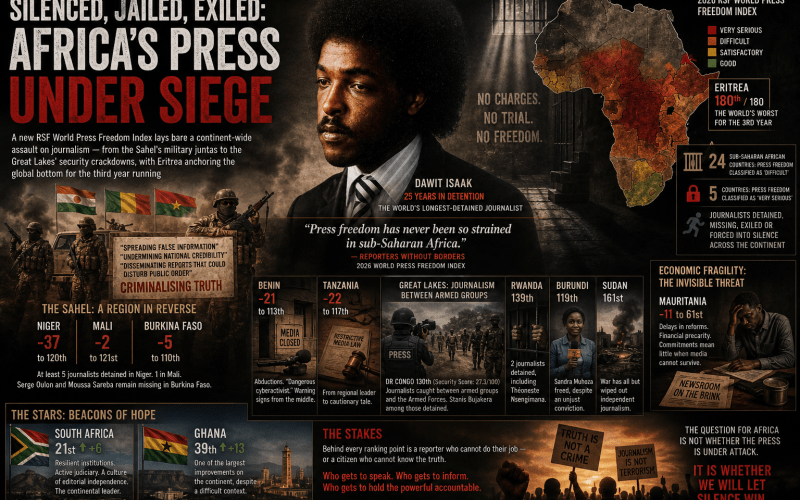
The RSF index, which ranks 180 countries and territories, classifies the state of press freedom as “difficult” in 24 of sub-Saharan Africa’s 48 countries and “very serious” in five. The report warns that “wars, the criminalisation of journalism and economic challenges are the catalysts of this decline” – a sentence that reads less like analysis and more like indictment.
This is the first comprehensive freedom audit of the continent’s media landscape since military coups tightened their grip across West and Central Africa, the war in Sudan entered its fourth year of catastrophic violence, and the DRC’s eastern provinces descended further into humanitarian catastrophe. The picture that emerges is of a profession under existential threat.
ERITREA: THE WORLD’S WORST, AGAIN
For the third consecutive year, Eritrea occupies last place globally – ranked 180th out of 180 countries – a distinction that RSF attributes to “its vehement denial of citizens’ right to be informed.” In the lexicon of press freedom, Eritrea is not merely a laggard. It is the floor.
This year’s index falls on the 25th anniversary of the arbitrary detention of Dawit Isaak, a Swedish-Eritrean journalist arrested in September 2001 and held incommunicado ever since – making him the world’s longest-detained journalist. He remains in custody alongside three colleagues: Temesgen Ghebreyesus, Seyoum Tsehaye and Amanuel Asrat. No charges. No trial. No freedom.
The anniversary is not a milestone to be celebrated. It is an accusation — directed at a government that has chosen, for a quarter-century, to answer journalism with a jail cell.
THE SAHEL: A REGION IN REVERSE
If Eritrea represents Africa’s nadir, the Sahel is its fastest-moving catastrophe. Niger has recorded the steepest fall in the entire 2026 index, plummeting 37 places to 120th. Mali dropped two spots to 121st, and Burkina Faso fell five places to 110th.
What is driving these collapses is not ambiguous. The Alliance of Sahel States (AES) – the military bloc linking the juntas of Niger, Mali and Burkina Faso – has weaponised the law to strangle the press. RSF documents a pattern of journalists being detained on charges that carry an almost comic legal elasticity: “spreading false information,” “undermining national credibility,” or “disseminating reports that could disturb public order.”
At least five reporters are currently detained in Niger, one in Mali, while in Burkina Faso, journalists Serge Oulon and Moussa Sareba remain missing – their fate unknown, their absence unremarked by their government.
This is the architecture of press suppression: arbitrary detention combined with media suspensions designed, in RSF’s words, to “control the press’ narratives.” The juntas are not fighting journalism because they fear foreign interference. They are fighting it because they fear their own citizens knowing the truth about how they govern.
BENIN AND TANZANIA: WARNING SIGNS FROM THE MIDDLE
Among the more alarming data points in this year’s index are the sharp falls recorded by countries previously considered middle-of-the-road performers – nations where the press was never free, but was at least functional.
Benin fell 21 places to 113th – a collapse that RSF describes as a “warning sign in a country that just elected a new president.” The previous Beninese authorities had the founder of online outlet Olofofo, Hugues Comlan Sossoukpè, abducted and “extradited” from neighbouring Ivory Coast. The justification offered was breathtaking: he was labelled a “dangerous cyberactivist who advocates terrorism.”
Tanzania’s decline is even more telling. The country – once a regional leader in press freedom – has dropped 22 places to 117th, reflecting what RSF characterises as a deterioration in “journalists’ working conditions and access to information as legislation becomes increasingly restrictive.” Once a benchmark, Tanzania has become a cautionary tale.
THE GREAT LAKES: JOURNALISM BETWEEN ARMED GROUPS
In the Democratic Republic of Congo – a country whose eastern provinces have been engulfed by armed conflict – RSF records a security indicator score of just 27.3 out of 100, reflecting the physical danger that journalists navigate daily.
The DRC is ranked 130th globally. Among those detained is Stanis Bujakera, held on national security charges in a case that drew international condemnation. Journalists “caught between armed groups and the Armed Forces of the DRC,” RSF reports, “are forced to flee the region or go into exile” – a sentence that captures, in miniature, the impossible arithmetic of conflict journalism in Central Africa.
In Rwanda (139th), two media professionals are currently detained, among them Théoneste Nsengimana, facing charges of “inciting unrest” – a charge as vague as it is convenient. In Burundi (119th), RSF records a rare piece of good news: journalist Sandra Muhoza has been freed, despite an unjust conviction. In Burundi, liberation is still considered progress.
In Sudan, ranked 161st, the picture is starkest of all. RSF’s assessment is unsparing: the war “has all but wiped out independent journalism.” Journalists facing arrest and torture have had no choice but to leave. Sudan’s media ecosystem, fragile at the best of times, has effectively been shattered.
ECONOMIC FRAGILITY: THE INVISIBLE THREAT
Beyond the jails and the juntas lies a quieter crisis – one that receives less attention but may, in the long run, prove equally corrosive: the economic fragility of African media markets.
Mauritania fell 11 places to 61st despite government commitments to the right to information, RSF attributing the decline to delays in implementing press sector reforms and the sector’s “financial precarity.” The commitment to press freedom means little when the outlets that could hold power accountable cannot pay their journalists or their bills.
RSF’s structural assessment of the Sahel – the region hit hardest – explicitly links deteriorating rankings to economic vulnerability. A media sector that cannot sustain itself is a media sector that can be captured, sidelined, or simply allowed to collapse.
THE STARS: SOUTH AFRICA AND GHANA LEAD THE CONTINENT
Against this bleak backdrop, two nations stand out as genuine regional beacons. South Africa ranks 21st globally – climbing six places – while Ghana ranks 39th, improving 13 places. Both countries fall into RSF’s “satisfactory” category for press freedom, topping the sub-Saharan African regional rankings.
For South Africa, the ranking reflects a resilient constitutional framework, an active judiciary, a culture of editorial independence, and a civil society willing to contest state overreach. The country is not without its challenges – economic pressure on newsrooms, political interference, SLAPP suits, and the unresolved question of media sustainability are all real. But the institutional bedrock holds.
Ghana’s 13-place rise is particularly notable – representing one of the largest positive jumps on the continent – and comes despite what RSF acknowledges is “a difficult socio-economic context.” It is a reminder that political will to protect the press can make a measurable difference even when economic conditions are unfavourable.
THE STAKES
The RSF index is, at its core, a document about power. Who gets to speak. Who gets to inform. Who gets to hold the powerful accountable. In country after country across Africa in 2026, the answer is being narrowed – by law, by force, by economic strangulation, and by the deliberate cultivation of impunity.
Dawit Isaak has been in detention for a quarter-century. Serge Oulon and Moussa Sareba are missing in Burkina Faso. Sudan’s journalists are in exile. Tanzania is legislating its press into silence. The numbers in the RSF index are not abstractions. Behind every ranking point is a reporter who cannot do their job – or a citizen who cannot know the truth.
The question the 2026 index poses, but cannot answer, is whether Africa’s media freedom story turns around – or whether the current trajectory becomes permanent.