FOR nearly two decades, Adrian Hadland carried a secret in his wardrobe. Not a dark secret – but one luminous with history, humming with the voices of giants. Stuffed inside a battered cardboard box were newspaper cuttings, columns, notebooks, and sheaves of paper: the raw, unedited record of one of the most extraordinary periods in human history. It was the birth of a new South Africa, and Hadland had been there – pen in hand, eyes wide open – for every astonishing moment.
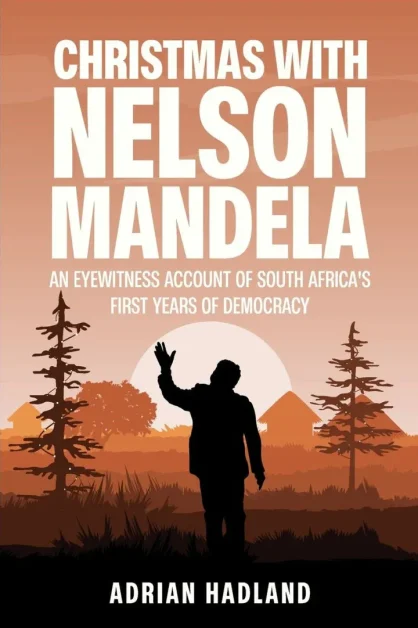
Now, ahead of Mandela Day on 18 July 2026, Hadland has finally opened that box. The result is Christmas with Nelson Mandela: An Eyewitness Account of South Africa’s First Years of Democracy – a book that is part memoir, part journalism, part love letter to a country that dared to believe.
Hadland was no ordinary observer. As a parliamentary journalist in the 1990s, he covered the Government of National Unity – Nelson Mandela’s historic administration from 1994 to 1999 – from the inside. He sat in the press gallery as Mandela addressed Parliament. He moved through the corridors of power at a moment when those corridors crackled with possibility. He was, as he puts it himself, present for “a ringside seat for one of humankind’s greatest achievements.”
“I had in my grasp the voices, thoughts and actions of almost every major figure from every party. I had Mandela, of course, but also deputy president FW De Klerk. Cabinet ministers, opposition leaders and senior police and military officials talking about what it was like to be living and working at this unique time.”
The roll call of figures Hadland encountered reads like the founding pantheon of democratic South Africa. He was present at Mandela’s divorce. He attended his inauguration. He discussed the future presidency with Thabo Mbeki – a relationship he would later explore in depth in a separate book on Mbeki’s rise. He listened to Patricia de Lille and Gerald Morkel speak about their pathways to politics. He recorded the thoughts of Cyril Ramaphosa, General Constand Viljoen, Mangosuthu Buthelezi, and Desmond Tutu, who appear in the book celebrating what he called “the miracle of the Rainbow Nation.”
It is, in short, a remarkable archive – assembled in real time by a journalist at the top of his craft, during a period that would define not just South Africa, but the global imagination of what justice and reconciliation can look like.
The Death That Made Him Write
So why did it take so long? Hadland is candid about what he calls the inertia of a busy life – the way intention yields to urgency, the way tomorrow becomes a decade. But something changed in 2022. His roommate in Parliament, the journalist Donwald Pressly – a former chairperson of the Parliamentary Press Gallery – died.
“I noticed that many of the journalists who worked with me in Parliament covering South African politics at that time had begun to retire, or die. This was an amazing cohort of journalists who I believe played a hugely important role in delivering democracy to South Africa by being a conduit for information between political parties, their supporters and the international community.”
The deaths and retirements of his contemporaries brought into sharp relief a troubling realisation: the journalists who had covered South Africa’s transition from apartheid – people who could have written definitive, irreplaceable accounts of that era – were leaving the world without writing them. “Most of them could have written brilliant, definitive books about South Africa’s transition from apartheid,” Hadland reflects. “But none of them did.”
When Pressly died, Hadland made a decision. “Enough is enough,” he told himself. He dug out the box from the wardrobe, dusted off the papers, and started to type.
The Publishers Who Said No
What followed was both inspiring and, in its own way, revealing. When Hadland reached out to established publishers with his treasure trove – first-hand accounts, authentic voices, the raw material of a great untold story – the response was deflating.
“I was told that South Africans were embarrassed about the false optimism and hope of the Mandela era, that things had soured, promises hadn’t been delivered, that they didn’t want to read about what Desmond Tutu called the miracle of the Rainbow Nation.”
It is a charge Hadland refuses to accept. For him, the story of South Africa’s transition is not one of failed promises but of something far larger and rarer: a triumph of the human spirit. “This is one of the great stories of human history,” he insists, “the triumph of love over hate, of forgiveness over blame, of brotherhood over enmity.”
Undeterred, Hadland did what a certain breed of journalist always does when official channels close: he found another way. He taught himself to self-publish, created an imprint he called Low Battery Books – a name inspired, with characteristic warmth and humour, by his friends and family’s perpetual complaints about his old mobile phone running out of battery – and published the book himself.
Hadland has not stood still in the years since he left South Africa. Now a professor at a university in Scotland, he has had a distinguished career as both an academic and author, producing several books on South African politics and media, including an acclaimed study of the rise of Thabo Mbeki. He has moved between the worlds of scholarship and journalism with rare fluency, never losing the reporter’s instinct for the essential human truth at the centre of a story.
But it is South Africa – and above all, that five-year window of Mandela’s presidency – that has remained the gravitational centre of his intellectual and emotional life. He is returning to South Africa shortly, visiting Cape Town for the first time in more than 17 years. He describes it as his favourite city in the world, the birthplace of his two sons, and the place where he lived what he calls “the most amazing life experience imaginable.”
There is another dimension to this book that lends it particular urgency. Much of the journalism produced in South Africa in the 1990s was never digitised. As the internet was still emerging, the words that appeared in newspapers – the reportage, the interviews, the colour pieces – were never transferred to any permanent digital archive. They exist, if at all, in boxes like Hadland’s. They are, in a very real sense, at risk of being lost forever.
“Much of the reportage of these times was not digitised as the internet was just emerging, and so have been lost. I hope this book and these words will be a reminder of what South Africans are capable of: a monumental feat of human empathy, togetherness and trust that will be celebrated for ever and that will make us proud once again.”
It is a plea as much as a statement: remember who you are. Remember what you achieved. Remember that, at the most dangerous and uncertain moment in your modern history, South Africans chose each other.
Hadland is disarmingly modest about his commercial ambitions. “I don’t expect Christmas with Nelson Mandela to become a huge bestseller or be made into a movie,” he says. His goals are simpler and more lasting: “I am just happy to have put my experiences down so that others can see what it was like to have been there at such an exhilarating moment and with such extraordinary people.”
That modesty, one suspects, is genuine. But it may also underestimate the hunger that exists – particularly now, in 2026, as South Africa navigates the complex realities of democratic governance three decades on – for a reminder of where it all began. Not as nostalgia. Not as rebuke. But as testimony.
This is a book by a journalist who was there. Who sat in the gallery as Mandela spoke. Who walked the corridors of the National Assembly when the paint was barely dry on the new democratic order. Who kept, in a wardrobe in Ireland, the voices of people who changed the world.
As Mandela Day 2026 approaches, Christmas with Nelson Mandela arrives not a moment too soon.
| BOOK DETAILS Title: Christmas with Nelson Mandela: An Eyewitness Account of South Africa’s First Years of Democracy Author: Adrian Hadland Publisher: Low Battery Books Available: Most bookshops in South Africa and on Amazon |