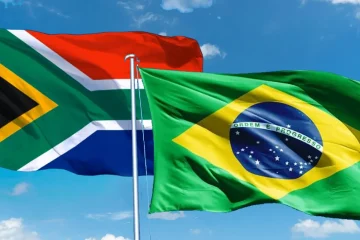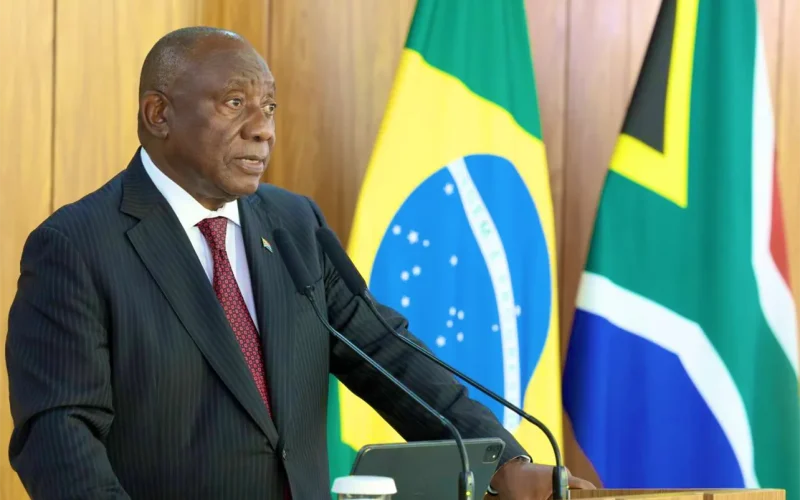
PRESIDENT Cyril Ramaphosa stood before the cameras at the Palácio do Planalto this week and did something South African presidents have rarely done in Brasília: he made it personal. Thanking Brazil for its solidarity during South Africa’s liberation struggle, and invoking the 30th anniversary of the country’s democratic Constitution, Ramaphosa reframed what might have been a routine state visit communiqué into something closer to a declaration of civilisational kinship – then pivoted sharply to the imperatives of trade, investment, and regional geopolitics.
“We remain deeply grateful for the solidarity of the people of Brazil during our struggle for freedom,” Ramaphosa told reporters alongside President Luiz Inácio Lula da Silva. “This support contributed meaningfully to the achievements we celebrate today.”
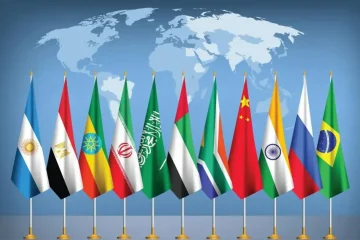
The remarks – measured, warm, and deliberate – set the tone for a two-day visit designed to translate a three-decade diplomatic partnership between two founding BRICS members into a more muscular economic and political alliance. Ramaphosa heads a delegation of eight Cabinet ministers and a business contingent spanning agribusiness, aerospace, defence, energy, mining, and pharmaceuticals.
“South Africa serves as a strategic entry point for Brazil into the African continent, just as Brazil provides a gateway for South Africa into Latin America and the Caribbean.”
President Cyril Ramaphosa, Brasília, 9 March 2026
Condolences, Conflict, and the Weight of the Moment
Before the economics, Ramaphosa addressed tragedy and war. He opened his public remarks by conveying South Africa’s condolences to the victims of recent floods and landslides in the Brazilian state of Minas Gerais – a gesture that acknowledged the human dimension of a bilateral relationship too often reduced to trade statistics.
He then turned to the Middle East, reiterating South Africa’s consistent position: a call for the peaceful resolution of all disputes in line with the United Nations Charter, condemnation of civilian casualties and infrastructure destruction, and a demand for an immediate cessation of hostilities. The language was familiar — Pretoria has maintained its vocal stance on Gaza throughout the conflict — but its inclusion in a bilateral media briefing signalled that South Africa regards the issue as inseparable from its broader vision of a rules-based international order.
Thirty Years of Democracy: A Milestone as Diplomatic Frame
The visit falls in the year South Africa marks the 30th anniversary of the adoption of its post-apartheid Constitution — a document that has become the cornerstone of the country’s democratic identity and its claim to moral authority on the world stage. Ramaphosa invoked the milestone explicitly, using it to contextualise the sacrifices of the liberation era and the international solidarity that made the transition possible.
For Brazil under Lula — a leader whose own political biography is inseparable from resistance to authoritarianism — the framing resonated. Both presidents lead nations where democratic constitutionalism has been tested in recent years, and both have staked personal and political capital on its defence.
A R32.5 Billion Trade Relationship — and the Imbalance That Defines It
The economic logic of the visit is anchored in numbers that are impressive in aggregate but reveal structural tension on closer inspection. Bilateral trade between the two countries reached R32.5 billion in 2025 — yet South African exports to Brazil totalled only R5.2 billion against imports of approximately R27.3 billion. Pretoria ships chemicals, mineral products, machinery, iron and steel, and vehicles. Brasília sends back mineral products, live animals, machinery, vegetables, and steel.
Ramaphosa was direct about the remedy. He flagged South Africa’s commitment to strengthening cooperation in agriculture, agro-processing, and value-added exports — a clear signal that Pretoria wants to move up the value chain rather than remain a supplier of raw and semi-processed commodities. He also pointed to the MERCOSUR–SACU Preferential Trade Agreement, which has opened preferential market access for 1,500 product lines, as a vehicle whose potential remains largely untapped.
“Deepening our economic cooperation is imperative,” Ramaphosa said — a phrase notable for its urgency in the context of otherwise diplomatic language.
New Agreements and a Joint Commission on the Horizon
The visit produced tangible deliverables alongside the diplomatic warmth. Ramaphosa welcomed the conclusion of a Memorandum of Intent on Agriculture and a Memorandum of Understanding on Basic Education — two instruments that, while modest in scope, point to the broadening of a partnership that has historically centred on trade and geopolitical alignment.
He also confirmed that South Africa will host the eighth session of the South Africa–Brazil Joint Commission later in 2026 — the primary institutional mechanism for bilateral cooperation and the forum through which the outcomes of this week’s engagements will be operationalised.
Two Continents, Two Gateways
Perhaps the most strategically significant formulation in Ramaphosa’s remarks was his articulation of what the two countries represent to each other’s regional ambitions. South Africa, he said, is a strategic entry point for Brazil into the African continent; Brazil is South Africa’s gateway into Latin America and the Caribbean. The framing positions both nations not merely as bilateral partners but as each other’s indispensable regional interlocutors.
This logic underpins the multilateral agenda as well. Ramaphosa and Lula are expected to align positions within BRICS, IBSA, the G77+China grouping, the G20, and the United Nations — institutions through which both governments have championed a reformed, more equitable international order. For Pretoria, the Brasília visit is simultaneously a bilateral investment play and a geopolitical statement about the coherence of Global South leadership at a moment when that coherence is under serious pressure.
Business Forum: Testing Whether Diplomacy Can Drive Commerce
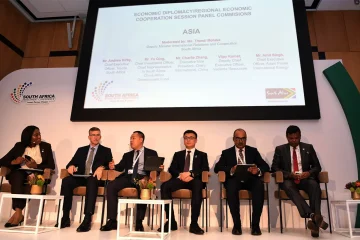
Monday evening, Ramaphosa addressed the South Africa–Brazil Business Forum at the Palácio Itamaraty — a platform aimed at translating state-level ambition into private-sector commitment. The forum follows a model Ramaphosa has used repeatedly since launching South Africa’s investment drive in 2018: using the ceremonial weight of a state visit to convene business leaders and extract pledges.
Brazilian capital already operates in South Africa across manufacturing, services, engineering, agriculture, and aviation. South African companies are active in Brazil’s retail, pharmaceutical, financial services, extractive, and chemicals sectors. Tourism continues to grow: Brazil ranked as South Africa’s ninth-largest source of international arrivals in 2025, a figure underpinned by the resumption and expansion of direct São Paulo–South Africa flights since 2023.
Ramaphosa closed his remarks by inviting Lula to visit South Africa — a diplomatic signal that Pretoria intends the momentum of this week’s engagement to be reciprocated, and that the relationship is entering a more active phase. “The clarity and warmth of our discussions give me confidence that the momentum generated during this visit will yield concrete outcomes for both our nations and our respective regions,” he said.