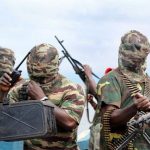
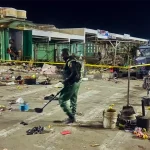
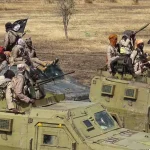
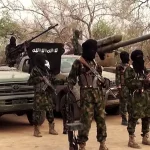
THE terrorist group Boko Haram has emerged from obscurity with a deadly resurgence across the Lake Chad Basin, massacring civilians and threatening renewed humanitarian catastrophe in a region already hosting nearly 3 million displaced people.
In one of the year’s bloodiest attacks, Boko Haram fighters killed close to 100 residents in Mallam Karamti and Kwatandashi villages in Nigeria’s Borno State on 15 May, according to security analyst Saheed Babajide Owonikoko, writing in The Conversation.
The group struck again on 5 September, killing about 60 people in Darul Jamal village in the same state. Residents who survived the massacre told researchers the attack was retribution for sharing intelligence with the Nigerian military.
“Boko Haram has become more active again in the Lake Chad region,” writes Owonikoko, a researcher at the Centre for Peace and Security Studies at Modibbo Adama University of Technology.
The violence has spread beyond Nigeria’s borders. In Cameroon’s Far North region, Boko Haram was responsible for 101 attacks out of 144 recorded incidents in July and August 2025 alone, according to reports cited by Owonikoko.
From Obscurity to Onslaught
The militant group had fallen into the shadows following the 2021 death of its leader, Abubakar Shekau, eclipsed by its breakaway faction, Islamic State West Africa Province (ISWAP). But under new leadership, Boko Haram has clawed back territory and influence.
Bakura Doro, who seized control in a violent May 2022 takeover, “reinforced Boko Haram by fighting Islamic State West Africa Province, killing members and capturing its territories in Lake Chad,” Owonikoko writes. Doro also abandoned the group’s previous media campaigns, allowing it to “grow unnoticed” while international attention focused on ISWAP.
Although reports in August claimed Doro was killed in Niger, the group has denied his death.
Military Fatigue and Failed Programmes
Regional security forces have struggled to contain the twin threats. Writing in The Conversation, Owonikoko warns that Lake Chad militaries gave Boko Haram “less attention” while focusing counterterrorism efforts on ISWAP, which launched coordinated attacks on 15 military outposts by July 2025.
“The Lake Chad region countries’ counterterrorism efforts focused on countering ISWAP, dangerously neglecting Boko Haram,” he writes.
Compounding the security vacuum are failed reintegration programmes that have pushed former fighters back to insurgency. “Community rejection, unmet government promises, limited political will and a weak framework have caused many ex-combatants to return to the trenches,” Owonikoko states.
Military exhaustion has also taken its toll. More than 1,000 Nigerian soldiers resigned between 2020 and 2024 from a force estimated at 230,000 personnel.
The regional Multinational Joint Task Force, established in 1994 to combat cross-border threats, has been crippled by Niger’s withdrawal following ECOWAS sanctions, declining support from Chad, and strained Nigeria-Cameroon relations.
“All this gives insurgent groups impetus to intensify their attacks,” Owonikoko writes.
Civilians Caught in Crossfire
The researcher warns that Boko Haram’s indiscriminate ideology poses particular danger to communities across the Lake Chad Basin.
“While [ISWAP] primarily targets military forces and non-Muslim communities, Boko Haram’s violence is aimed at all, except its members,” he writes, noting the group’s “ruthless attacks” distinguish it from its breakaway faction.
The violence threatens to worsen an already dire humanitarian situation. According to a June 2025 UN report cited by Owonikoko, the region hosts 2.9 million internally displaced people and 272,000 refugees. “I believe this figure may rise as violence escalates. But donor funding is shrinking,” he writes.
Communities face impossible choices as they navigate demands for loyalty from competing armed groups. “Each actor seeks local support and intelligence, and communities risk severe punishment if perceived as loyal to the opposing side,” Owonikoko warns.
The researcher predicts Boko Haram may escalate attacks on military installations to acquire weapons, potentially encouraged by ISWAP’s successes and expertise from Islamic State defectors now in its ranks. “If it joins the attacks against military outposts in the area, the consequences will be fatal,” he writes.
Call for Regional Response
Writing in The Conversation, Owonikoko urges Lake Chad governments to “pay attention to Boko Haram as much as Islamic State in their counter-terrorism efforts.”
He recommends revitalising the Multinational Joint Task Force by “luring Niger back” and ensuring member commitment, while strengthening welfare services to reduce recruitment incentives for insurgent groups.
“Strengthening defection programmes is crucial to prevent former terrorists from going back to groups like Boko Haram,” he writes, calling for harmonised regional deradicalisation efforts.
As Boko Haram extends its operations into Nigeria’s North Central region, collaborating with bandits and the new terrorist group Lakurawa, the urgency for coordinated regional action has never been greater.